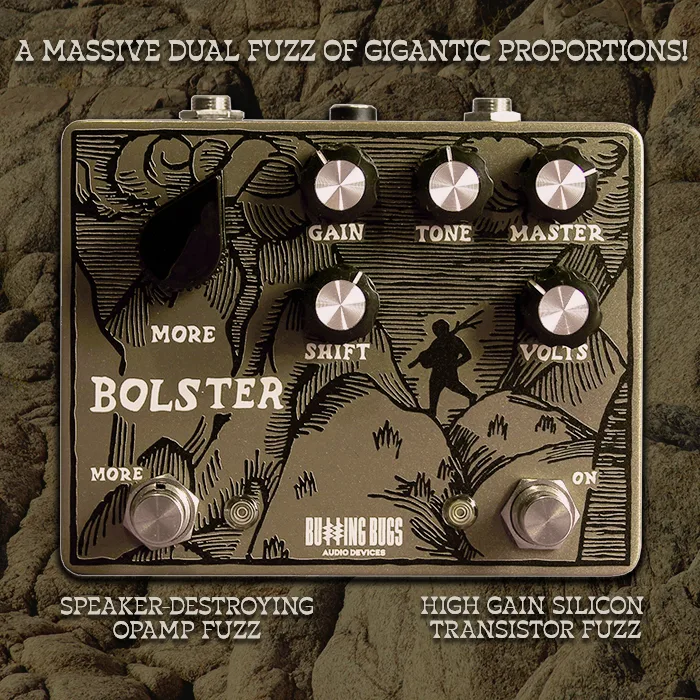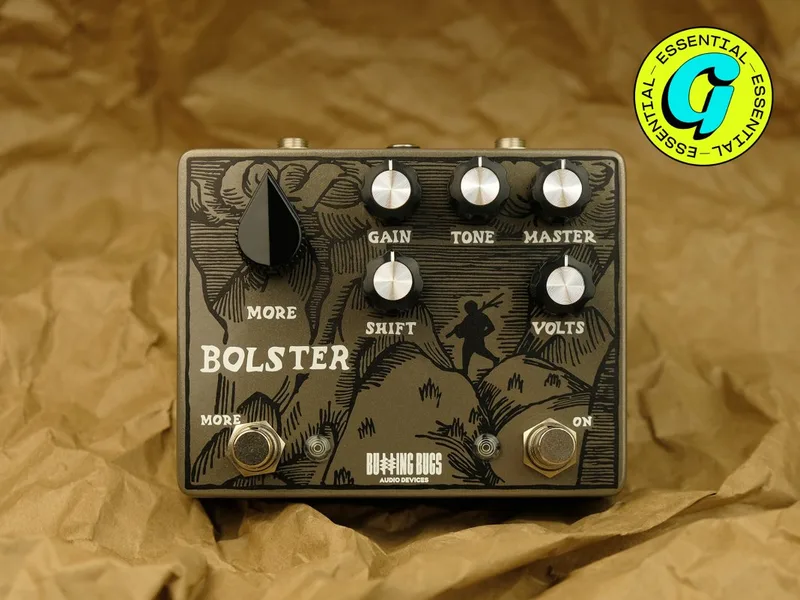

The Buzzing Bugs Bolster is a dual fuzz pedal from Buzzing Bugs Audio Devices, a maker based in Cornwall in the UK. It puts two fuzz circuits in one box: a silicon transistor high gain fuzz with Tone Bender lineage on one side, and a single-knob op-amp fuzz on the other, with a mode that runs both at once. It launched as the Bolster Dual Fuzz, available for preorder from late April 2026 with shipping from 1 May, at £17912.
The pedal is named after a giant figure of Cornish legend, and it is built in a diecast, robust metal enclosure23.
Two fuzz circuits in one pedal
The Bolster's right-hand channel is a silicon transistor fuzz built around a Tone Bender MKII adjacent high gain design using three 2N5088 transistors1. Guitar.com's reviewer described it as "a classic high-gain dirt machine with elements of Big Muff, Tone Bender and Fuzz Face"2. Premier Guitar characterizes this main channel as a silicon transistor high gain fuzz that ranges from a classic Tone Bender-esque drive to a synthy buzzsaw, depending on how you starve or saturate the circuit with the volts control3.
The left channel, called the MORE channel, is a single-knob op-amp fuzz. Premier Guitar calls it "a speaker destroying op-amp one-knob fuzz which gives a monolithic amount of sustain"3. Guitar Pedal X describes it as a single knob OpAmp fuzz with high-octane output1.
The two sides are not just alternatives. The pedal offers instant access to two individual sounds plus a mode with both circuits engaged, which Guitar.com's reviewer called an apocalyptic "both" option2.
| Channel | Circuit | Character |
|---|---|---|
| Right (main) | Silicon transistor fuzz, Tone Bender MKII adjacent high gain design, 3 x 2N50881 | Ranges from Tone Bender-esque drive to synthy buzzsaw via the volts control3 |
| Left (MORE) | Single-knob op-amp fuzz1 | Speaker-destroying, monolithic sustain3 |
| Both | Both circuits engaged2 | Apocalyptic combined mode2 |
The Bolster comes from Buzzing Bugs Audio Devices, which launched it as a two channel fuzz3. One side is a Tone Bender MKII adjacent high gain fuzz built on three 2N5088 transistors, and the other, the MORE channel, is a single knob op-amp fuzz1.
The controls
The two channels are controlled very differently. The right-hand silicon fuzz carries the bulk of the knobs, while the MORE channel keeps a single control231.
| Control | Channel | What it does |
|---|---|---|
| Gain | Right | Ranges from sparkling cleans to growling fuzz3 |
| Tone (Muff EQ) | Right | A Big Muff-style tone EQ1 |
| Master | Right | Output volume control3 |
| Shift | Right | Input gain control1 |
| Volts / Starve | Right | Bias control for gating and starved sounds1 |
| More (Master) | Left | The MORE channel's single level control1 |
| ON footswitch | Right | Engages the silicon fuzz1 |
| More footswitch | Left | Engages the op-amp fuzz1 |
Guitar.com's reviewer found the tone controls subtle but clever, and noted that the left channel feels more open, with a distinctly mids-scooped voicing that sounds properly gigantic on its own and even bigger with both sides on2.
Volts, shift and tone in detail
The volts knob is where the Bolster's wilder sounds live. On the right channel alone, keeping it at noon gives normal biasing; turned either way, it produces a jerky, spluttery, signal-killing gate effect2. With both circuits engaged, the clockwise half of the dial gives softer gating, and at maximum it produces a pinched buzzing effect that the reviewer placed "somewhere between a Zvex Fuzz Factory in velcro mode and an analogue synth"2.
The shift knob works at the input stage. Turning it down thins the bass at the input, bringing a leaner, more focused sound2. The tone knob is a Muff EQ, so it shapes the fuzz in the way Big Muff players will expect1.
With the volts knob at noon on the right channel alone, Guitar.com's reviewer found the result to be "the very nicest kind of thick, smooth, aggressive fuzz, with a good balance between body and clarity"2.
"Two monster fuzz circuits that sound even more monstrous together"
Guitar Pedal X's reviewer summed up the pedal as a great take on fuzz, giving you weapons-grade output on top of classic tones1. Guitar.com's verdict was similarly positive, calling it a fabulous dual fuzz that packs a surprisingly wide range of high gain tones, while noting limited availability outside the UK2.
The Bolster does not ship with a power supply. It needs a 9V DC supply with a standard center negative input, so plan on a dedicated pedal power output rather than assuming anything is in the box3.
Videos
Pedal Experiments
Questions
Is the Buzzing Bugs Bolster true bypass?
Yes. The Bolster uses true bypass switching, so with the pedal off your signal passes through without buffering or coloration. It sits in a diecast, robust metal enclosure built to take pedalboard life.
What power supply does the Buzzing Bugs Bolster need?
It runs on a 9V DC supply with a standard center negative input. The power supply unit is not included with the pedal, so you need to supply your own, and a standard 9V pedal power output with center negative polarity is what it expects.
Can both fuzz circuits run at the same time?
Yes. The Bolster gives you two individual fuzz sounds plus a mode with both circuits engaged at once. Reviewers found the two circuits sound even bigger together, with the combined setting producing the pedal's most extreme gated and buzzing textures.
What does the volts knob do on the Bolster?
It biases the silicon fuzz circuit. Set at noon it gives normal biasing; turned either way it starves or saturates the circuit, producing a jerky, spluttery, signal-killing gate effect. With both circuits on, the clockwise side gives softer gating and, at maximum, a pinched buzzing sound.
Where is the Buzzing Bugs Bolster made?
The pedal is made in Cornwall, in the southwest of the UK, by Buzzing Bugs Audio Devices. The company debuted in 2023 with the BB01 Fuzz Preamp and BB02 Percolator Fuzz before launching the Bolster.
Does the Bolster come with a power supply?
No. The pedal takes a 9V DC center negative input but the power supply unit is not included, so you need to provide your own 9V supply with standard center negative polarity.
Sources (3)
- Guitar Pedal X, Guitar Pedal X, 2026-04-24
- Buzzing Bugs Bolster review, Guitar.com, 2026-08-10
- Buzzing Bugs Audio Devices Introduces Bolster Fuzz, Premier Guitar, 2026-05-13