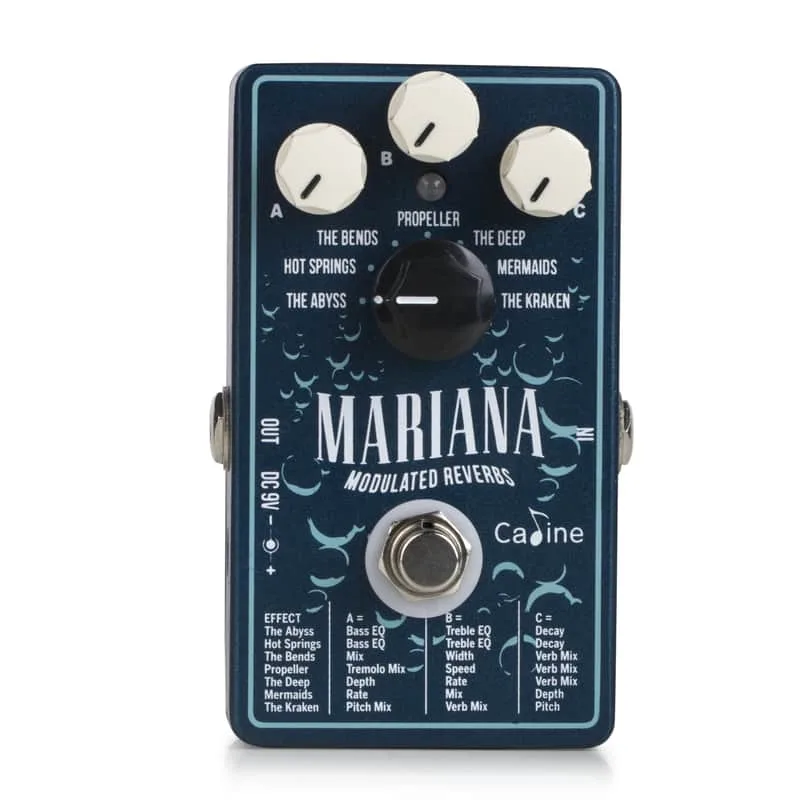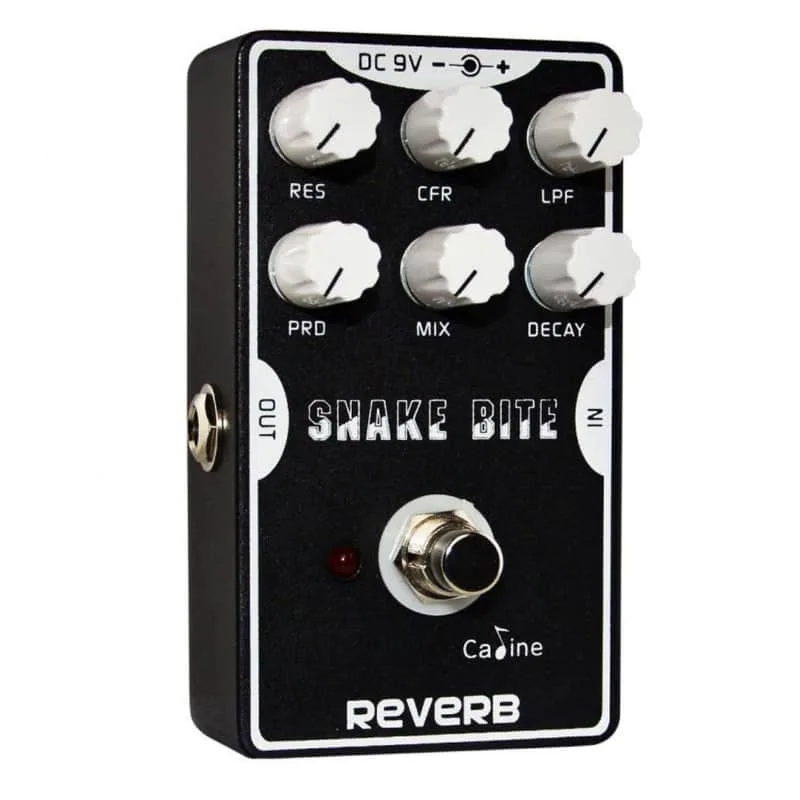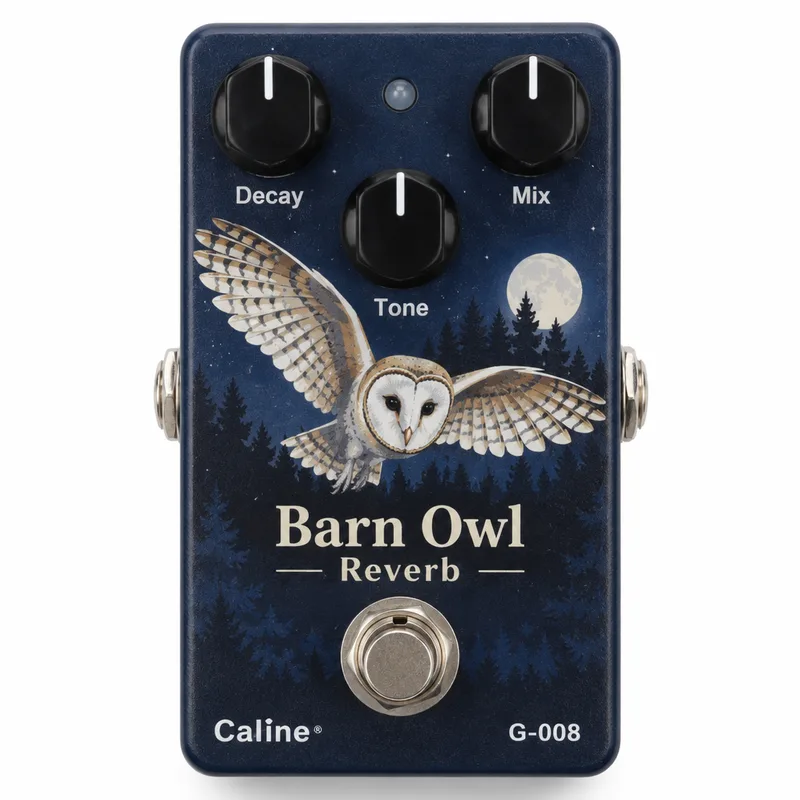


The Caline G-008 Barn Owl is a compact reverb pedal aimed at players who want a large, roomy effect from a small and inexpensive box. Pedal of the Day's review described it as "a haunting cavernous [reverb] with stacks of decay on tap and a wide ranging tone control to darken or brighten the effect"1. It sits in the reverb lane of Caline's range, alongside pedals like the Caline Mariana Modulated Reverb and the Caline CP-26 Snake Bite Cavernous Reverb.
Controls
The Barn Owl keeps things simple with three knobs, each covering one part of the reverb sound1:
| Control | What it does |
|---|---|
| Decay | Controls the duration of the reverberation1 |
| Mix | Controls the wet/dry signal ratio1 |
| Tone | Controls the reverb brightness1 |
The Tone control is the one that sets the character here. Because it shapes the brightness of the reverb itself rather than the dry signal, it lets you keep a clear underlying tone while pushing the reverb tail darker for ambience, or brighten it so the effect sits forward in the mix. Pedal of the Day's reviewer summed up the result as "excellent tone that's easy to dial in, coming in a wide range of genres"1.
Power and size
The Barn Owl runs on a 9V DC center negative supply, the same standard as most compact pedals, and draws 50 mA of current1. That is modest by reverb pedal standards, so most pedalboard power supplies will handle it without trouble, though a dedicated output rather than a daisy chain is always the safer route with any digital-style effect.
The published review lists 9V DC center negative power and a 50 mA current draw, and does not list battery operation as an option1. Plan for a DC supply.
Physically it is a small pedal: 11 x 6.6 x 2.3 cm in an aluminum alloy casing, with a package weight of 340g1. That footprint leaves room on a crowded board, and the metal housing is the standard hard-wearing format for this kind of pedal.
What reviewers said
The G-008 Barn Owl Reverb is built in an aluminum alloy casing, draws 50 mA, and ships at a package weight of 340g1. Its controls cover the two basics of any reverb pedal: Decay controls the duration of the reverberation, and Mix controls the wet/dry signal ratio1.
"excellent tone that's easy to dial in, coming in a wide range of genres"
Videos
Caline Technology
intheblues
Ryan Lutton
Questions
Is the Caline Barn Owl true bypass?
Yes. The G-008 Barn Owl features true bypass circuitry, so when the pedal is switched off your guitar's signal passes through without the reverb circuit loading it. That matters on a pedalboard where several pedals sit in front of the amp, since it helps keep your clean tone intact when the effect is not in use.
What power supply does the Caline G-008 Barn Owl need?
The Barn Owl runs on a 9V DC center negative supply and draws 50 mA of current. Use a standard pedal power supply or an isolated output on a pedalboard power brick. Because it has a current draw of 50 mA, a supply rated well above that figure is the safer choice for reliable operation.
Does the Caline Barn Owl take a battery?
The published review of the G-008 lists 9V DC center negative power and a 50 mA current consumption, and does not list battery operation. With a 50 mA draw, a battery would not last long in any case, so a DC supply is the practical way to run the pedal.
How big is the Caline G-008 Barn Owl?
The Barn Owl measures 11 by 6.6 by 2.3 cm, in an aluminum alloy casing, with a package weight of 340g. That is a compact footprint by pedalboard standards, so it fits alongside other small pedals without crowding a board.
What does the Tone knob do on the Barn Owl?
The Tone knob controls the brightness of the reverb itself. Turned one way it darkens the effect, the other way it brightens it, which is what gives the pedal its wide ranging tone control. Together with the Decay and Mix knobs it covers the whole character of the reverb.
Sources (1)
- Caline G-010 Parrot Delay / G-008 Barn Owl Reverb, Pedal of the Day, 2023-01-23