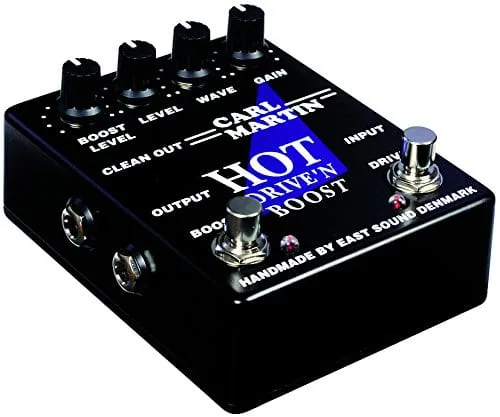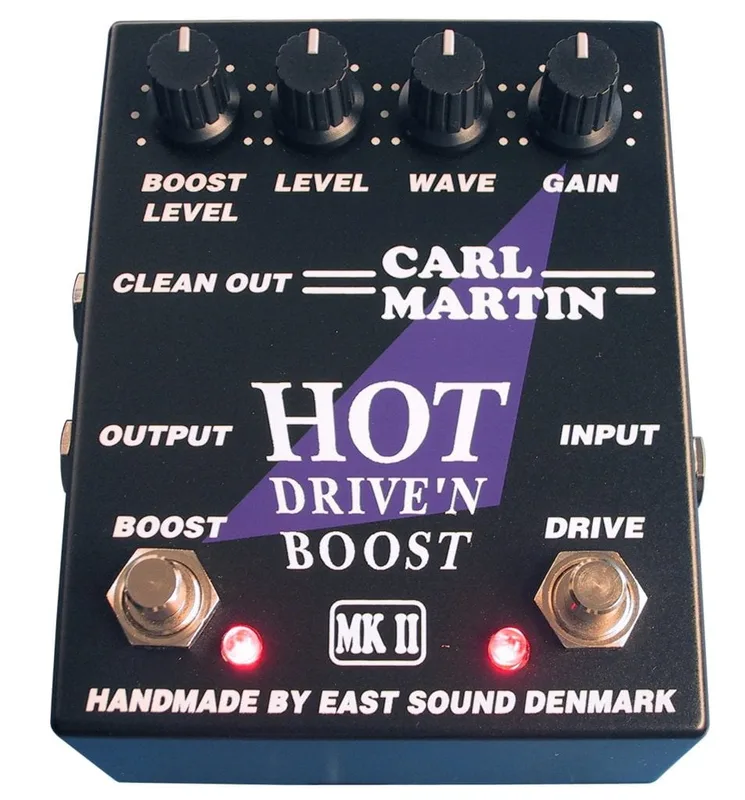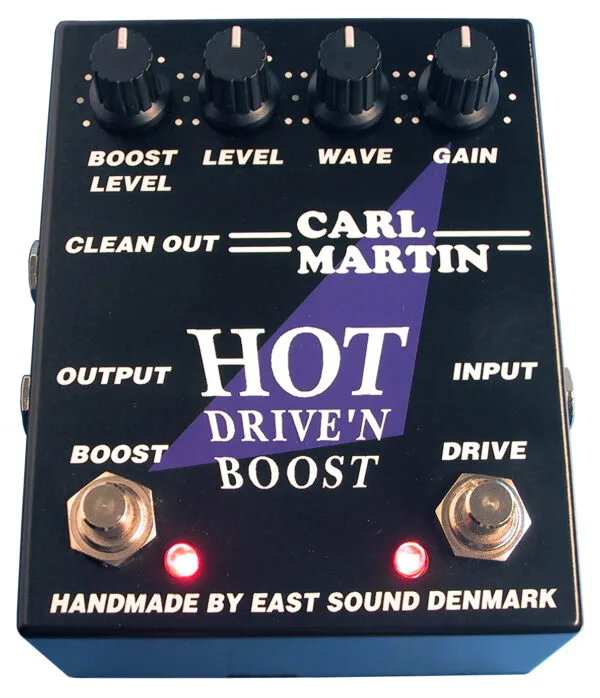


The Carl Martin Hot Drive'n Boost is an overdrive pedal with a built-in clean boost, made by Carl Martin. Carl Martin describes it as a classic tube-amp style overdrive with an integrated 20dB transparent boost and a separate clean output, designed to authentically replicate classic tube amplifier overdrive tones, from crisp blues tones to big, hard rock distortion with organic response1. The idea behind every version of the pedal, as MusicRadar put it, is "to get as close as possible to the compressing beauty of the drive of an all-valve amp"2.
What sets it apart from most overdrives on a pedalboard is its power: instead of a 9V battery or wall wart, it carries a built-in regulated mains power supply, which is why the enclosure sits lower and squatter than a typical stompbox2.
Tube-amp overdrive with a separate clean boost
The Hot Drive'n Boost is two circuits in one box: an overdrive voiced to behave like a tube amp being pushed, and a transparent boost that sits on its own footswitch. Carl Martin says the integrated boost provides up to 20dB of clean gain, for pushing the overdrive into higher sustain or lifting solos so they stand out1. The Mk 3's maker page puts the same "kick" at up to 20dB for solos5, while MusicRadar's review of the Mk 3 found the boost "can kick in as much as 22dB for either solos or a more aggressive drive"2.
The two functions are independent. The pedal has two switches, one for on/off and one for boost, each with its own dedicated LED2. MusicRadar's reviewer found this opens up a third usable sound:
"if you step on the boost without having the drive engaged, you have yet another useable tone at your boot-tips"2
The original and Mk II also carry a separate clean output, which Carl Martin says allows splitting the signal to multiple amps or keeping a clean blend running alongside the overdriven output16.
Controls
| Control | What it does |
|---|---|
| Gain | Sets the amount of drive4 |
| Wave | Tone control; MusicRadar calls the Mk 3's version "a subtle but very musical EQ sweep"42 |
| Level | Sets the overdrive's output level4 |
| Boost level | Sets how much boost is applied4 |
| Drive bypass switch and LED | Turns the overdrive on and off4 |
| Boost bypass switch and LED | Turns the boost on and off42 |
On the Wave control specifically, Vintage Guitar's reviewer reported that "by manipulating the Wave control, we were able to get a smooth, tight, tube overdrive with both guitars" they tried4.
Power: a built-in mains supply
The Hot Drive'n Boost does not take a battery or an external adapter. Vintage Guitar's review noted its "built-in regulated power supplies (no batteries or wallwarts)"4, and MusicRadar observed of the Mk 3 that "the pedal is mains-driven, which accounts for its rather squat appearance"2.
The Mk 3's supply is regulated internally at plus and minus 12V, and Carl Martin says this is deliberate: "This enables us to design circuitry of the highest quality with maximum headroom"5. For a player, that headroom is what lets the boost push an amp hard without the pedal itself falling apart. The trade-off is practical: the pedal needs a mains outlet, so it does not fit the standard 9V daisy-chain setup most pedalboards are built around.
Because the power supply is built in and mains-driven, the Hot Drive'n Boost cannot run from a 9V battery, a standard pedalboard power brick or a daisy chain. Plan for mains power at your pedalboard position.
History and versions: the original, Mk II and Mk 3
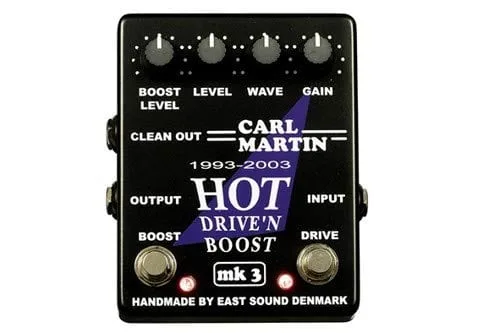
The Hot Drive'n Boost is now on its third iteration3, and all three versions share the same goal of getting as close as possible to the compressing beauty of the drive of an all-valve amp2.
| Version | How it differs |
|---|---|
| Hot Drive'n Boost | The original; classic tube-amp style overdrive with integrated 20dB boost and separate clean output13 |
| Hot Drive'n Boost MK II | Takes the original's foundation into a rougher, deeper voicing, tuned for a heavier, more aggressive character with thick saturation; same 20dB boost and separate clean output6 |
| Hot Drive'n Boost MK3 | Anniversary version with a complete new overdrive design, intended to give an even more authentic tube feel than the original5 |
The Mk II is aimed squarely at players who want more weight. Carl Martin says it "delivers a rougher, deeper voicing that's perfect for players seeking thicker saturation and more muscular drive"6. Vintage Guitar's reviewer found the Mk II's overall lower tone was more suited to a Strat's single-coil pickups4.
The Mk 3 is a redesign rather than a reissue. MusicRadar describes it as "a complete overhaul to the internal design intended to bring that aural goal even closer"2, and Carl Martin's own page says the new design "provides even more authentic tube amp simulation than the celebrated original"5. Carl Martin describes its character as sounding "like a tweaked-up quality tube amp with clear, brilliant tube drive character that enhances rather than transform your core voice and playing dynamics"5.
What reviewers said
Vintage Guitar reviewed the original and Mk II together in 2001, at a list price of $1894. Their verdict on the drive's flexibility was positive: with the Wave control they got a smooth, tight tube overdrive with both test guitars, and they noted the Mk II's darker voicing suited single-coils4.
MusicRadar's 2026 review of the Mk 3 was more direct:
"This has to be amongst the very best overdrive pedals we've tried"2
Their findings on the Mk 3's character:
- Through a clean, slightly crunchy or cooking amp, it "authentically replicates the tone and, most importantly, the feel of a driven valve amp"2
- It "works beautifully for soulful blues, rock and all points in between," with huge headroom from the boost2
- On the plus side of their summary: "Valve-like tones. Second to none at this price."2
- The limit they found: "It doesn't really do extreme metal or rock tones: use your amp drive to really wind up the wick"2
MusicRadar's reviewer was similarly positive about the Mk 3, writing that it "works beautifully for soulful blues, rock and all points in between, and the boost option gives you huge headroom"2. The same review found a limit to its range, noting that "It doesn´t really do extreme metal or rock tones - use your amp drive to really wind up the wick"2.
Where it sits among Carl Martin's overdrives
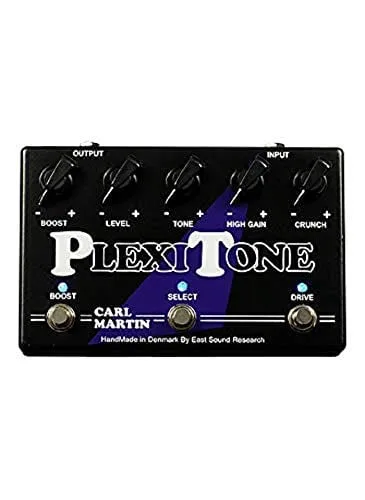
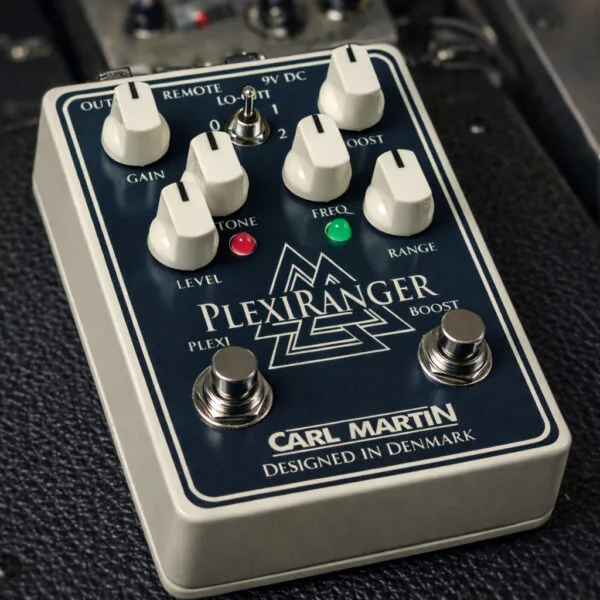
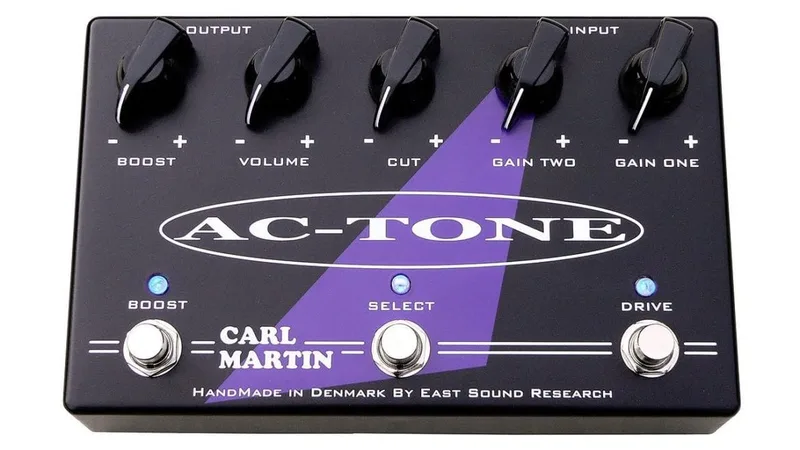
The Hot Drive'n Boost sits at the head of Carl Martin's drive line, and the company's later drives branch out from it: the PlexiTone and PlexiRanger chase Marshall-style tones, the AC-Tone goes after Vox character, and the Panama and Rock Drive cover other corners of the drive range. The Hot Drive'n Boost remains the one built around a built-in mains supply and a standalone boost, which is still its distinguishing feature against every one of them41.
Videos
Alberto Barrero
Guitarsenal
EytschPi42
Questions
Does the Carl Martin Hot Drive'n Boost need a power adapter?
No. The pedal has a built-in regulated power supply that runs off the mains, so there is no battery compartment and no external wall wart or 9V adapter to buy. The Mk 3's supply is regulated at plus and minus 12V internally, which Carl Martin says gives the circuitry maximum headroom. This is also why the pedal looks squat compared with most stompboxes.
Can you use the boost without the overdrive on the Hot Drive'n Boost?
Yes. The boost is on its own footswitch with its own LED, separate from the drive's on/off switch. MusicRadar's reviewer noted that stepping on the boost with the drive off gives you another usable tone, so it works as a standalone clean boost for pushing an amp's input stage, not just as a solo lift on top of overdrive.
What does the Wave control do?
Wave is the pedal's tone control. Vintage Guitar described it as a tone control, and MusicRadar called the Mk 3's version a subtle but very musical EQ sweep. Vintage Guitar found that manipulating the Wave control produced a smooth, tight, tube overdrive with both guitars they tried, so it shapes the drive's character rather than just cutting treble.
How much boost does the Hot Drive'n Boost give?
Carl Martin rates the integrated transparent boost at up to 20dB of clean gain, enough to push the overdrive into higher sustain or lift solos. MusicRadar measured the Mk 3's boost as kicking in as much as 22dB, usable for solos or for a more aggressive drive into an amp that is already working.
Where are Carl Martin pedals made?
In Denmark. Vintage Guitar's 2001 review described the Hot Drive'n Boost as a Danish-made Carl Martin pedal. The company was transferred to new ownership, Thomas Svenstrup of DanGuitar.dk, in January 2024, and continues to release new pedals such as the HeadRoom Mini in 2025.
Sources (6)
- Hot Drive'n Boost, Carl Martin, 2026
- Carl Martin Hot Drive'n Boost Mk 3 review, MusicRadar, 2007-11-15
- Carl Martin's Long-Awaited Tube Amp/Speaker Sim Pedal, GuitarPlayer, 2022-02-16
- Carl Martin Hot Drive’n Boost, Vintage Guitar magazine, 2003-09-03
- Hot Drive'n Boost MK3, Carl Martin, 2026
- Hot Drive'n Boost MK II, Carl Martin, 2026