

The Chase Bliss Audio Brothers Analog Gainstage is a twin-channel dirtbox: two independent analog gain channels in one enclosure, each of which can be set to Boost, Drive or Fuzz1. It was designed in collaboration with Resonant Electronic2. Its signal path is 100 per cent analog, while a digital control side handles presets, expression and MIDI, reflecting Chase Bliss's stated goal to "give unprecedented digital control to original and creative analog designs"1.
What it is and what it does
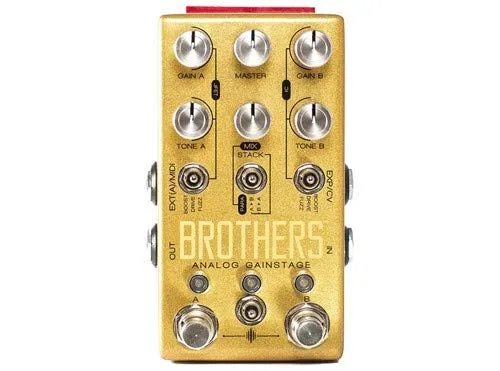
The Brothers is built on two independent JFET/IC analog channels that together comprise six unique boost, drive or fuzz circuits, and those circuits can be combined3. Each channel is selected independently via two soft footswitches, and each offers a three-way toggle for choosing between Boost, Drive and Fuzz modes2. Because both channels can be on at once, the pedal works as a simple single-channel boost, a two-stage stacked drive, or a parallel blend of two different gain flavors.
For a player, that means one box can cover the clean boost into overdrive setup many players build from two separate pedals, or a fuzz running alongside a low-gain drive, all switchable from the two footswitches. MusicRadar's reviewer described it as a twin-channel dirtbox and counted 33 different ways the two channels can be combined, all of which can be saved, along with knob positions, as presets1.
The controls
The front panel keeps things straightforward. You choose boost, drive or fuzz for each channel, then set the Gain and the Tone for each, and a single Master knob sets the output volume1. Pedal of the Day noted that the Master control sets the overall output volume regardless of which effects mode you are currently in2.
| Control | What it does |
|---|---|
| Gain A / Gain B | Sets the gain for each channel1 |
| Tone A | Tone control for channel A, with an emphasis on transparency2 |
| Tone B | Tone control for channel B, with an emphasis on the midrange2 |
| Master | Sets the overall output volume, regardless of which mode is active12 |
| Mode toggle (per channel) | Selects Boost, Drive or Fuzz on each channel2 |
| Mix/Stack knob | Used only when both channels are simultaneously active2 |
| PARA / A>>B / B>>A toggle | Sets the routing; used only when both channels are active2 |
| Preset toggle | Two presets, set via the toggle switch between the footswitches2 |
The two channels are not identical, and that is the point. Channel A is based on JFET circuitry and channel B is IC-based1. MusicRadar's reviewer found that channel B has more stridency and top end presence, though, as he put it, "that's not the whole story"1. The tone controls differ too: channel A's has an emphasis on transparency, while channel B's emphasis is more on the midrange2.
Routing: how the two channels combine
When only one channel is active, the pedal behaves like a single boost, drive or fuzz. The routing controls matter when both channels are on2:
- PARA mode: both channels are set in parallel2
- A>>B mode: channel A is cascaded in series into the circuit of channel B2
- B>>A mode: channel B is cascaded in series into channel A1
MusicRadar counts 33 different ways the two channels can be combined, all savable as presets along with knob positions1. The Mix/Stack knob and the routing toggle are only used when both channels are simultaneously active2.
Jacks: Exp/CV and EXT/MIDI
Two side-panel jacks extend the pedal beyond its knobs and footswitches.
- Exp/CV jack: control any of the parameters with an external footswitch2
- EXT(a)/MIDI jack: activate or bypass channel A with an external momentary switch, or access MIDI capabilities2
Through MIDI, presets can be saved and recalled: six via the mini pedal-sized Chase Bliss Faves MIDI controller and 122 via MIDI Program Change messages1. MusicRadar listed saveable presets among the pedal's reasons to buy1.
Where it came from
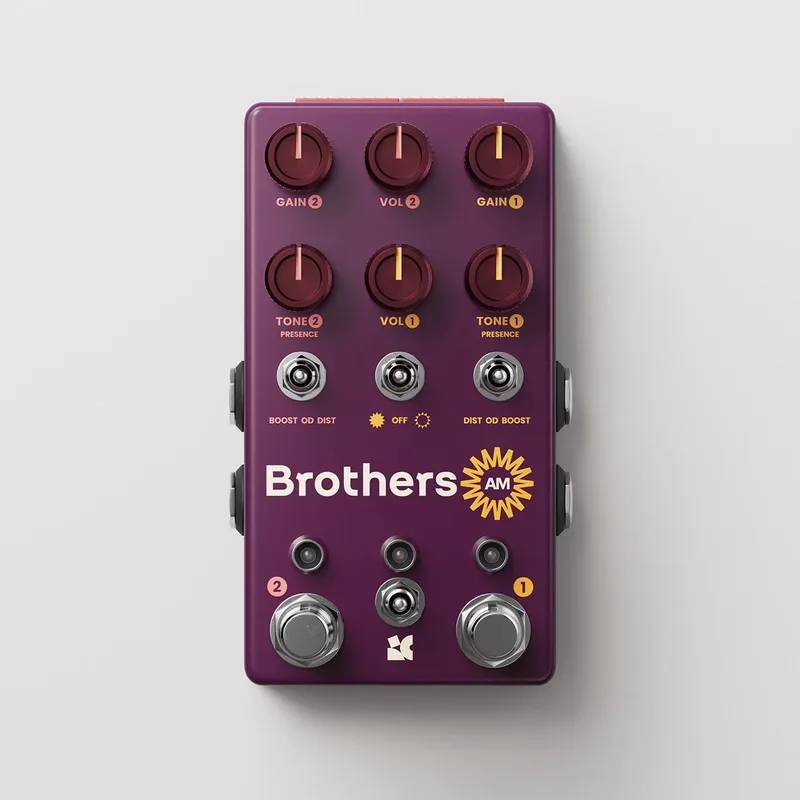
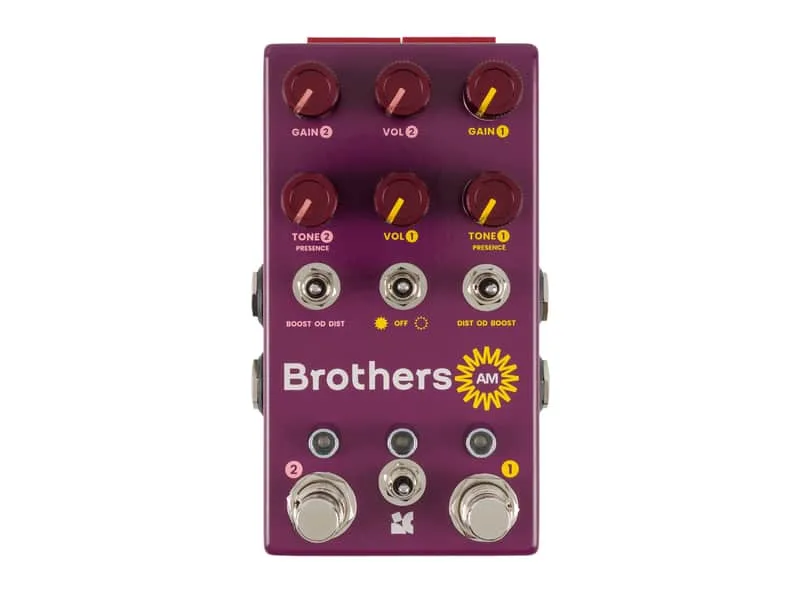
The Brothers Analog Gainstage was designed by Chase Bliss Audio in collaboration with Resonant Electronic2. In April 2025, Chase Bliss and Analog Man launched the Brothers AM, an updated Brothers variant covering the Analog Man King of Tone and Beano Boost in the standard Chase Bliss pedal format4. The original Brothers keeps its own Stacking Options of Parallel / A>B / B>A, while the AM variant brings its own preset scheme, with four internal sounds plus an additional bank of presets, and external control over everything via expression, MIDI and CV54.
What reviewers said
MusicRadar's verdict was enthusiastic:
"Brothers is the perfect addition to any family. Make sure it's on your must-try list1!"
MusicRadar, on the Brothers Analog Gainstage1
The same review highlighted the 100 per cent analog signal path, the 33 routing combinations and the saveable presets as the pedal's strengths1.
Videos
chase bliss
Mike Hermans
Reverb
Questions
Is the Chase Bliss Brothers fully analog?
The signal path is 100 per cent analog, built on two independent JFET and IC channels. What is digital is the control side: Chase Bliss's stated goal is to give unprecedented digital control to original analog designs, which is how the pedal handles presets, expression and MIDI while the audio itself stays analog.
What is the difference between channel A and channel B on the Brothers?
Channel A is based on JFET circuitry and channel B is IC-based. Each channel can be set to Boost, Drive or Fuzz, and each has its own Gain and Tone controls. Channel A's tone control has an emphasis on transparency, while channel B's emphasis is more on the midrange, with more stridency and top end presence.
Can the Chase Bliss Brothers run both channels at once?
Yes. Both channels can be active simultaneously, and a Mix/Stack knob and the PARA / A>>B / B>>A toggle come into play only when they are. In PARA mode the channels run in parallel; in A>>B mode channel A is cascaded in series into channel B's circuit, and B>>A reverses that. There are 33 different ways to combine the two channels.
Does the Chase Bliss Brothers have MIDI?
Yes. MIDI capabilities are available through the EXT(a)/MIDI jack, and presets can be saved and recalled via MIDI: six via the mini pedal-sized Chase Bliss Faves MIDI controller and 122 via MIDI Program Change messages.
How many presets does the Chase Bliss Brothers save?
Two presets can be set directly via the toggle switch between the footswitches. With MIDI, six presets are accessible via the Chase Bliss Faves MIDI controller and 122 via MIDI Program Change messages. All 33 routing combinations can be saved along with knob positions as presets.
Who designed the Chase Bliss Brothers?
The Brothers Analog Gainstage was designed by Chase Bliss Audio in collaboration with Resonant Electronic. It is a twin-channel analog gainstage in which each channel can be set to Boost, Drive or Fuzz, with the two channels combinable in 33 different ways.
Sources (5)
- Chase Bliss Brothers Analog Gainstage review, MusicRadar, 2018-02-25
- Chase Bliss Audio Brothers Analog Gainstage, Pedal of the Day, 2017-06-14
- Hamstead Soundworks Subspace Intergalactic Driver review, Guitar World, 2020-07-10
- Guitar Pedal X, Guitar Pedal X, 2025-04-15
- Chase Bliss / Analog Man Brothers AM Dual Overdrive Distortion Boost, Pedal of the Day, 2025-05-10