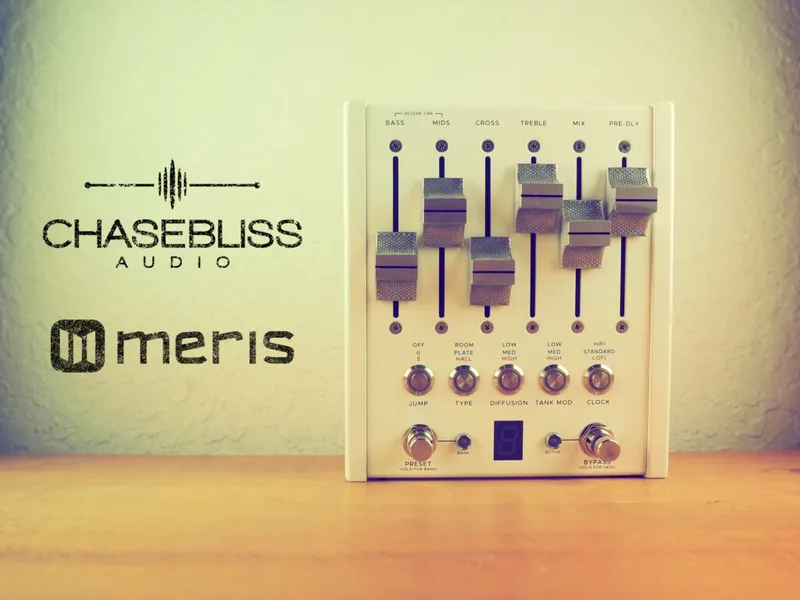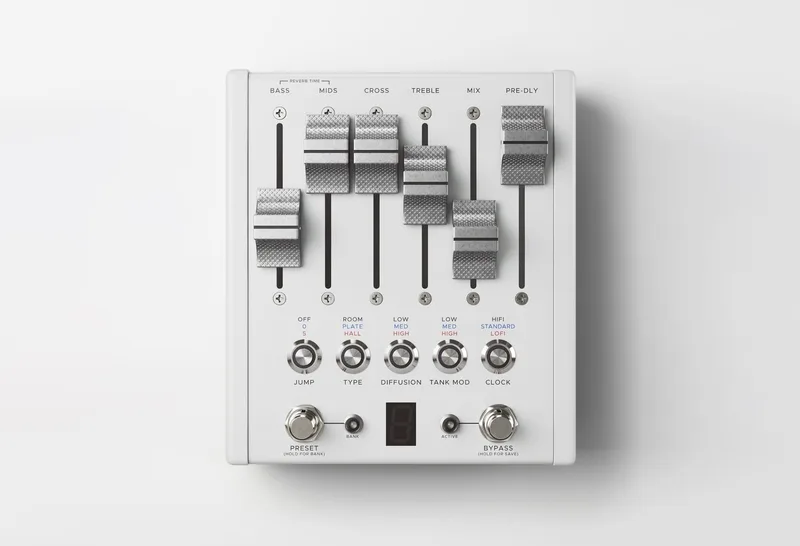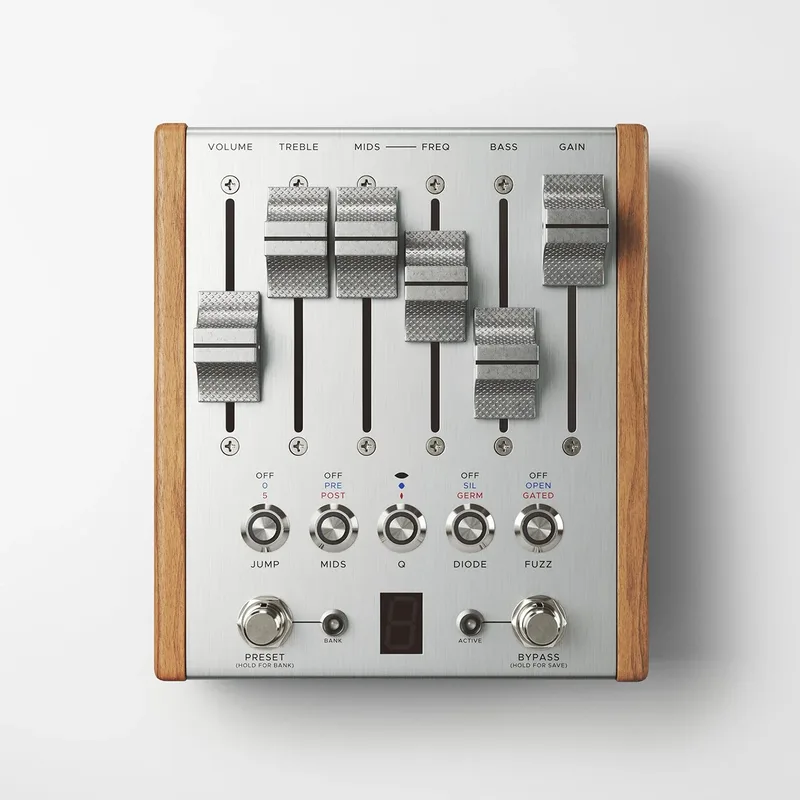


The Chase Bliss CXM 1978 is a digital reverb pedal built in collaboration with Meris, and it is a pedal adaptation of the venerable Lexicon 224 studio reverb, the rack unit Lexicon released in 197812. Chase Bliss calls it "our fresh take on the iconic reflections of the 70's", a reverb built from a moving, evolving network of digital reflections rather than a single static algorithm3. It arrived in 2020 as the second pedal in Chase Bliss's Automatone series, following the Preamp MKII made with Benson Amps, and its defining feature is a row of motorized faders that physically move to show and recall your settings4.
The pedal runs three classic algorithms, Room, Plate and Hall, with 32 bit AD/DA conversion, an analog dry thru, and optional fully balanced stereo I/O35. It is a premium piece of gear: the list price is $899.003.
A Lexicon 224-style studio reverb in a pedal
The Lexicon 224 Digital Reverb came out in 1978, and it is the direct inspiration for the CXM 1978, whose name and front-panel styling echo that era of studio rack gear2. Delicious Audio describes the pedal as "a pedal adaption of the venerable Lexicon 224 studio reverb"1, and in an interview about the pedal, the two companies called it "a reinterpretation of the vintage Lexicon 224 Digital Reverb"8. Guitar.com's review framed it as a modern take on vintage studio reverb, made with the help of Meris9.
Chase Bliss describes the reverb itself as highly interactive and physical, where each space has its own behavior and response, and Guitar World's launch coverage pointed to "the dawn of sprawl, massive trails and infinite decay, allowing you to explore the charm of those late '70s imperfections"310. The processing runs at 32 bit and 48kHz in HIFI mode, with a lower-fidelity Standard mode also available311.
Room, Plate and Hall
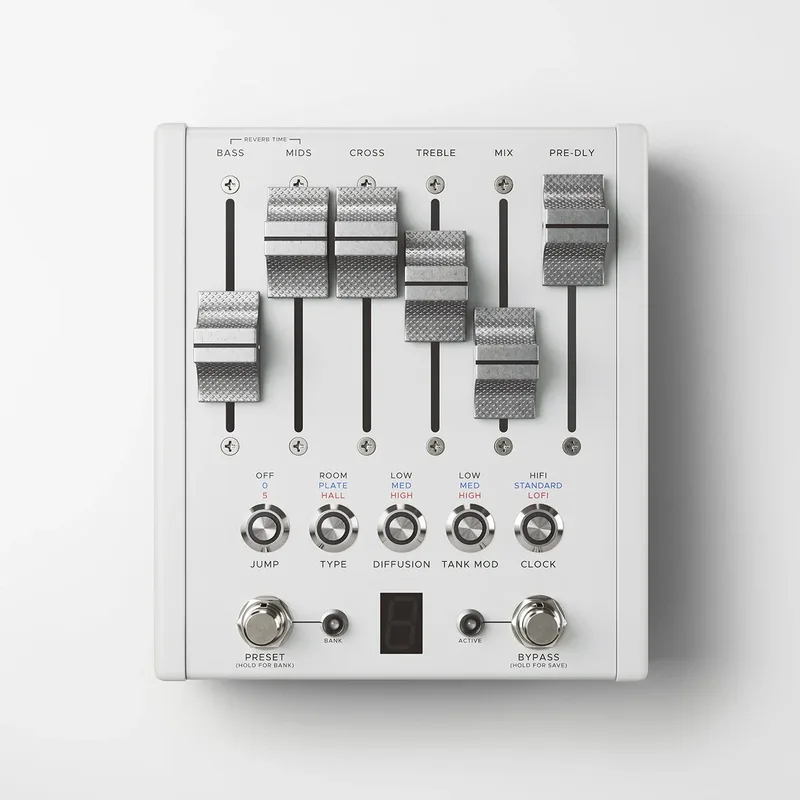
The Type button toggles between the three reverb algorithms: Room, Hall and Plate4. Chase Bliss describes Room as having a lively and grounded character that creates a natural sense of space, with Hall building more slowly into richness3. Guitar Pedal X's coverage characterized Room as having a lively degree of movement and reflection, and Plate as typically fast and dense, easy to blend in12.
The controls: motorized faders and the crossover
The control surface is a set of motorized sliders, the format Chase Bliss introduced with its Automatone series131214. Switch presets and the faders move to recall the saved position of each parameter, and the faders also respond to MIDI4. A Jump button skips to a favorite preset, and there are two multi-function footswitches4.
| Control | What it does |
|---|---|
| Type | Selects Room, Plate or Hall4 |
| Cross / Crossover | Sets the frequency point that splits decay control: everything below goes to the Bass slider, everything above to the Mids slider3126 |
| Bass, Mids, Treble | Conjointly shape the sustain and decay of the reverb tail12 |
| Diffusion | Shapes the onset and attack of the reverb, from a relatively uncolored onset at Low to pre-delay regeneration, comb-filtering, echo taps and smearing at High12 |
| Tank Mod | Modulation inside the algorithm, from subtle movement through chorus-style to rotary-speaker-style modulation12 |
| Clock | Sets fidelity and pre-delay range, from clean and pristine down to signal degradation touching on bitcrushing12 |
The Crossover is the control that most sets the CXM 1978 apart from a conventional reverb pedal. Rather than one decay time for the whole tail, it acts as a frequency splitter, so bass and mids decay independently312. Guitar Pedal X also noted a secret mode: Diffusion set to Low on the Hall type delivers sparse, very slightly soft delay taps12.
Pre-delay depends on the Clock setting:
- HIFI (48kHz, 32 bit): 42 milliseconds of pre-delay1112
- Standard / Midfi: pre-delay increases to 168 milliseconds12
- LOFI: pre-delay reaches a maximum of 1700 milliseconds12
Power and connections: balanced I/O, MIDI and CV
The CXM 1978 runs on 9V DC, center negative, drawing around 500 mA3. That current draw rules out a battery and means it needs a power supply with real headroom on its 9V output.
Connections include stereo 1/4-inch input and output jacks, MIDI in and thru, and expression pedal and aux inputs4. The maker's page lists MIDI program change and CC control, expression control, and CV control3. The I/O can run fully balanced or unbalanced, with 9.5V pk-pk headroom and -108 dB SNR311.
When using balanced mode you need TRS cables on both the input and output. Conversely, you can only use TS cables when in unbalanced mode11.
Two operational details from the maker's support pages: Dry Kill is engaged or disengaged by holding down the left (preset) footswitch on power up11, and an aux footswitch is connected by holding down the Jump button while plugging a TRS cable into the Aux Jack11.
History: a Chase Bliss and Meris Automatone
Meris announced the collaboration on 1 October 2020 as its first joint pedal with Chase Bliss, a new Automatone reverb15. It was the second Automatone pedal, following the Preamp MKII collaboration with Benson Amps from earlier in 20204169. The pedal opened for pre-order in October 2020 at $899, with shipping slated for 30 November, and due to COVID-related supply issues the first batch was available in limited numbers, sold only directly from the Chase Bliss website102.
That Pedal Show counted it among the three big reverb releases of 2020, alongside the Strymon NightSky and Eventide Blackhole17. MusicRadar later described it as the world's most expensive reverb pedal18.
What reviewers said
Reviews were strong across the board. Pedal of the Day wrote: "We're astounded once again"6. Guitar.com's review scored it 9/10, and the site later said it "succeeds in elevating the humble reverb pedal concept to a whole new level of tonal excellence and creative potential", naming it among the best premium effects pedals of 20214914.
Guitar Pedal X compared it directly with the Strymon NightSky, finding that "this sounds every bit as good as the Strymon NightSky, while not quite delivering the same degree of overall functional depth and versatility", and calling its preset storage and recall "an infinitely superior format/mechanic" to the NightSky's. The same writer concluded it is "one of the truly great Studio Reverb Workstation Units and will easily and consistently generate killer reverb sounds"12. Gearnews asked at launch: "Dare we say it, is this the reverb pedal of the decade?"2
Videos
Pete Thorn
Ricky Tinez
Vintage King
Questions
Is the Chase Bliss CXM 1978 based on the Lexicon 224?
Yes. The CXM 1978 is a pedal adaptation of the Lexicon 224 Digital Reverb, the studio rack unit released in 1978. Chase Bliss describes it as its fresh take on the reflections of the 70s, and it was designed in collaboration with Meris.
How much pre-delay does the CXM 1978 have?
It depends on the Clock setting. In HIFI mode, at 48kHz and 32 bit, you get 42 milliseconds of pre-delay. Standard mode raises the maximum to 168 milliseconds, and the LOFI setting reaches a maximum of 1700 milliseconds.
How do I turn on dry kill on the CXM 1978?
Hold down the left footswitch, the preset switch, while powering the pedal up. Doing the same thing again disengages Dry Kill, which mutes the analog dry signal and leaves only the reverb.
Does the CXM 1978 need TRS cables?
Only in balanced mode. When using balanced mode you need TRS cables on both the input and output. In unbalanced mode you can only use TS cables, so match the cable to the mode you have selected.
How much current does the CXM 1978 draw?
Around 500 mA at 9V DC, center negative. That is far more than a typical compact pedal, so it needs an isolated power supply with adequate current rather than a battery or a shared daisy chain.
How many presets does the CXM 1978 store?
It stores 30 internal presets, arranged as three banks of 10 preset slots. When you recall a preset, the motorized faders physically move to the saved position of each parameter.
Sources (18)
- Chase Bliss & Meris CXM 1978 Reverb, Delicious Audio, 2025-02-19
- Chase Bliss Audio CXM 1978 opens for pre-orders: The reverb pedal of the decade?, gearnews.com, 2020-10-02
- CXM 1978, Chase Bliss
- Review: Chase Bliss Audio Automatone CXM 1978, Guitar.com, 2021-01-27
- Guitar Pedal X, Guitar Pedal X, 2021-08-16
- Chase Bliss Audio CXM 1978 Automatone Reverb, Pedal of the Day, 2020-12-06
- Chase Bliss Audio CXM 1978 Automatone Demo, Premier Guitar, 2020-01-20
- A Q&A With Chase Bliss Audio And Meris About The CMX 1978 Automatone, Delicious Audio, 2020-11-03
- Gear Of The Year: Best Premium Effects Pedal of 2021, Guitar.com, 2021-12-09
- Chase Bliss Audio teams up with Meris for the automated slider-equipped CXM 1978 Studio Reverb, Guitar World, 2020-10-02
- Support | Get Expert Support Now - Chase Bliss, Chase Bliss
- Guitar Pedal X, Guitar Pedal X, 2020-10-02
- Best Stereo Reverb Pedals For Synths For Texture, Ambiance, And Automation, Delicious Audio, 2024-02-23
- Chase Bliss Audio teases new pedal that’s “taken two years to get right”, Guitar.com, 2022-03-28
- CXM 1978, Meris, 2022-10-10
- Chase Bliss Big Time Automatone™ Analog/Digital Echo, Pedal of the Day, 2026-08-31
- Spectacular Reverbs! Strymon NightSky, Chase Bliss CXM 1978, Eventide Blackhole, That Pedal Show (thatpedalshow.com), 2020-11-27
- Meris aims to shake up the ambient reverb pedal market with its MercuryX Modular Reverb System, MusicRadar, 2023-10-11