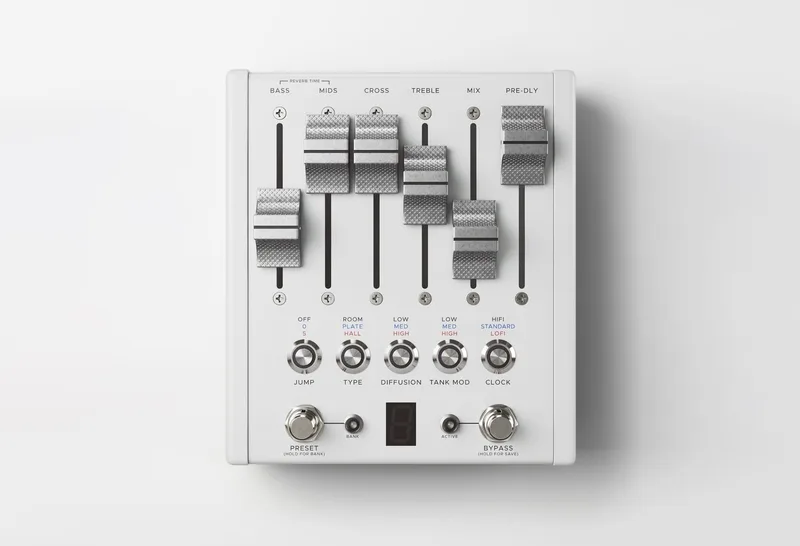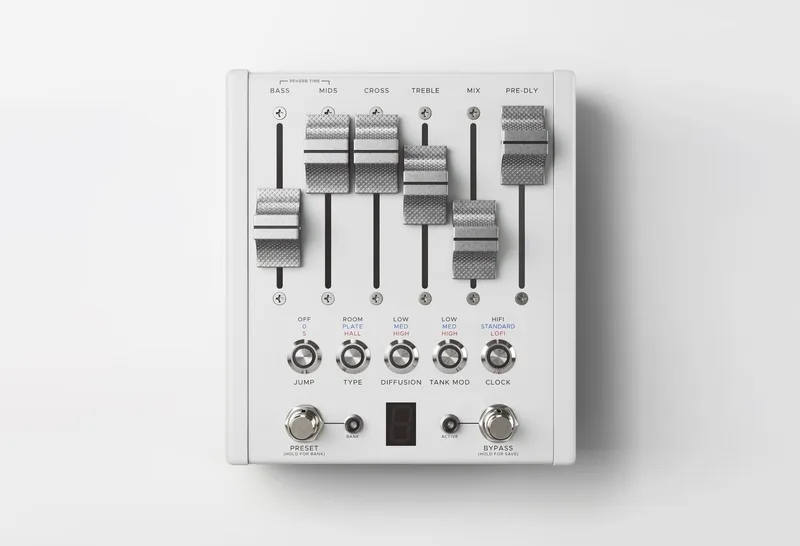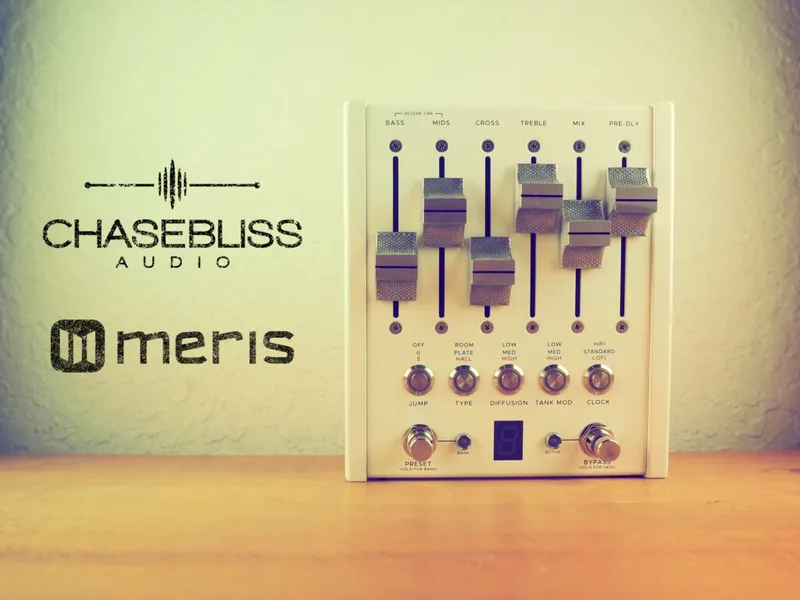


The Chase Bliss Automatone CXM 1978 is a digital reverb pedal, made in the USA, built as a collaboration between Chase Bliss Audio and Meris1. It is a 32-bit AD/DA pedal adaptation of the venerable 1978 Lexicon studio reverb2: a reinterpretation of the vintage Lexicon 224 Digital Reverb, the rack unit that defined studio reverb in the late 1970s31. Where the original was a rackmount box the size of a briefcase, the CXM 1978 packs that character into a stompbox with the moving-fader format of Chase Bliss's Automatone series2.
For a player, what that means is a fully stereo reverb pedal with three algorithms, Hall, Room and Plate2, and a set of motorized faders that physically move when you recall a preset. It was the second Automatone pedal, following the Preamp MKII collaboration with Benson Amps1.
A Lexicon 224 style reverb in a pedal
The CXM 1978 was designed in tribute to the coveted Lexicon 224 Digital Reverb6, and its sound is modeled on early digital reverb rack units from the 1970s7. Meris are the creators and programmers of its reverb algorithms, which were honed from the Meris Mercury7 and largely matched to the legendary Lexicon 2245. Guitar.com described the result as aiming to offer "a modern take on vintage studio reverb"8.
The pedal includes three algorithms, Hall, Room and Plate, selected with the Type button for three distinct reverb characters26. Beyond the algorithms, three buttons each offer three settings that shape the reverb in different ways2:
| Button | Settings | What it does |
|---|---|---|
| Type | Room, Plate, Hall | Selects the reverb character6 |
| Diffusion | Low, Med, High | Low is uncolored and clear; Med is a softer, gentler attack; High introduces Regeneration and depends on the pre-delay time6 |
| Tank Mod | Low, Med, High | Adjusts the amount of modulation in the reverb tank, with a range of modulation effects including chorus and rotary speaker emulation6 |
| Clock | HiFi, Standard, LoFi | Sets the sound quality of the tails26 |
The Clock setting is where the vintage character lives. At its lowest settings the tails can sound like grainy multi-delays, emulating the early digital reverbs the pedal honors2.
The controls and motorized faders
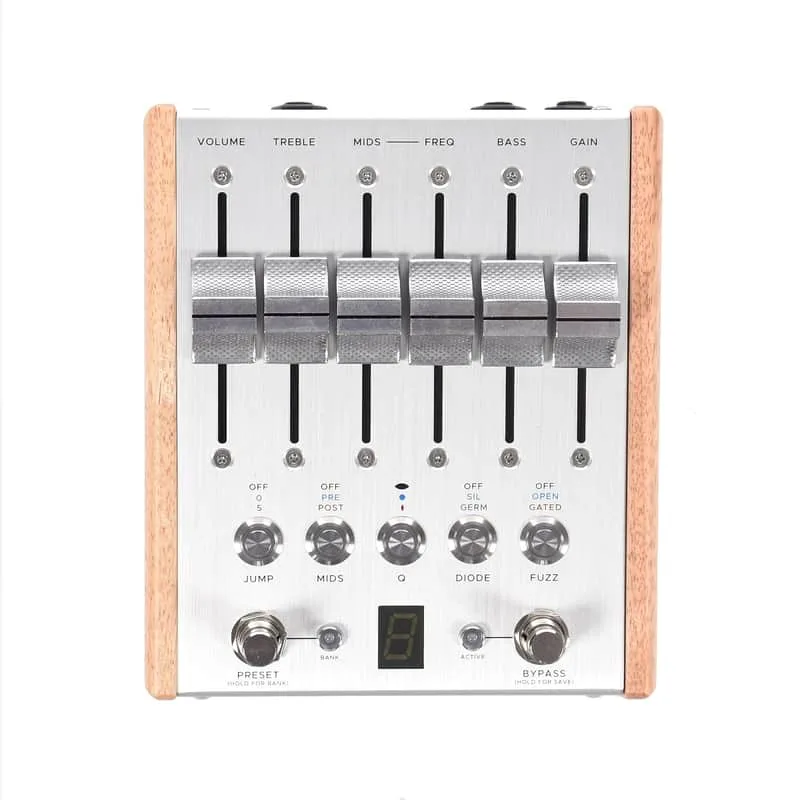
The heart of the pedal is its motorized, slider-based operation7. The faders cover Bass, Mids, Cross, Treble, Mix and Pre-delay1, and they react individually to preset changes, expression pedal control, control voltage and MIDI, moving automatically to recall saved preset positions1. Switch presets and the reassuringly substantial faders fly to the saved position of each parameter; a jump button skips to a favorite preset1.
What each fader does:
- Bass and Mids: EQ for the reverb, split by the Cross fader, everything above that point going to the Mids control and everything below to the Bass6
- Treble: Darkens the reverb reflections, working with the other EQ settings6
- Mix and Pre-delay: Set the reverb level and the time before the reverb begins1
The fader automation also allows slow-moving ambience effects, obtained by cross-fading from one preset to the next or using MIDI control on any of the parameters2. The expression pedal input supports global expression control over the reverb mix level and morphing between fader positions at toe and heel settings1. There are two multi-function footswitches, MIDI in and thru, and the faders respond to MIDI1.
The 500 mA current draw at 9V center negative means this pedal needs a dedicated power supply output rated for at least 500 mA. It is not a candidate for a battery or a low-current daisy chain14.
Line level and studio use
Although it defaults to unbalanced instrument level, the CXM 1978 can be switched to balanced line level, which transforms it into a powerful outboard processor in the studio1. It also features optional ultra-low-noise, fully balanced I/O, stereo inputs and outputs, 32-bit AD/DA conversion, and internally boosted plus and minus 15V rails for line level use6. The Guitar.com reviewer strongly recommended experiencing the unit in stereo with a pair of amps1.
What reviewers said
The CXM 1978 was exceptionally well received. Guitar.com gave it a 9/107, and in the site's best premium effects pedals of 2021 awards it wrote that the pedal "succeeds in elevating the humble reverb pedal concept to a whole new level of tonal excellence and creative potential"8. Pedal of the Day's verdict was simply:
"We're astounded once again"
Despite its rather hefty price tag, $899 as listed in 202141, the pedal was exceptionally well received7, and it placed 11th with 2 points in Delicious Audio's best guitar pedals of 2020 roundup46.
Videos
Pete Thorn
chase bliss
Ricky Tinez
Sources (8)
- Review: Chase Bliss Audio Automatone CXM 1978, Guitar.com, 2021-01-27
- Best Stereo Reverb Pedals For Synths For Texture, Ambiance, And Automation, Delicious Audio, 2024-02-23
- A Q&A With Chase Bliss Audio And Meris About The CMX 1978 Automatone, Delicious Audio, 2020-11-03
- The Best Guitar Pedals Of 2020 according To The Internet Experts, Delicious Audio, 2021-01-21
- Guitar Pedal X, Guitar Pedal X, 2021-08-16
- Chase Bliss Audio CXM 1978 Automatone Reverb, Pedal of the Day, 2020-12-06
- Chase Bliss Audio teases new pedal that’s “taken two years to get right”, Guitar.com, 2022-03-28
- Gear Of The Year: Best Premium Effects Pedal of 2021, Guitar.com, 2021-12-09