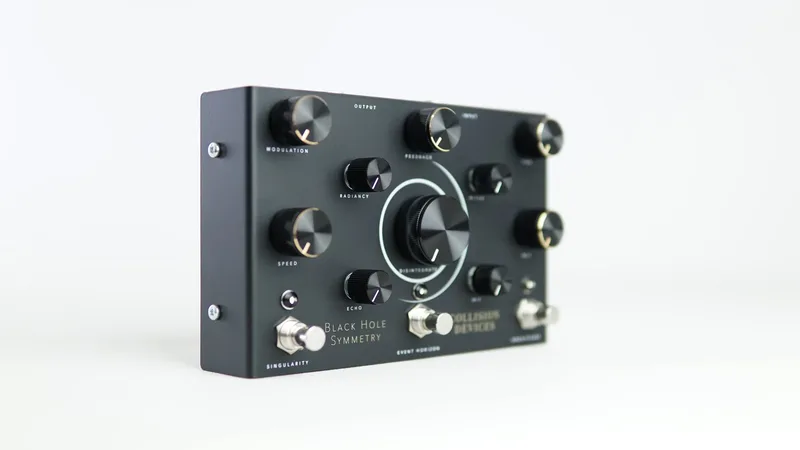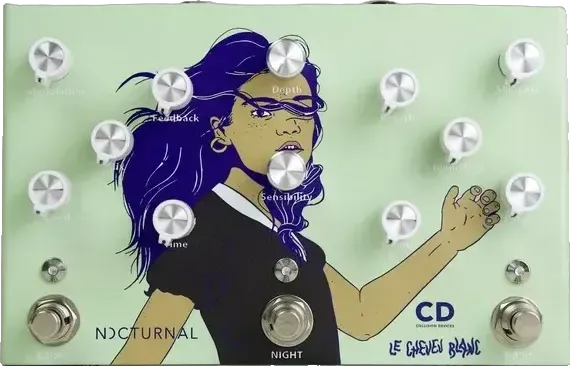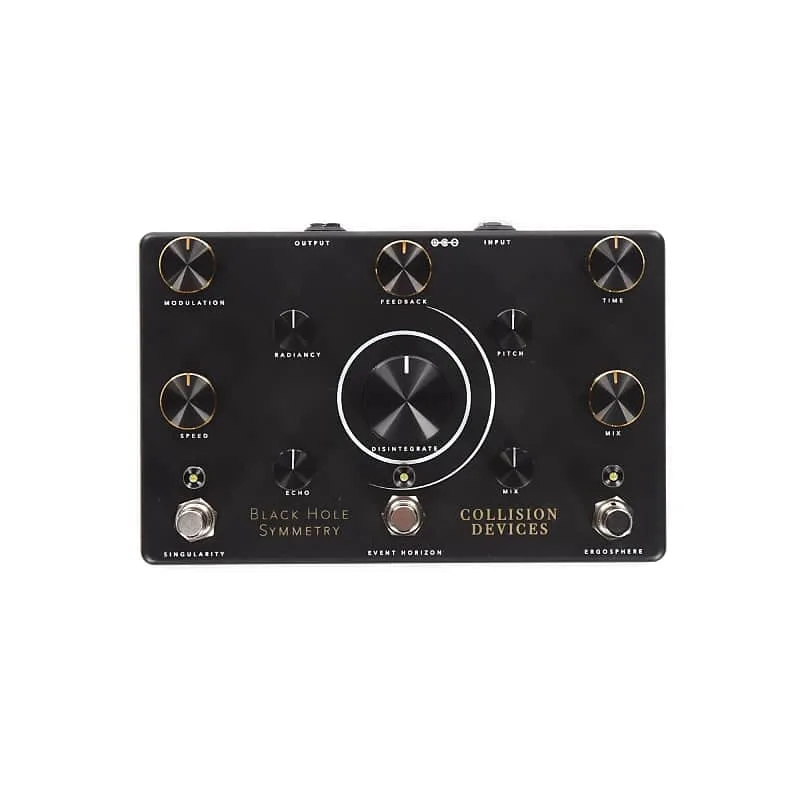


The Collision Devices White Black Hole Symmetry is a three-in-one pedal that combines a modulated delay, a pitch-shifted space reverb and a fuzz. Collision Devices describes it as "a Modulated Delay / Pitch Shifted Reverb / Destruction Fuzz pedal," with three footswitches and a separate set of controls for each effect. The three sections, named Ergosphere, Event Horizon and Singularity, can be played together or separately1.
The White Black Hole Symmetry is a three-in-one pedal from Collision Devices that stacks a delay, a reverb and a "Destruction Fuzz" in one enclosure. The maker describes the fuzz's single Disintegrate setting as a way to "raise your sound," and the pedal carries a lifetime warranty1. Its controls include the Pitch knob in the Event Horizon section, which shifts the pitch of the note, and the Feedback knob in the Ergosphere section, which sets the number of repetitions1.
The three sections
Each of the pedal's three sections carries a black-hole name and its own job1:
- Ergosphere (Modulated Delay): based on the PT2399 chip to produce a warm echo, with the echo signal modulated by two oscillators1.
- Event Horizon (Space Reverb): a long reverb based on the FV-1 chip, which harmonizes the reverb signal with a pitch shifter1.
- Singularity (Destruction Fuzz): a fuzz whose single setting, Disintegrate, "allows you to raise your sound"1.
Because each section has its own footswitch, the pedal works as three pedals in one box: run the delay alone for echo, the reverb alone for ambience, the fuzz alone for destruction, or stack any combination of the three1.
Controls
| Section | Control | What it does |
|---|---|---|
| Ergosphere (delay) | Time | Time between each repetition, from 0s to 1s1 |
| Ergosphere (delay) | Feedback | Number of repetitions1 |
| Ergosphere (delay) | Modulation | Proportion of modulation in the delay signal1 |
| Event Horizon (reverb) | Pitch | Shift the pitch of the note1 |
| Event Horizon (reverb) | Echo | Echo time, max 15s1 |
| Singularity (fuzz) | Disintegrate | Volume setting with a huge fuzz1 |
The Echo knob on the Event Horizon section reaches a maximum of 15 seconds of echo time, while the delay section's Time knob runs from 0 to 1 second between repetitions. The two knobs do different jobs, so it is worth knowing which section you are adjusting1.
Power and connections
The pedal runs on 9V DC with a negative center connector and draws a maximum of 250 mA. Collision Devices recommends an isolated power supply for all of its pedals and states that a power supply is not included. At 250 mA maximum draw, the pedal is beyond what many daisy-chain supplies offer per output, so a dedicated isolated output is the safe assumption1.
Other specifications from the maker:
Where it comes from
Collision Devices builds the pedal in France: "Each pedal is designed, assembled, tested and numbered by hand in our workshop near Angers, France," according to the maker's product page1. The company backs the pedal with what it calls a lifetime warranty: "The B.H.S. has a lifetime warranty. Of course."1
The pedal's specifications give a picture of what it asks of a board: a maximum current draw of 250 mA, a 1 MOhm input impedance and a 1 KOhm output impedance1. Collision Devices measures the enclosure at 119 x 116 x 56mm with a weight of 200gr, and stands behind the Black Hole Symmetry with a lifetime warranty1.
Where it sits in the Collision Devices range
Within the Collision Devices range, the Black Hole Symmetry stands out for combining a fuzz with its delay and reverb: the maker describes the Singularity section's Destruction Fuzz, whose single Disintegrate setting "allows you to raise your sound"1. The Pitch knob in the Event Horizon section shifts the pitch of the note, while the Feedback knob in the Ergosphere section sets the number of repetitions, giving each of the three effects its own control1.
Videos
The Pedal Zone
Eirik Stordrange
Tone Factory
Questions
Is the Collision Devices White Black Hole Symmetry true bypass?
Yes. Collision Devices states on its product page that the pedal is true bypass, so when it is off, your guitar's signal passes through without the delay, reverb or fuzz circuits in the way. The pedal also has a 1 MOhm input impedance and a 1 KOhm output impedance.
Can the three sections of the Black Hole Symmetry be used separately?
Yes. The pedal has three sections, Ergosphere, Event Horizon and Singularity, and Collision Devices describes them as parts that can be played together or separately. Each section has its own footswitch, so you can run the delay, reverb and fuzz on their own or stacked in any combination.
Does the Black Hole Symmetry come with a power supply?
No. Collision Devices notes that a power supply is not included with the pedal. The company recommends using an isolated power supply for all of its pedals. The pedal runs on 9V DC with a negative center connector and draws a maximum of 250 mA.
What chips does the Black Hole Symmetry use for its reverb and delay?
The Event Horizon space reverb is based on the FV-1 chip and harmonizes the reverb signal with a pitch shifter. The Ergosphere modulated delay is based on the PT2399 chip, chosen for a warm echo, with the echo signal modulated by two oscillators.
Where is the Black Hole Symmetry made?
In France. Collision Devices says each pedal is designed, assembled, tested and numbered by hand in its workshop near Angers, France. The White Black Hole Symmetry is a limited edition version of the pedal.
How long can the echo time go on the Event Horizon section?
The Echo knob on the Event Horizon section sets the echo time up to a maximum of 15 seconds. Note that the Event Horizon is the reverb section; the delay section, the Ergosphere, has its own Time knob that sets the time between repetitions from 0 to 1 second.
Sources (1)
- Store 1 - COLLISION DEVICES, Collision Devices