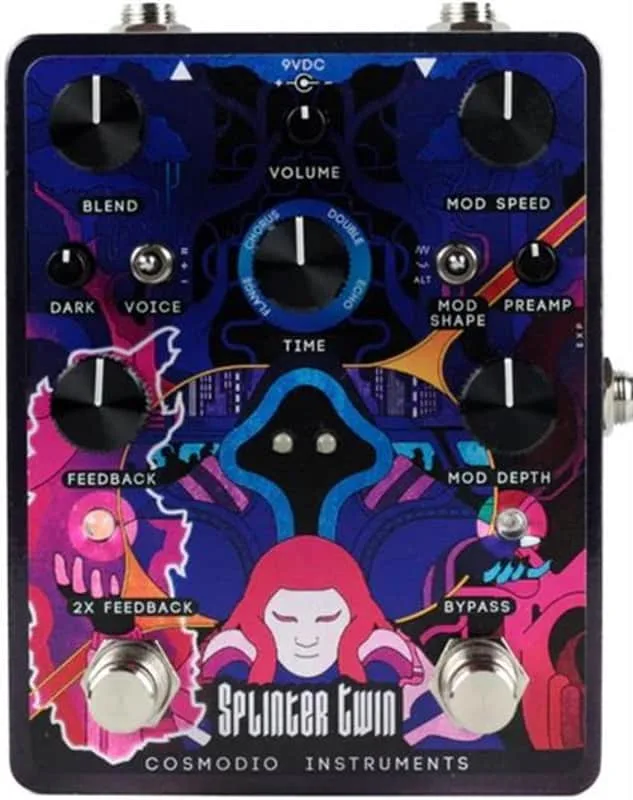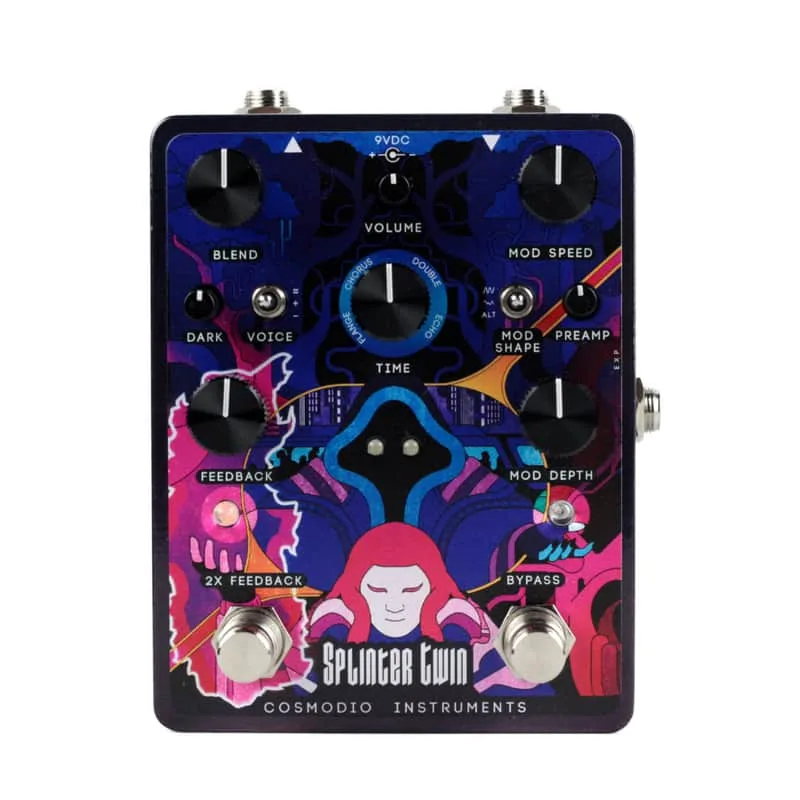


The Cosmodio Instruments Splinter Twin is a Time Modulator pedal: a delay line manipulator that covers flanger, chorus, vibrato, double tracking, slapback and echo in a single unit1. Instead of giving you separate modes for each effect, it clones your signal, alters that clone in time, pitch, texture, phase and feedback, and then re-combines the altered clone with your original signal to create something new1. The result is one continuous sweep from through-zero flanging at one end to 340ms of echo at the other2.
Guitar Pedal X's Stefan Karlsson called it "one of the most unusual Delay Line Modulators / Manipulators I've seen to date" and possibly his favorite delay of the year1.
A delay line manipulator from flange to echo
Most pedals that do time-based effects give you a mode switch: pick flanger, pick chorus, pick delay. The Splinter Twin takes a different approach. Delicious Audio describes it as "a master delay-line manipulator, cloning your signal and warping its time, pitch, and texture before blending it back with the original"2. Where most pedals offer distinct modes, the Splinter Twin provides a continuous, modeless journey2.
The core of that journey is the Time control, which spans the whole territory in one knob142:
| Time setting | What you get |
|---|---|
| Flange | Radical phase cancellations, including through-zero flanging2 |
| Chorus | Modulated doubling of the signal1 |
| Double | An instantaneous double, near-zero delay2 |
| Echo | Echoes and slapback, up to 340ms2 |
The Time control sweeps seamlessly from 340ms of delay down to an instantaneous double, enabling everything from echoes and slapback to the radical phase cancellations of through-zero flanging2. Pedal of the Day describes the pedal as a time modulation workstation that lets you "modelessly move within, around and between these iconic sounds" and then push beyond them into exotic, hybrid, novel and experimental territory3.
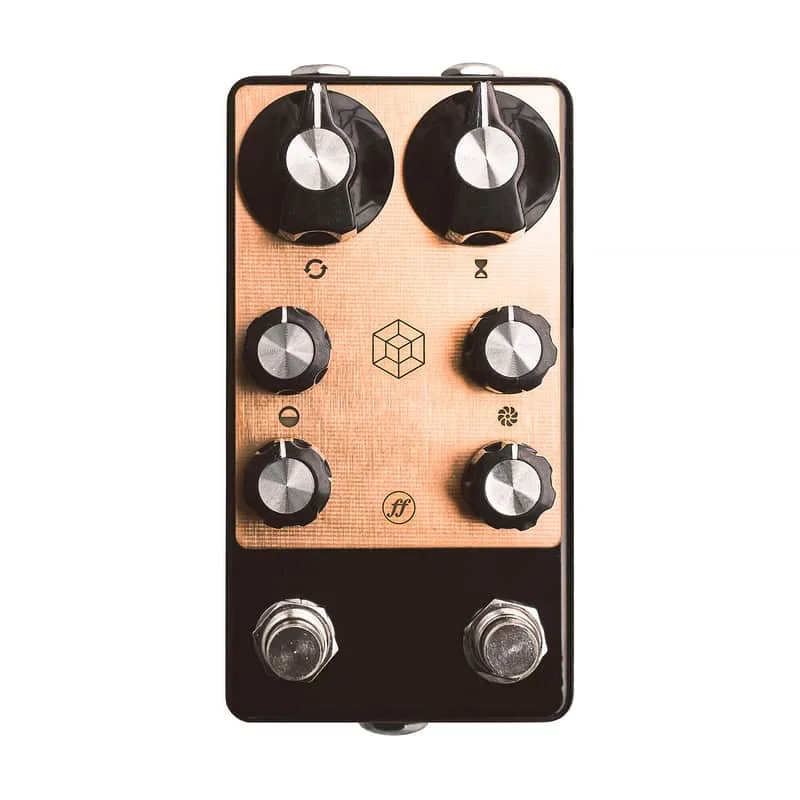
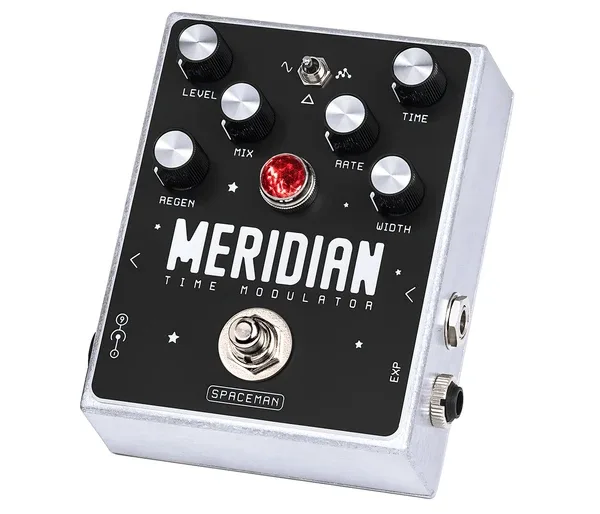
The pedal also has a responsive analog preamp section, with all-analog preamp, feedback paths, tone shaping and mixing circuits23. Guitar Pedal X's reviewer compared its circuit lineage to the Fjord Fuzz Loke and Spaceman Effects Meridian, but with quite a few more variations onboard1.
The controls and footswitches
The control set divides into three groups: Time, MOD and the timbre shaping controls21.
- Time: the master control, sweeping from flange through chorus and double to echo1
- MOD section: Speed, Depth and a selectable Shape control, giving precise command over the modulation's character2
- VOICE switch and DARK control: adjust the timbral character of the delay line itself, ensuring optimal voicing for everything from bass and synths to guitar2
The MOD section is what turns the delay line into a modulator. With Speed, Depth and a selectable Shape for the modulation waveform, you can shape the character of the chorus or vibrato rather than just its speed and intensity2.
The pedal carries two footswitches: a bypass footswitch and a 2x Feedback footswitch for dynamic adjustments12. Delicious Audio calls the feedback footswitch "performative," meaning you can kick it mid-phrase to push the delay line into more intense repeats or resonant flanging and back off again2.
The three voice options
The VOICE switch offers three options for what the cloned signal actually is1:
- Dry copy: a precise copy of your original dry signal1
- Phase inversion: the clone with its phase inverted, which is what enables the through-zero flanging effects1
- Multi-tap: multi-tap effects on the delay line1
Guitar Pedal X's reviewer found the multi-tap setting capable of "various Rainbow Machine variants" of tone, referencing the EarthQuaker Devices pedal's glitchy, magical character1.
Power and connections
The Splinter Twin runs on 9V DC with a center negative plug and draws 200mA1. Connections are simple: one TS input and one TS output1.
The pedal is mono only, with no stereo output. Guitar Pedal X's reviewer noted he "would of course have loved it to have been Stereo Output," but it is not1.
The 200mA draw is on the hungry side for a compact pedal, comparable to digital pedals rather than typical analog ones, so it is best run from a powered pedalboard rather than a small daisy chain1.
Expression control
A TRS expression input lets you control the pedal in real time, assignable to either Time or Mod Speed via an internal switch1. Assigning it to Time gives you foot-swept delay time, which on a flanger setting means foot-controlled through-zero sweeps; assigning it to Mod Speed gives you foot control over the chorus or vibrato rate.
What reviewers said
The Splinter Twin drew strong reviews from the guitar press in late 202512:
- Guitar Pedal X (Stefan Karlsson, November 2025): "one of the most unusual Delay Line Modulators / Manipulators I've seen to date," and possibly his favorite delay of the year1
- Pedal of the Day (December 2025): a time modulation workstation that lets you move modelessly between the classic time-based effects and beyond3
- Delicious Audio (Paolo De Gregorio, December 2025): "less a single pedal and more a laboratory for sonic discovery," calling it an endless sandbox for experimental players and the ultimate modulation and short-delay workstation for the practical player2
"The Cosmodio Splinter Twin Time Modulator is less a single pedal and more a laboratory for sonic discovery."
At $349 (November 2025), it sits in the upper range of boutique time-based pedals, and its appeal is breadth: one pedal covering flanger, chorus, vibrato, doubling, slapback and echo territory that would otherwise take several units13.
Videos
Cosmodio
Cosmodio
Cosmodio
Questions
What does the Cosmodio Splinter Twin do?
It is a Time Modulator pedal that clones your signal, alters that clone in time, pitch, texture, phase and feedback, then blends it back with the original. Depending on the Time setting it covers flanging, chorus, vibrato, double tracking, slapback and echo, from 0ms up to 340ms of delay.
Does the Cosmodio Splinter Twin have stereo output?
No. The pedal has a single TS output, so it is mono only. Guitar Pedal X's reviewer noted he would have loved a stereo output, but the pedal does not offer one.
Can I use an expression pedal with the Splinter Twin?
Yes. It has a TRS expression input that can be assigned to either the Time control or the modulation Speed, selected by an internal switch. This lets you sweep delay time or modulation speed in real time with your foot.
How much current does the Splinter Twin draw?
It runs on 9V DC with a center negative plug and draws 200mA. That is a fairly hungry draw for a compact pedal, so a dedicated spot on a powered pedalboard is the practical way to run it.
What are the three voice options on the Splinter Twin?
The first voice is a precise copy of your original dry signal. The second is a phase inversion of that signal, which enables through-zero flanging effects. The third provides multi-tap effects, which reviewers found capable of tones reminiscent of the EarthQuaker Devices Rainbow Machine.
Sources (4)
- Guitar Pedal X, Guitar Pedal X, 2025-11-12
- Cosmodio Splinter Twin Time Modulator, Delicious Audio, 2025-12-04
- Cosmodio Instruments Splinter Twin Time Modulator, Pedal of the Day, 2025-12-04
- Guitar Pedal X - GPX Blog - 2025 Best New Delay and Reverb Pedals of the Year, Guitar Pedal X