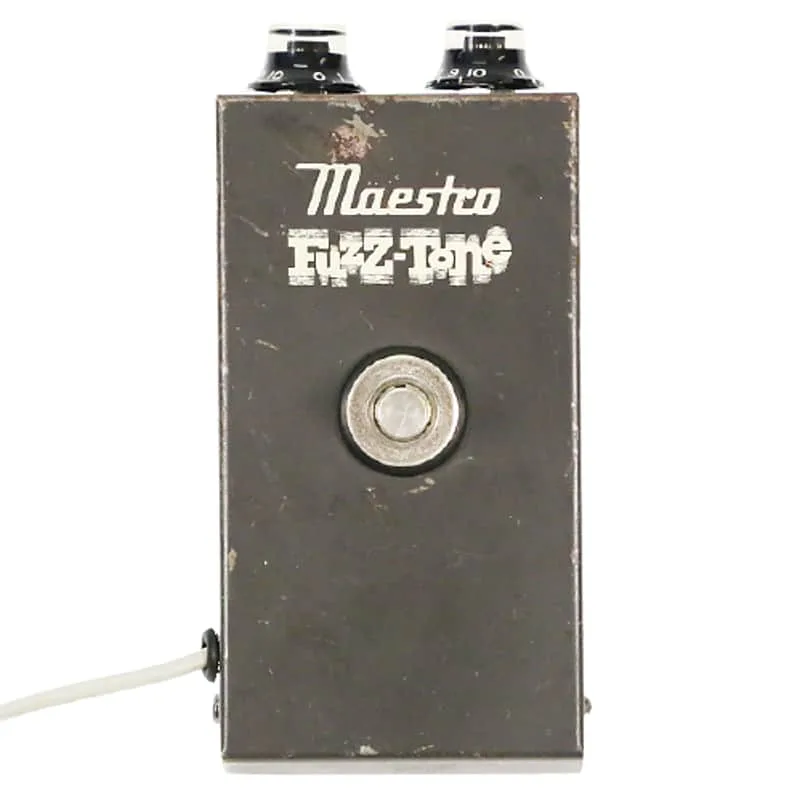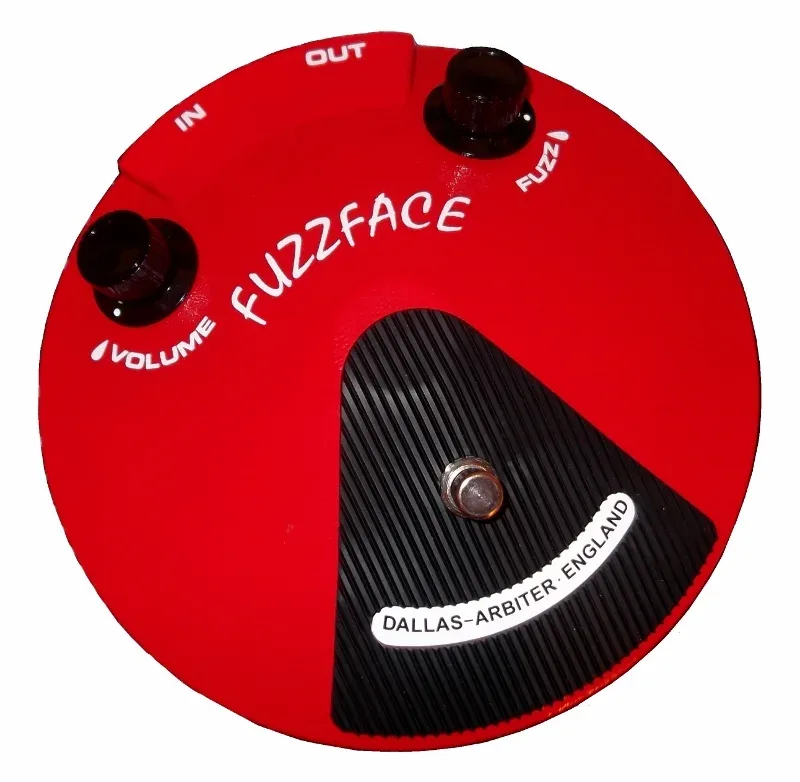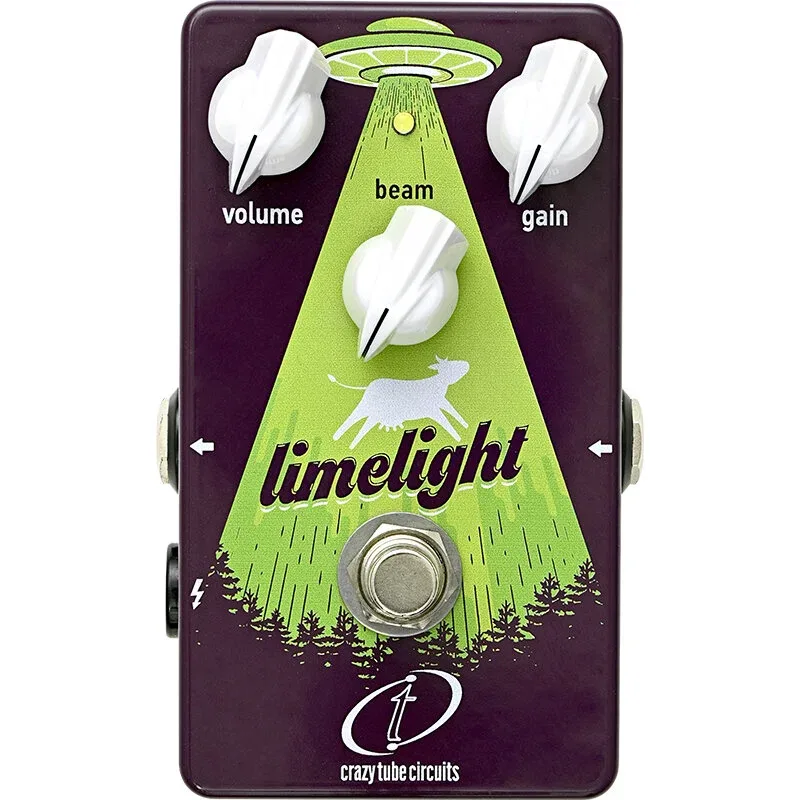


The Crazy Tube Circuits Limelight is a vintage-voiced fuzz / distortion pedal with a modern implementation, built around three hand-selected New Old Stock Black Glass germanium transistors12. It is an all-analog design, and its original circuit was devised as a tribute to the first commercially available fuzz, the Gibson Maestro FZ-1 Fuzz-Tone, and to the British fuzzes that followed it34.
The range it covers is wide for a fuzz pedal. The maker describes it as running "From germanium 'clean' boost to nasty satisfaction fuzz or modern distortion/fuzz sounds"5. At one end it can act as a low-gain boost, and at the other it delivers the ragged, gated fuzz of the early 1960s designs it honors.
What it does: germanium boost to fuzz distortion
The Limelight is designed to pay tribute to the first commercially available fuzz and its British derivatives, but it is not a part-for-part clone. Delicious Audio described it as "an original circuit devised as a tribute to the early fuzz circuits, its British derivatives and their offsprings"3, and Premier Guitar's reviewer noted that "Crazy Tubes says the Limelight isn't an FZ-1 clone"7.
What it offers instead is a broader range than the originals. Premier Guitar's reviewer found that the pedal captures the character of the FZ-1 while adding capability7:
"Crazy Tubes has managed to capture the honking voice of an FZ-1, give it more body and gain, extend its range in low gain settings"7
At the low-gain end, the Limelight doubles as a boost. Delicious Audio called it "probably the first fuzz pedal to have extraordinary low gain boost sounds," achieved by setting Gain at minimum with the Beam control all the way up3. Guitar.com described the same setting as producing "a thick, clean boost," and reported that Crazy Tube Circuits claims this low-gain boost capability is "probably" a first for a fuzz pedal2.
The controls and the Beam bias knob
The control that defines the pedal is Beam, a bias circuit. Premier Guitar's reviewer explained how it works76:
"the beam control: a bias control that starves the circuit of voltage at counter clockwise settings and juices the works at the other end."7
In practice, the knob changes the character of the fuzz rather than just its amount. Delicious Audio described the sweep as running from "nasty 'satisfaction' gated fuzz up to mkI / II style fuzz distortion"3, and Guitar.com similarly noted that the Beam control "takes the pedal from nasty gated fuzz up to MKI/II-style fuzz distortion" by modifying the transistors2. MusicRadar characterized it as "a bias circuit that promises 'virtually limitless' fuzz varieties"6.
Gearnews called Beam the pedal's stand-out feature, writing that "the Beam control will set this pedal apart from its vintage counterparts; this is the stand-out feature"4.
| Control | What it does |
|---|---|
| Gain | Sets the amount of drive; at minimum with Beam maxed, the pedal works as a thick, clean boost2 |
| Beam | Bias control; counterclockwise starves the circuit of voltage for gated, ragged fuzz, clockwise increases voltage for fuller MKI/II-style fuzz distortion73 |
A tribute to the Maestro FZ-1 and its British offspring
The Limelight's lineage goes back to the Maestro FZ-1 Fuzz-Tone, the fuzz that started the effect's commercial history. Gearnews reported that the pedal's circuits "are based on US-built fuzz pedals like the Gibson Maestro FZ-1," which inspired later British designs like the Tone Benders4.
That lineage matters because of what the FZ-1 spawned. In a MusicRadar interview about Maestro's history, Craig Hockenberry traced the family tree: "Obviously, the Tone Bender and Fuzz Face, but there were so many others that followed suit" in the mid-1960s8. Premier Guitar has also grouped the FZ-1 with "lower voltage vintage fuzzes like the Maestro FZ-1 or Selmer Buzz Tone" as a category of circuits9.
The Limelight sits on that same family tree, but as a more flexible branch. Premier Guitar's reviewer concluded7:
"it's hard to imagine a more versatile branch on the FZ-1 family tree than this one."7
Power, bypass and where it is made
The Limelight is a PNP germanium, positive ground circuit. Like other PNP germanium fuzz pedals, it requires a positive-ground power supply or a 9V battery64. It cannot be safely daisy-chained on a standard negative-ground supply.
The pedal features true bypass switching1. It is designed and built in Athens, Greece, by Crazy Tube Circuits, a pedal company based there46. Premier Guitar's review also identified it as "the made-in-Greece Crazy Tubes Circuits Limelight fuzz"7.
Videos
Premier Guitar
CrazyTubeCircuits
R.J. Ronquillo
Questions
Does the Crazy Tube Circuits Limelight need a positive ground power supply?
Yes. Like other PNP germanium fuzz pedals, the Limelight is a positive ground circuit, so it requires a positive-ground power supply or a 9V battery. That means it cannot share a standard daisy chain with negative-ground pedals without an isolated output.
What transistors are in the Limelight?
The pedal uses three New Old Stock Black Glass germanium transistors, hand selected for each unit. Crazy Tube Circuits selects them to ensure ideal performance and consistency between pedals.
Can the Limelight be used as a clean boost?
Yes. Set the Gain control to minimum and turn the Beam control all the way up, and the pedal produces a thick, clean boost. Guitar.com reported that this low-gain boost capability is, in the maker's words, probably a first for a fuzz pedal.
Is the Limelight true bypass?
Yes. The pedal features true bypass switching, so it leaves your dry signal untouched when disengaged.
Where is the Crazy Tube Circuits Limelight made?
The Limelight is designed and built in Athens, Greece, by Crazy Tube Circuits, a pedal company based there.
Sources (9)
- Crazy Tube Circuits Announces New Limelight Fuzz Pedal, Guitar World, 2019-03-11
- Crazy Tube Circuits launches Limelight fuzz pedal, Guitar.com, 2019-03-12
- Crazy Tube Circuits Limelight Fuzz/Distortion, Delicious Audio, 2020-07-05
- Crazy Tubes Circuits Limelight pedal: Vintage fuzz tones beamed to the future, gearnews.com, 2019-03-11
- Limelight (B-Stock), Crazy Tube Circuits
- Crazy Tube Circuits steps into the Limelight with new vintage-voiced fuzz pedal, MusicRadar, 2019-03-11
- Crazy Tube Limelight Review, Premier Guitar, 2019-09-30
- Interview: "It's arguably the first guitar effects pedal ever", MusicRadar, 2022-02-21
- Electro-Harmonix Bender Royale Review, Premier Guitar, 2026-02-22