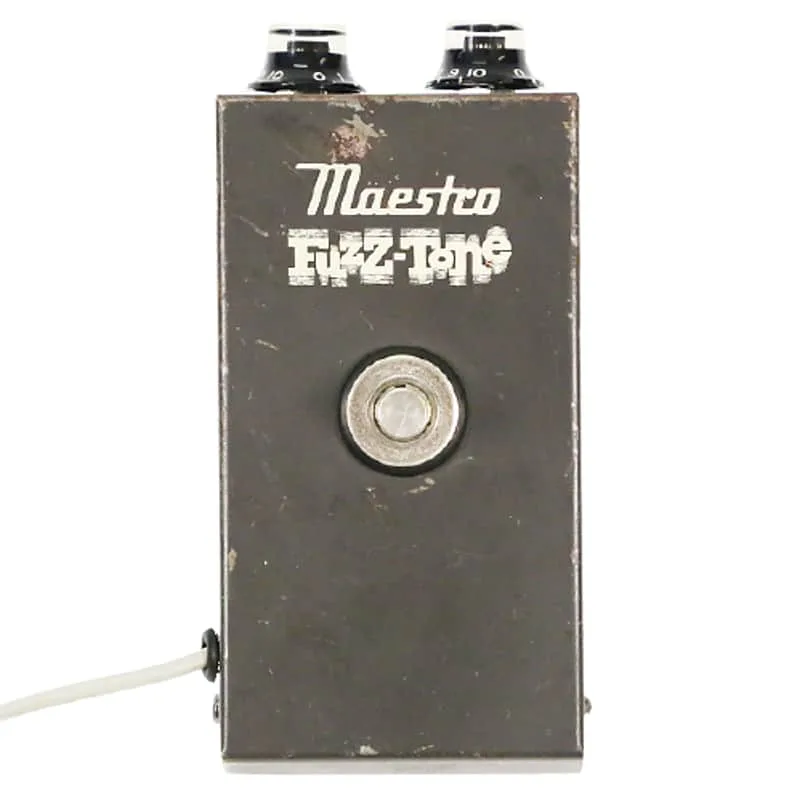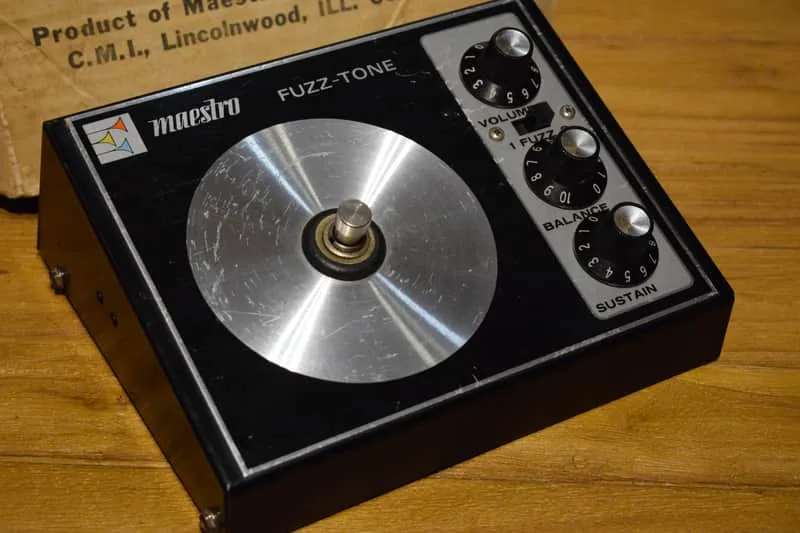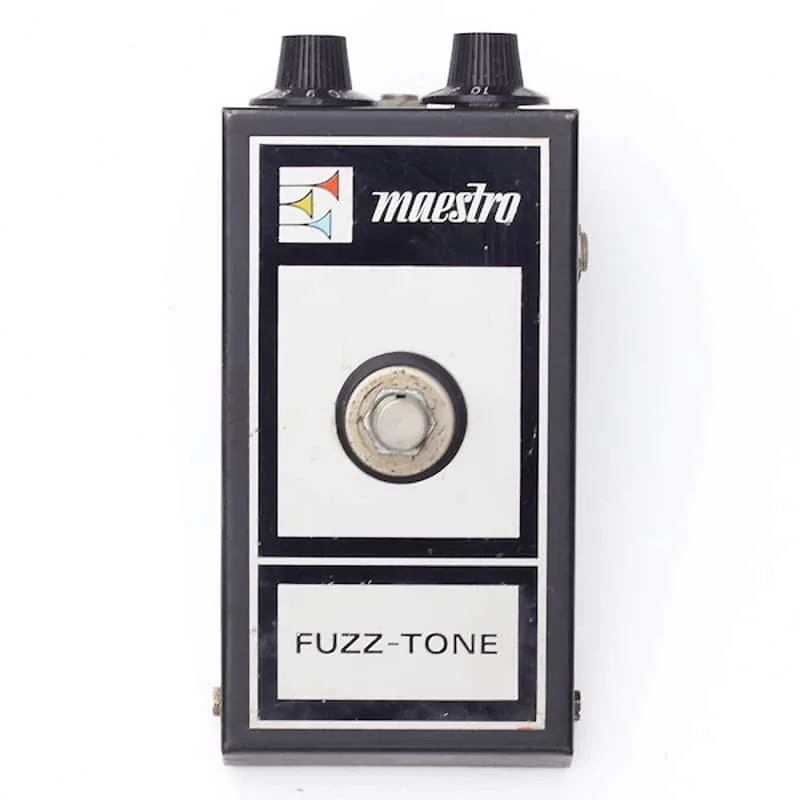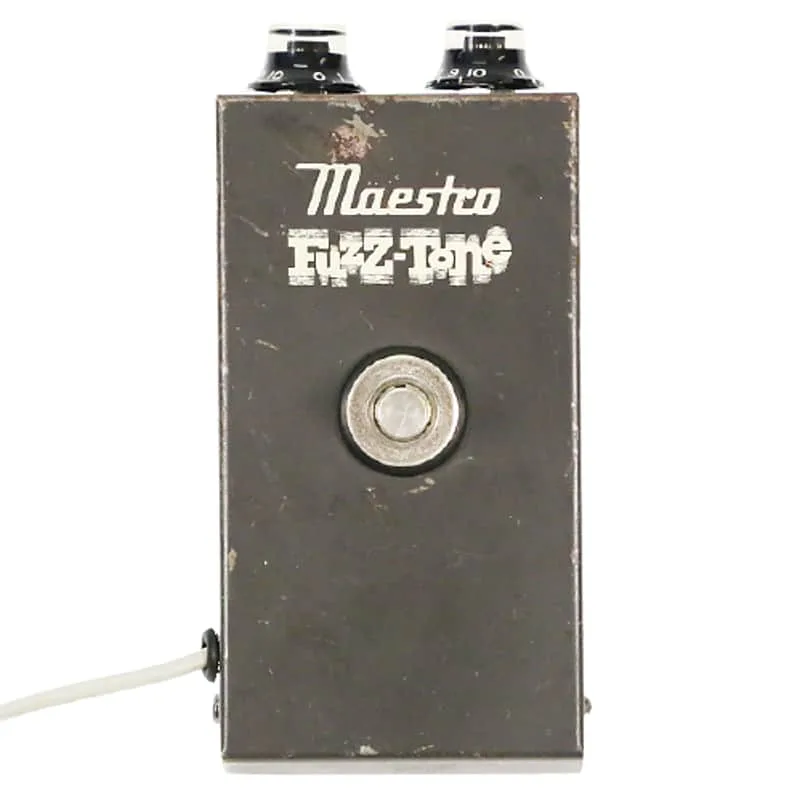


The Maestro FZ-1 Fuzz-Tone is a fuzz pedal that Gibson launched in 1962 under its Maestro brand name1. It is widely described as the first fuzz pedal and the first commercially successful stompbox: a two-knob box that etched its place in history thanks to Keith Richards' use of it in 1965 on the Rolling Stones' "(I Can't Get No) Satisfaction"234. Inside its wedge-shaped enclosure sat a simple three-germanium-transistor circuit, and its distorted, sustaining tone gave guitarists a sound no riff had had before56.
The FZ-1 was originally marketed to make your guitar achieve tones similar to those of a brass instrument5. That marketing pitch is exactly how it found its way onto Satisfaction: Richards used the FZ-1 for temporary sax tones on the demo, and ended up keeping the fuzzed riff instead7.
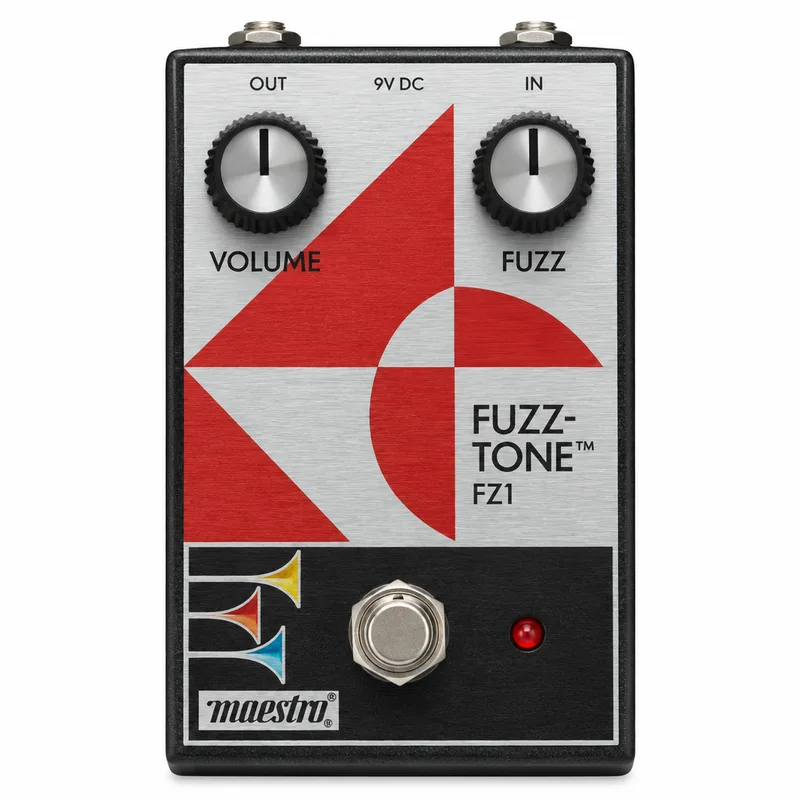
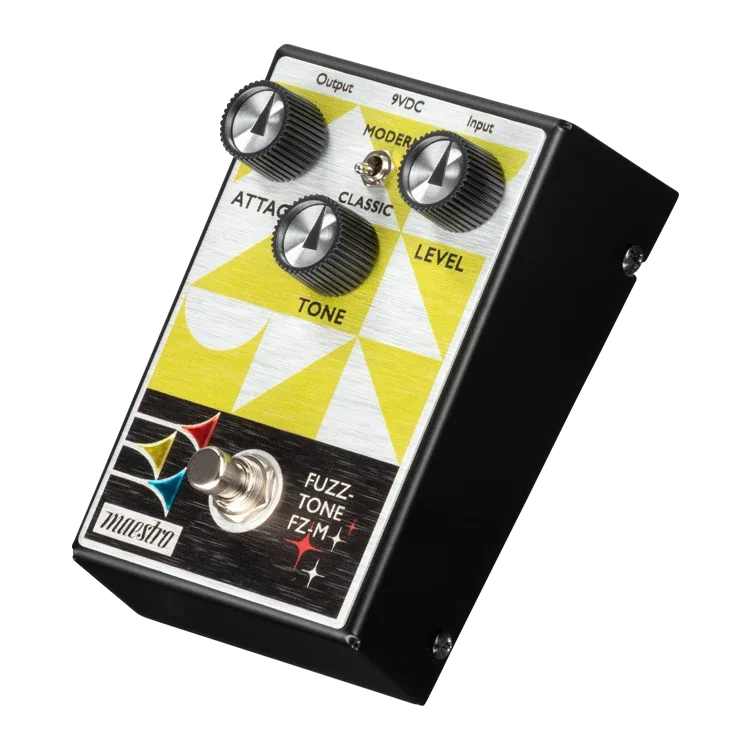
The FZ-1 is a vintage, discontinued pedal. Gibson revived the Maestro name in 2022 with the Maestro Fuzz-Tone FZ-M, a modern pedal inspired by the original, but the 1960s FZ-1 units themselves are collector items.
The first commercially successful fuzz pedal
Gibson introduced the FZ-1 as the first mass-market fuzz pedal5. Guitar.com calls it "the first ever commercially successful stompbox," launched in 19624, and MusicRadar describes it as arguably the first commercially available distortion or fuzz pedal49. A 2005 Guitar Player retrospective dates its introduction to 196310, while most other histories place it in 1962101112.
The pedal's origins trace back to engineer Glenn Snoddy, who recreated a distorted bass tone from a failed mixing board channel strip on the Marty Robbins session for "Don't Worry"13. Snoddy worked out the details of the Fuzz-Tone with Revis Hobbs, and their patent application was filed on May 3, 19621.
Commercially, the pedal started slowly. Guitar.com notes that the floor pedal version was initially a commercial failure14. But dealers responded by snapping up all 5,000 units produced in 19621, and after Satisfaction hit in 1965, the FZ-1 became the first fuzz effect to gain widespread popularity1511. The germanium-driven box quickly made its way into the rigs of some of the most prominent guitar players of the time15.
Not every prominent player was sold on it. Roger Mayer recalled that Jimmy Page and Jeff Beck went up to a music shop in Shaftsbury Avenue to look at a Maestro FZ-1, but it didn't have enough sustain for them16:
"I think they went up to a music shop in Shaftsbury Avenue to have a look at a Maestro..."
History and versions
The FZ-1 line went through several redesigns over its first decade, each changing the transistors and power supply5.
| Version | Year | Transistors | Power | Notes |
|---|---|---|---|---|
| FZ-1 | 1962 | Three germanium | Two 1.5-volt batteries (3 volts) | Original wedge enclosure51 |
| FZ-1A | 1965 | Germanium, 2N2614 or 2N2613 | Single 1.5-volt battery | Same wedge-shaped enclosure511 |
| FZ-1B | 1968 | Silicon, two or four depending on date of manufacture | Nine-volt supply | Circuit by Robert Moog5 |
| FZ-1S Super-Fuzz | 1970s | Different circuit | Different design | Designed by Tom Oberheim58 |
The FZ-1 and FZ-1A used largely the same circuitry with three germanium transistors, and both carried controls for Volume and Attack1. The FZ-1A revision kept the familiar wedge-shaped enclosure but moved to a single 1.5-volt battery5. DIY builders note that PNP transistors with some leakage work best in FZ-1A builds, with SFT323 transistors verified in one build17.
In 1968 the design changed again: synthesizer engineer Robert Moog crafted a circuit using a nine-volt power supply that powered two or four silicon transistors, depending on the date of manufacture5. Then, in the 1970s, the FZ-1S Super-Fuzz updated the decade-old design with a different look and a distinctly different sound; it was designed by Tom Oberheim58.
Who used it
The player most associated with the FZ-1 is Keith Richards. He used a Maestro FZ-1 Fuzz-Tone on the Rolling Stones' "(I Can't Get No) Satisfaction" in 196518, originally for temporary sax tones on the demo, and ended up keeping the fuzzed riff7. MusicRadar's Jonathan Horsley wrote that Richards used it "to give his riff something that no riff had had before"18.
The FZ-1's low operating voltage is part of its character. Premier Guitar groups it with lower-voltage vintage fuzzes8, and the original ran on 3 volts from AA batteries8. That low headroom is one reason the pedal's attack and sustain differ from later nine-volt designs like the FZ-1B.
Did the Fuzz-Tone inspire the Tone Bender and Fuzz Face?
The FZ-1's influence runs through the two most famous British fuzzes. According to the Tone Bender's maker history, Gary Hurst's modifications of the FZ-1 led him to design his own circuit, which became the Tone Bender19. Delicious Audio adds that after the FZ-1's 1965 success, "the Fuzz Face and Tone Bender pedals would emerge, and fuzz claimed its place atop the pantheon of guitar effects"20.
"Soon the Fuzz Face and Tone Bender pedals would emerge, and fuzz claimed its place atop the pantheon of guitar effects."
For a player today, the FZ-1's legacy is available two ways: the 1990s FZ-1A reissue, now discontinued5, and Gibson's own 2022 FZ-M revival5.
Videos
pinstripedclips
Charlie Massacre
Soulman Vintage
Questions
What transistors are in the Maestro FZ-1?
The original FZ-1 used a three-germanium-transistor circuit powered by two 1.5-volt batteries. The 1965 FZ-1A kept three germanium transistors but moved to 2N2614 or 2N2613 types on a single 1.5-volt battery. The 1968 FZ-1B switched to silicon, using two or four transistors depending on the date of manufacture.
What is the difference between the FZ-1, FZ-1A and FZ-1B?
The FZ-1 (1962) ran three germanium transistors on two 1.5-volt batteries. The FZ-1A (1965) revised the circuit with 2N2614 or 2N2613 transistors on one 1.5-volt battery, in the same wedge-shaped enclosure. The FZ-1B (1968), designed by Robert Moog, used silicon transistors and a nine-volt supply.
What fuzz pedal was used on Satisfaction?
Keith Richards used a Maestro FZ-1 Fuzz-Tone on the Rolling Stones' (I Can't Get No) Satisfaction in 1965. He originally reached for it to fake saxophone tones on the demo and ended up keeping the fuzzed riff. The FZ-1 was the earliest germanium fuzz pedal, introduced in 1962.
Who invented the Maestro Fuzz-Tone?
Engineer Glenn Snoddy, who had recreated a distorted bass tone from a failed mixing board channel strip on a Marty Robbins session, worked out the details of the Fuzz-Tone with Revis Hobbs. Their patent application was filed on May 3, 1962, and Gibson launched the pedal under its Maestro brand.
Did the Fuzz-Tone inspire the Tone Bender and Fuzz Face?
Yes. Gary Hurst's modifications of the FZ-1 led him to design his own circuit, which became the Tone Bender. After the FZ-1's 1965 success, both the Fuzz Face and Tone Bender emerged, and fuzz took a central place among guitar effects.
Sources (20)
- Maestro Fuzz-Tone, Vintage Guitar magazine, 2015-12-08
- Maestro Comet Chorus Review, GuitarPlayer (www.guitarplayer.com), 2022-04-06
- Maestro FZ-M Fuzz-Tone Review, GuitarPlayer, 2022-04-06
- The Big Review: Maestro Original Collection pedals, Guitar.com, 2022-02-10
- The history and origins of the iconic Maestro FZ-1 Fuzz-Tone, Guitar World, 2021-10-20
- Crazy Tube Limelight Review, Premier Guitar, 2019-09-30
- Hear the oldest guitar effects pedal demo ever from 1962, MusicRadar, 2023-03-30
- Electro-Harmonix Bender Royale Review, Premier Guitar, 2026-02-22
- Jimmy Page talks about Roger Mayer bringing the distortion pedal into his life, MusicRadar, 2019-09-19
- FUZ-1 | Guitar Player (October 2005) | Demeter Amplification, Guitar Player, 2005-10
- BALTIC BLUE FUZZ (OC-BBFn), One Control USA
- Five Rare British Vintage Fuzzboxes (That Aren't Tone Benders or Fuzz Faces!), GuitarPlayer, 2021-08-31
- Interview: "It's arguably the first guitar effects pedal ever", MusicRadar, 2022-02-21
- All About… Fuzz, Guitar.com, 2015-08-27
- The legendary Maestro Fuzz-Tone appears poised to make a comeback in 2022, Guitar.com, 2022-01-06
- Roger Mayer on making effects for Page, Beck and Hendrix, Guitar Player (www.guitarplayer.com), 2025-07-21
- Guitar FX Layouts: Maestro Fuzz Tone FZ-1A, Guitar FX Layouts (tagboardeffects.blogspot.com), 2015-08-29
- Electro-Harmonix adds beef to the Keef with the expanded Satisfaction Plus fuzz debuting an all-new Fat mode, MusicRadar, 2023-04-28
- Tone Bender History, britishpedalcompany.com
- The Best Maestro FZ-1 Fuzz Tone Clones & Evolutions In 2023, Delicious Audio, 2023-05-15
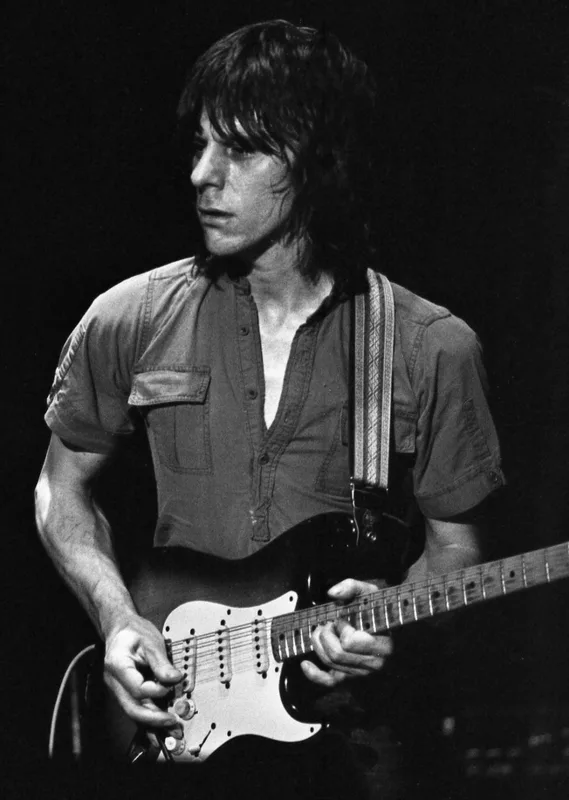 Jeff Beck
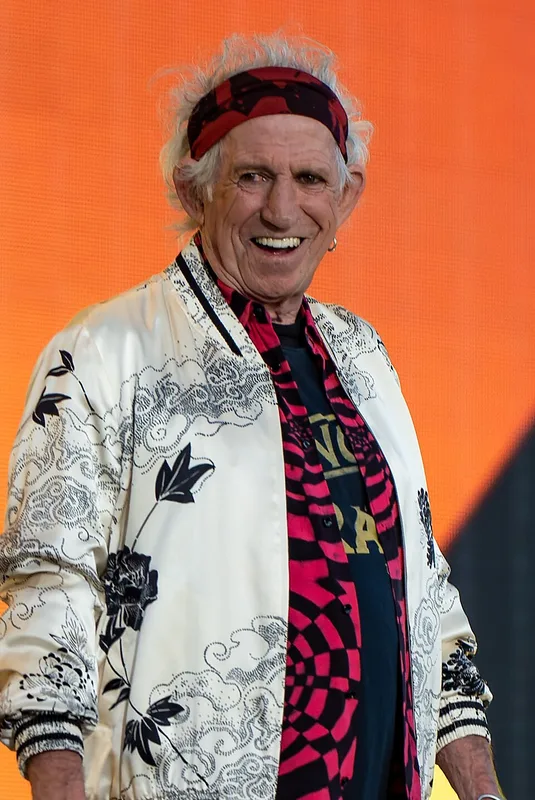 Keith Richards