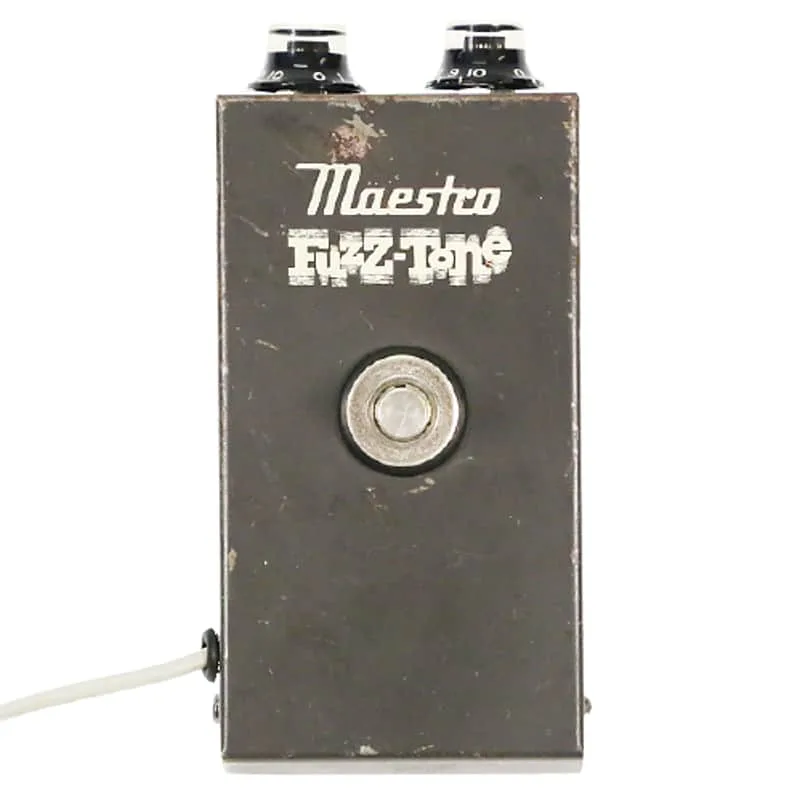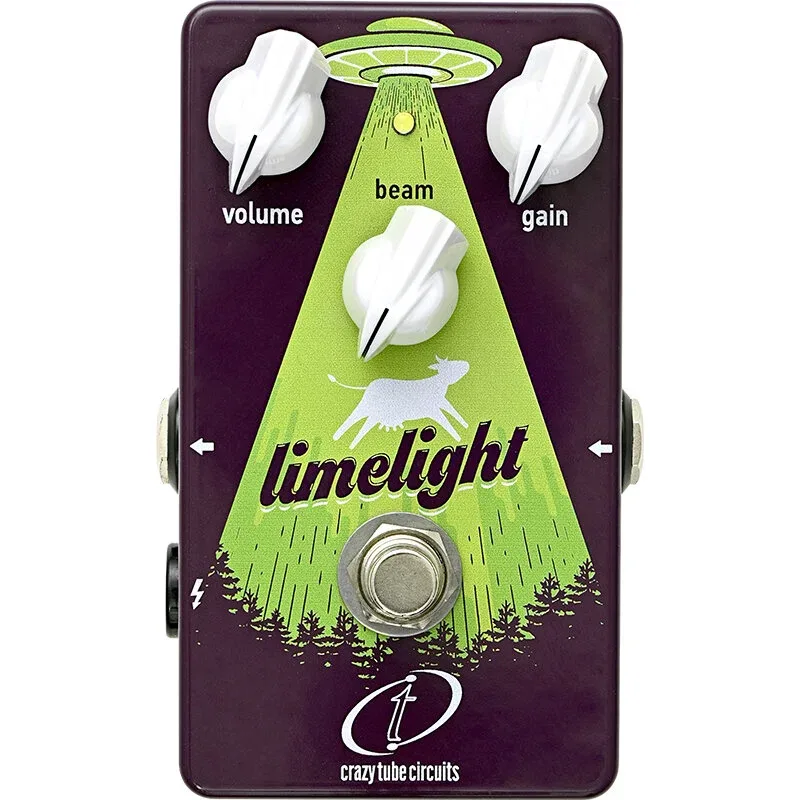


The Crazy Tube Limelight is a fuzz / distortion pedal from Greek maker Crazy Tube Circuits, designed and built in Athens, Greece12. It is an original circuit that pays tribute to the first commercially available fuzz, the Maestro FZ-1 Fuzz-Tone, and its British derivatives, though Crazy Tubes says it is not an FZ-1 clone13.
What the Limelight does with that inspiration is what sets it apart. Premier Guitar's reviewer found that it "captures the honking voice of an FZ-1, give[s] it more body and gain, extend[s] its range in low gai[n]," and can also be stripped back to the FZ-1's ragged essence1. Where the original FZ-1 was a lower-voltage vintage fuzz, the Limelight extends the formula with a bias control that opens up what MusicRadar called "virtually limitless" fuzz varieties4.
A Maestro FZ-1-inspired fuzz with more body
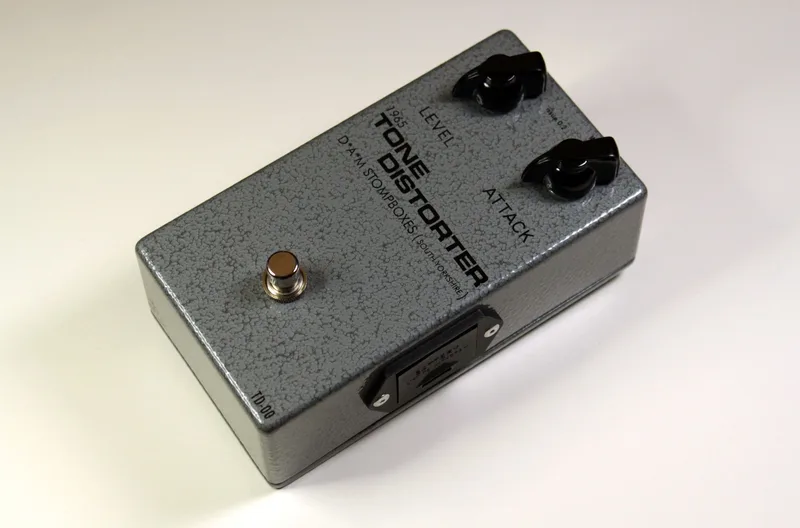
The Maestro FZ-1 Fuzz-Tone occupies a foundational place in fuzz history. In a MusicRadar interview on the Maestro line, Craig Hockenberry noted its circuit lineage: "Obviously, the Tone Bender and Fuzz Face, but there were so many others that followed suit" in the mid-'60s6. The Limelight sits squarely in that family tree: gearnews reported at launch that its circuits "are based on US-built fuzz pedals like the Gibson Maestro FZ-1, which inspired later British designs like the Tone Benders"2.
The Limelight is not a reproduction, though. Delicious Audio described it as "an original circuit devised as a tribute to the early fuzz circuits, its British derivatives and their offsprings," and not a part-for-part clone3. In practice, that means the pedal keeps the fizz and buzz of an FZ-1 while adding gain, range, and body the original did not have1.
Premier Guitar's verdict on the result:
"Awesomely enhanced, extended, and expanded variations on Maestro FZ-1 tones. Very cool clean-to-low-gain capabilities."
The controls: volume, gain and beam
The Limelight keeps its panel deliberately vintage. Three controls do the work:
| Control | What it does |
|---|---|
| Volume | Output level, styled after vintage Maestro, early Tone Bender, and Fuzz Face controls1 |
| Gain | More gain and range than an FZ-1, yielding more sustain at hotter settings while retaining much of the FZ-1's fizz and buzz1 |
| Beam | A bias control that starves the circuit of voltage counterclockwise and increases voltage clockwise1 |
The volume and gain controls "mimic what you'd see on a vintage Maestro, or an early Tone Bender or Fuzz Face," as Premier Guitar put it, so players familiar with those boxes will feel at home immediately1. The gain control is where the Limelight pulls ahead of its inspiration: it has "way more gain and range here," with more sustain available at hotter settings than an FZ-1 could deliver1.
What the beam control does
The Beam control is the Limelight's signature feature, and it is what gives the pedal its range. It is a bias control: turned counterclockwise it starves the circuit of voltage, and turned clockwise it increases the voltage feeding the transistors1.
Guitar.com explained what that means in practice: the Beam "takes the pedal from 'nasty gated fuzz up to MKI/II-style fuzz distortion'" by modifying the transistors7. Delicious Audio described the same sweep as morphing "from nasty 'satisfaction' gated fuzz up to mkI / II style fuzz distortion"3. In other words, one knob spans the whole history of early fuzz, from sputtering, gate-out "Satisfaction"-style tones at one end to smoother, fuller Tone Bender MKI/II-style fuzz at the other.
The Beam control also unlocks a second trick. By setting the Gain control to a minimum and diming the Beam control, you achieve a thick, clean boost7, which puts the Limelight in reach of boost duties as well as fuzz.
Low-gain and overdrive territory
The Limelight is not only a full-on fuzz box. Premier Guitar's reviewer found that "when you use high volume settings and the lowest possible gain settings, the pedal takes on the qualities of a growly ge[rmanium overdrive]," one that stays responsive to guitar tone and volume attenuation1. That makes it usable for overdrive sounds rather than fuzz alone, and it is the basis of the maker's low-gain boost feature noted at launch7.
History and versions
The Limelight was announced in March 2019 as a new vintage-voiced fuzz pedal with modern implementation from the Greek company84. Guitar World's launch coverage highlighted its NOS germanium transistors8, and MusicRadar reported it available at launch for €1894.
Since then, the pedal has remained part of the Crazy Tube Circuits lineup, with the maker's store listing a B-Stock variant as of October 20265.
As of October 2026, the maker's store lists the B-Stock Limelight (original price €179.00, sale price €139.00) as sold out, so it cannot be bought directly from Crazy Tube Circuits at present5.
Videos
Premier Guitar
R.J. Ronquillo
JayLeonardJ
Questions
Where is the Crazy Tube Limelight made?
The Limelight is designed and built in Athens, Greece, by Crazy Tube Circuits. The Greek company has been active with new designs for years, and the Limelight is one of its vintage-voiced offerings alongside pedals like the Constellation and Memphis.
How much does the Crazy Tube Limelight cost?
At its 2019 launch the Limelight sold for 189 euros. Premier Guitar listed its street price as $209 in its 2023 review. As of October 2026 the maker's site shows a B-Stock unit at an original price of 179 euros, marked down to 139 euros, though that unit is sold out.
Can the Limelight do low-gain overdrive sounds?
Yes. Premier Guitar's reviewer found that with the volume high and the gain at its lowest setting, the pedal takes on the qualities of a growly germanium overdrive, responsive to guitar tone and volume knobs. The maker also notes a low-gain boost capability, and a thick clean boost is possible with gain at minimum and the Beam control dimed.
Is the Crazy Tube Limelight still available?
As of October 2026 the maker's store lists a B-Stock Limelight as sold out, so the pedal cannot be bought directly from Crazy Tube Circuits at present. Players looking for one may need to check retailers or the secondhand market.
Sources (8)
- Crazy Tube Limelight Review, Premier Guitar, 2019-09-30
- Crazy Tubes Circuits Limelight pedal: Vintage fuzz tones beamed to the future, gearnews.com, 2019-03-11
- Crazy Tube Circuits Limelight Fuzz/Distortion, Delicious Audio, 2020-07-05
- Crazy Tube Circuits steps into the Limelight with new vintage-voiced fuzz pedal, MusicRadar, 2019-03-11
- Limelight (B-Stock), Crazy Tube Circuits
- Interview: "It's arguably the first guitar effects pedal ever", MusicRadar, 2022-02-21
- Crazy Tube Circuits launches Limelight fuzz pedal, Guitar.com, 2019-03-12
- Crazy Tube Circuits Announces New Limelight Fuzz Pedal, Guitar World, 2019-03-11