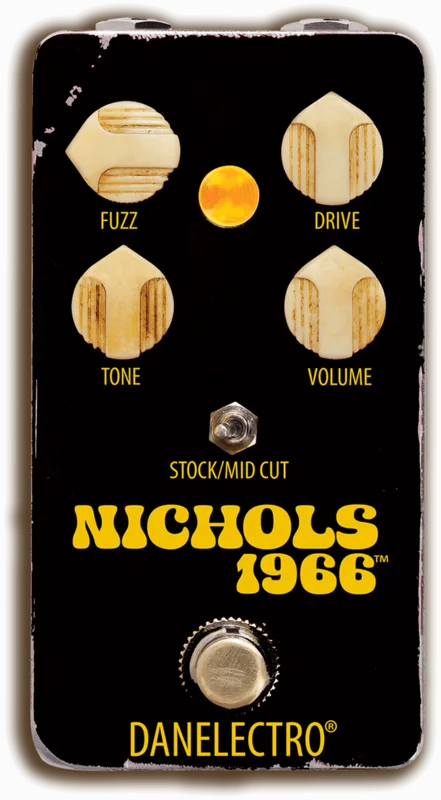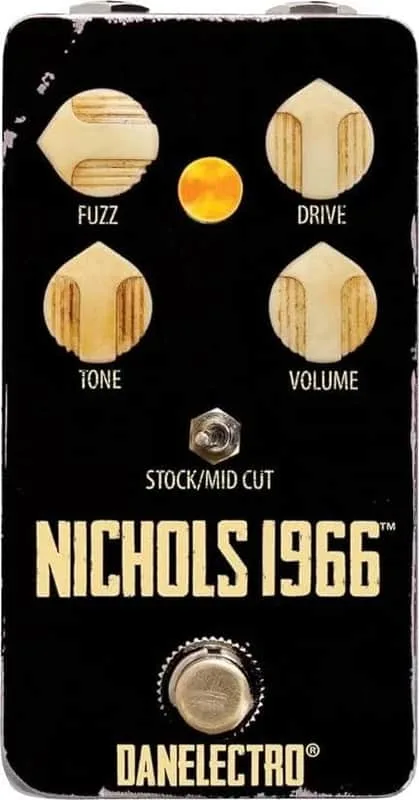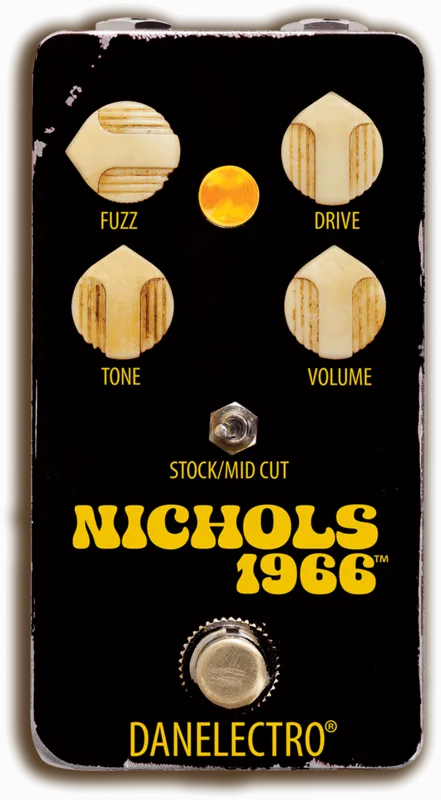


The Danelectro Nichols 1966 Fuzz Drive is a fuzz pedal that blurs the lines between fuzz and overdrive. Released by Danelectro in 2024, it is a modern re-creation of the very first circuit created by Steve Ridinger, the founder of the FOXX pedal line and Danelectro's current owner, built from a homemade pedal he made in 1966123. Where most fuzz pedals copy a known classic, this one revives a design that never had a wide release the first time around, which gives it a voice of its own2.
The pedal uses a three-transistor circuit that Danelectro's documentation says delivers a dynamic range of tones, from subtle overdrive to saturated fuzz4. Reviewers placed its character squarely between the two categories: Pedal of the Day described a distinctive "glass-shattering" sound that falls somewhere between a fuzz and a distortion, and one that is highly reactive to the guitar's volume knob3.
Between a fuzz and a distortion
The Nichols 1966 does not sit cleanly in either the fuzz or distortion camp. Gearnews described it as straddling somewhere between a fuzz and a distortion, depending on where the controls are set2. Danelectro's own build documentation calls it a distinctive fuzz pedal that blurs the lines between fuzz and overdrive, offering a versatile palette from subtle overdrive to saturated fuzz4.
That in-between character comes from the interactive Fuzz and Drive knobs. Because the two controls affect each other, the same pedal can be dialed toward a softer overdrive voice or pushed into full saturation. GuitarPlayer's reviewer Art Thompson found that a blend of the two distortion types best suited his ears, and recommended starting with the fuzz and drive controls about halfway up and taking it from there6.
Pedal of the Day's review went further on the pedal's character, calling it a box that "dishes out delicious tones unlike those of any pedal ever made" and recommending it for players looking for something non-traditional and intriguing3. The same review noted the sound is highly reactive to the guitar's volume knob, so rolling back the volume at the guitar changes the pedal's response, a behavior players usually associate with vintage germanium fuzz designs3.
Controls and the Mid Cut switch
The control layout is four knobs plus one toggle:
| Control | What it does |
|---|---|
| Fuzz | Sets the fuzz side of the interactive Fuzz/Drive pair2 |
| Drive | Sets the drive side; interacts with the Fuzz knob27 |
| Tone | Conventional tone control23 |
| Volume | Output level23 |
| Stock/Mid Cut toggle | Selects the stock voicing or a scooped midrange24 |
The Stock/Mid Cut switch is the one control that goes beyond the standard set. Danelectro's documentation says the Mid Cut position provides additional tonal shaping, allowing for a scooped midrange response4. Delicious Audio described it as a switch for added sonic flexibility7. A scooped midrange pushes the pedal's energy toward the lows and highs, which can suit rhythm parts or amps that already emphasize mids.
Because the Fuzz and Drive knobs are interactive, settings on one change the effect of the other. Thompson's advice of starting both around halfway and adjusting from there is a practical way to hear how the two sides of the circuit trade off6.
Steve Ridinger's first pedal design
The story behind the Nichols 1966 goes back to the mid-1960s. Steve Ridinger, who later created the FOXX pedal line in the 1970s and now owns Danelectro, lived with his parents in a home on Nichols Canyon Place28. It was in the garage of that home that he created his first effects pedal, which he named the Liverpool Fuzz Tone1. The modern pedal takes its name, Nichols 1966, from that canyon address2.
The timeline of Ridinger's designs, as the press tells it:
- 1966: Ridinger designs the Liverpool Fuzz Tone, his first pedal, in the garage on Nichols Canyon Place15
- 1970s: Ridinger creates the FOXX pedal line, including the Foxx Tone Machine85
- 2024: Danelectro re-creates the 1966 circuit as the Nichols 1966, shown new at NAMM1
Pedal of the Day reported that the reissue was meticulously crafted under the direction of Steve himself3. GuitarPlayer's Art Thompson framed the pedal simply as a reissue of Steve Ridinger's own original-design dirt pedal6.
One naming point matters for anyone searching for the old circuit: the original was the Liverpool Fuzz Tone, and Gearnews noted the pedal was originally named the Liverpool Fuzz when first released2. Danelectro states plainly that it is not affiliated with any current owners of Liverpool or Fuzz Tone trademarks, which explains the change to the Nichols 1966 name1.
The Nichols 1966 is a separate pedal from the Danelectro Nichols 66, another revised version of the same 1966 Liverpool Fuzz Tone circuit that Danelectro unveiled in February 2024. Both trace back to the same original design.
What reviewers said
Published reactions to the Nichols 1966 have been positive about its versatility and distinctiveness236:
- Gearnews found the demo videos all sounded pretty good, and that the pedal comes across as a lot more than a one-trick pony2
- The same review noted it appears to have a pretty distinct drive tone and one that sounds pretty versatile2
- Gearnews also made the point that separates this pedal from most fuzz reissues: because the original circuit never circulated widely, it has a unique voice, rather than being a take on another classic fuzz design2
- Pedal of the Day called it an incredible box with tones unlike those of any pedal ever made, aimed at players looking for something non-traditional3
- GuitarPlayer's Art Thompson found that a blend of fuzz and drive character, with both knobs about halfway up, best suited his ears6
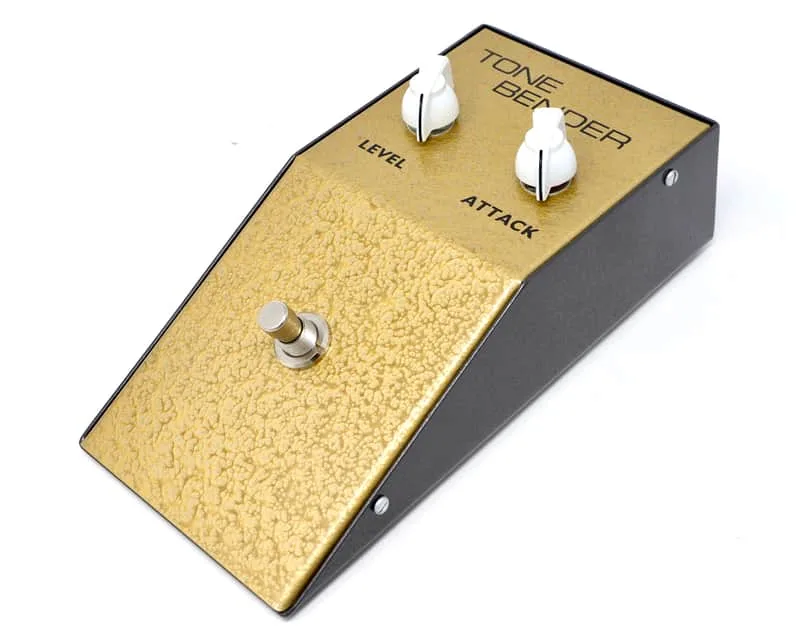
The common thread is that reviewers heard a pedal that does not clone a familiar circuit. For players comparing fuzzes, that is the practical difference: the Nichols 1966 is not another Fuzz Face, Tone Bender, or Big Muff variant, but its own 1966 design brought forward2.
Videos
Premier Guitar
Guitar World
Soul String
Questions
Was the Danelectro Nichols 1966 called the Liverpool Fuzz?
The circuit behind it was. Steve Ridinger built his first effects pedal in 1966 and named it the Liverpool Fuzz Tone, after the garage workshop on Nichols Canyon Place where he lived with his parents. The modern pedal is named Nichols 1966 after that location, and Danelectro notes it is not affiliated with any current owners of Liverpool or Fuzz Tone trademarks.
Who designed the Danelectro Nichols 1966 Fuzz Drive?
The original circuit was designed by Steve Ridinger in 1966. Ridinger went on to create the FOXX pedal line in the 1970s and is the current owner of Danelectro. The Nichols 1966 reissue was crafted under his direction.
What does the Stock/Mid Cut switch do?
The toggle switch selects between the stock voicing and a mid-cut setting. The Mid Cut position provides additional tonal shaping and allows for a scooped midrange response, which can help the pedal sit differently in a mix or suit darker amps.
How do the Fuzz and Drive knobs interact?
The Fuzz and Drive knobs are interactive, so each one changes how the other behaves. GuitarPlayer's reviewer Art Thompson found it good to start with both about halfway up and adjust from there, since the pedal moves between fuzz and overdrive character depending on where the controls are set.
How many transistors are in the Nichols 1966?
Three. The Nichols 1966 uses a unique three-transistor circuit, which Danelectro's documentation says delivers a dynamic range of tones, from subtle overdrive to saturated fuzz.
How much does the Danelectro Nichols 1966 cost?
Guitar Pedal X listed the Nichols 1966 at $199 when it was released in 2024. Gearnews reported a Thomann preorder price of $136.00, or £124.00, in February 2024, so street and preorder pricing have differed.
Sources (8)
- Nichols 1966™, Danelectro (danelectro.com)
- Danelectro Nichols 1966 Fuzz Drive, gearnews.com, 2024-02-08
- Danelectro Nichols 1966 Distortion Fuzz, Pedal of the Day, 2024-04-21
- Danelectro-Nichols-1966-Build-Document.pdf, GuitarPCB, 2025-10
- Guitar Pedal X, Guitar Pedal X, 2024-01-30
- “The Nichols keeps the sounds of your guitars intact while running at distortion levels that you can control for lead and rhythm right from the guitar”: Danelectro Nichols 1966 review, GuitarPlayer, 2024-08-23
- Danelectro Nichols 1966 Fuzz, Delicious Audio, 2024-04-22
- Danelectro 3699 Fuzz review, Guitar World, 2020-09-09