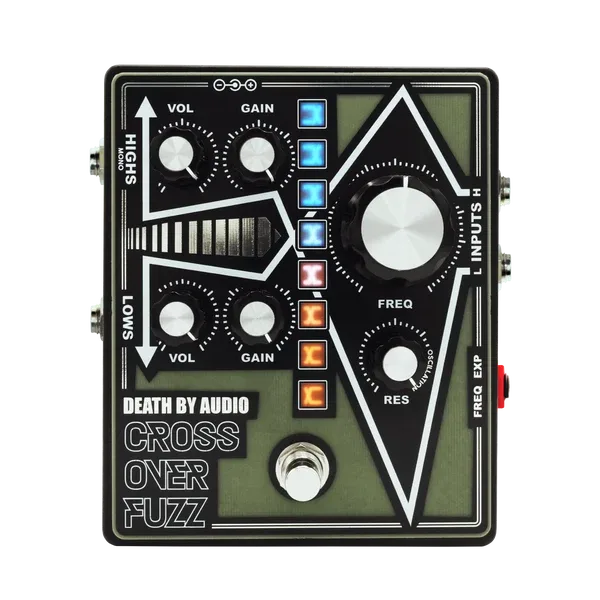


Where most fuzz pedals give you one sound for the whole guitar, the Crossover Fuzz lets you push the lows and highs in different directions, from clean to overdrive to what the maker calls "towering fuzz," and then pan, sweep or sum the two bands on their way out1. Pedal of the Day's reviewer found it "unlike any other fuzzy filter I've ever come across"2.
A fuzz that splits highs and lows
The core idea is the crossover: the pedal contains a low-pass filter and a high-pass filter, each with its own gain stage and output level. The low-pass band ranges from 30Hz to 7.6kHz and the high-pass band from 80Hz to 17kHz, so the two filters can meet anywhere across most of the audible guitar range1. Each band can then be driven from clean, through overdrive, into full fuzz independently1.
The controls are shared between the two bands:
| Control | What it does |
|---|---|
| FREQ | Frequency of the low-pass and high-pass filters; low-pass ranges 30Hz to 7.6kHz, high-pass 80Hz to 17kHz1 |
| RES | Resonance of the filters, from smooth to hyper focused to nasty oscillation1 |
| GAIN | Amount of gain going into each filter, from clean to overdrive to towering fuzz1 |
| VOL | Output level of each filter1 |
The RES control is where the pedal gets its character: at high settings the filters self-oscillate, which the maker suggests automating through the expression input for panning, filtering and stereo sweeps1. The enclosure is a rugged, tour-grade build1.
On an Andertons demo, presenters Oz and Pete walked through the layout: "we have two inputs, high and low," with two discrete separate circuits inside, meaning "you basically have two discrete separate circuits" that can serve a whole band, such as guitar to a guitar amp and bass to a bass amp4.
Mono and stereo routing
The pedal supports four routing configurations, which is what makes it more than a standard fuzz box1:
| Configuration | How to set it up | What happens |
|---|---|---|
| Mono | Plug into either INPUT H or INPUT L, connect the HIGHS MONO output | Both the low-pass and high-pass signals are summed into a single output1 |
| Mono to Stereo | Plug into either INPUT H or INPUT L, connect both the HIGHS and LOWS outputs | The signal splits into stereo: LOWS carries the low-pass signal, HIGHS carries the high-pass signal1 |
| Full Stereo | Use both inputs and both outputs | INPUT L routes to the LOW output, INPUT H routes to the HIGHS output1 |
| Stereo to Mono | Plug into INPUT H and INPUT L, connect the HIGHS MONO output | Both the low-pass and high-pass signals are summed1 |
The full stereo mode is the one that lets two instruments run through the pedal at once, each getting its own fuzzed and filtered output14. Death By Audio pitches the stereo compatibility as "massive spatial tone sculpting"1.
Expression and CV control
A side jack labeled FREQ EXP lets you control the filter frequency with an expression pedal or 0 to 5V external CV, modulating the crossover point in real time1. The FREQ knob sets the minimum frequency, and the expression wiring is tip to output, ring to 5V, sleeve to ground1. With the RES control pushed into oscillation, an expression pedal can sweep the filters dynamically while you play1.
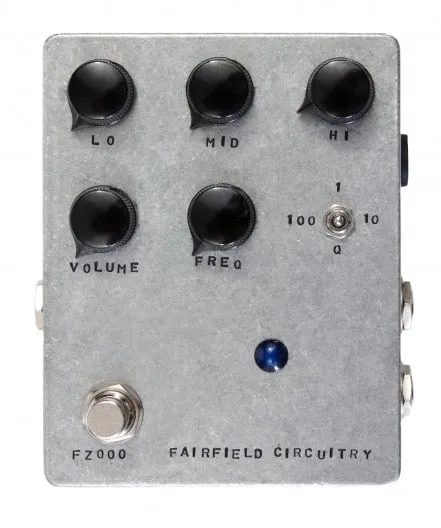
Expression control of a crossover fuzz is not unique to this pedal: the Fairfield Circuitry Four Eyes Crossover Fuzz also lets you control the interaction between its resonance and filter with an expression pedal, as Delicious Audio's Ed Gross noted in his review of that pedal5.
LED color sets
An internal switch, called the Light Switch, changes the color set of the LEDs that show what each band is doing1:
- Cyber Light: low-pass shows red, high-pass shows blue1
- Sky Light: low-pass shows yellow, high-pass shows cyan1
Price and where it is made
The Crossover Fuzz lists at $320.00 USD direct from Death By Audio1. At launch, Guitar Pedal X reported European pricing of €379 and UK pricing of £3293. Later UK press has listed it at £3696, while Guitar.com listed $320/£3297, so UK figures vary between sources. The pedal is hand-made in New York, USA3.
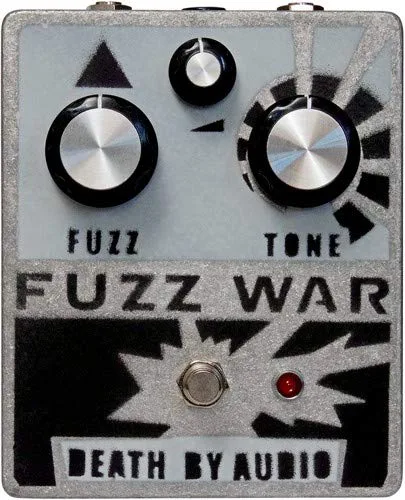
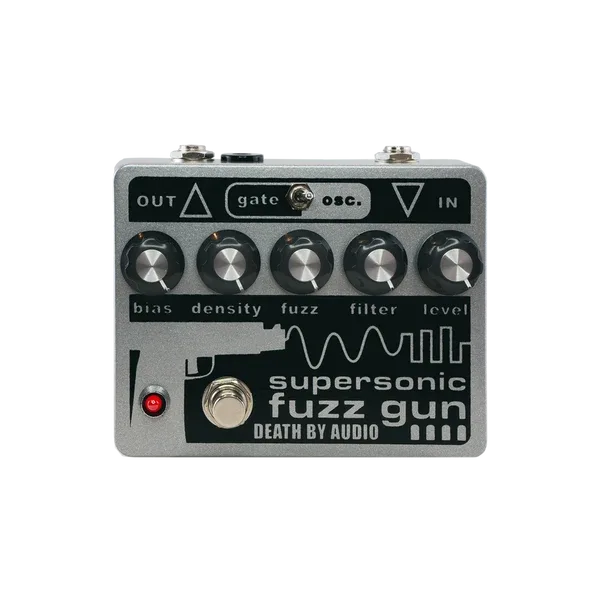
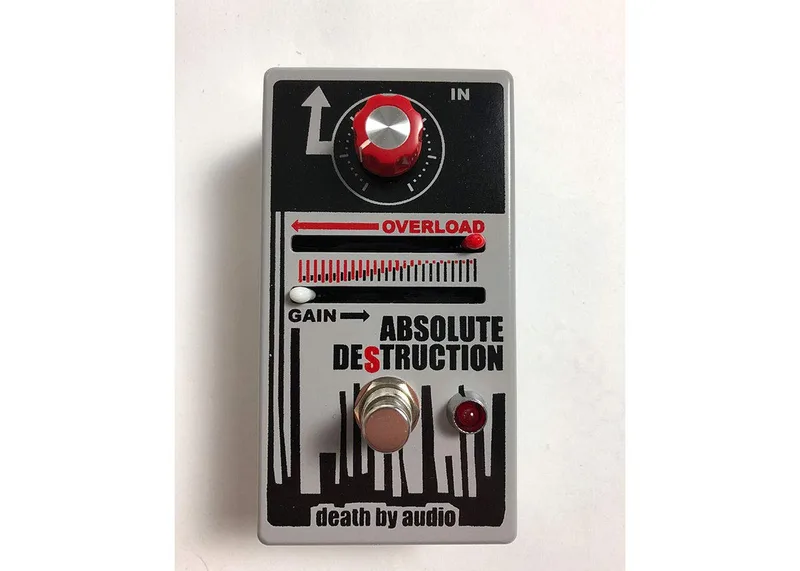
Within Death By Audio's fuzz lineup, the Crossover Fuzz sits alongside the Fuzz War, the Supersonic Fuzz Gun and the Absolute Destruction Fuzz, but its dual-band filter design and stereo routing set it apart from those single-path fuzzes1.
Videos
Death By Audio
Reverb
The Pedal Zone
News
Questions
Can a guitar and bass run through the Crossover Fuzz at the same time?
Yes. The pedal has two inputs, high and low, and two outputs, high and low, each feeding its own circuit. In the full stereo configuration you can send a guitar into one input and a bass into the other, with each instrument coming out of its own output, for example into a guitar amp and a bass amp.
Does the Crossover Fuzz work with an expression pedal?
Yes. A side jack labeled FREQ EXP accepts an expression pedal or 0 to 5V external CV to control the filter frequency in real time. The FREQ knob sets the minimum frequency, and the wiring is tip to output, ring to 5V, sleeve to ground.
How do you change the LED colors on the Crossover Fuzz?
An internal switch called the Light Switch changes the color set of the LEDs. The Cyber Light setting shows the low-pass band in red and the high-pass band in blue, while Sky Light shows the low-pass in yellow and the high-pass in cyan.
Where is the Death By Audio Crossover Fuzz made?
It is hand-made in New York, USA, by Death By Audio, the Brooklyn-based effects maker known for aggressive fuzz designs like the Fuzz War and the Supersonic Fuzz Gun.
How much does the Crossover Fuzz cost?
The list price is $320.00 USD direct from Death By Audio. UK and European pricing reported at launch was £329 and €379 respectively, with later UK press listing £369.
Sources (7)
- CROSSOVER FUZZ, Death By Audio
- Death By Audio Crossover Fuzz + Photo Modulator Expression Controller, Pedal of the Day, 2025-08-19
- Guitar Pedal X, Guitar Pedal X, 2025-08-20
- Death By Audio, Andertons Music Co, 2026-07-16
- Fairfield Circuitry Four Eyes Crossover Fuzz, Delicious Audio, 2011-01-26
- Kernom Moho Fuzz review, Guitar World, 2025-10-11
- Blue FX Devices Fuzz Fields review, Guitar.com, 2026-04-20