

For a player, that means two things a basic switching pedal cannot do: you can reorder your pedals from the floor without replugging anything, and you can run two effects side by side instead of one into the other. Guitar World's reviewer noted that parallel processing opens up textures such as simultaneous clean and distorted tones, dry guitar blended with reverb, or compression blended with the dry signal1.
What it does: series and parallel routing
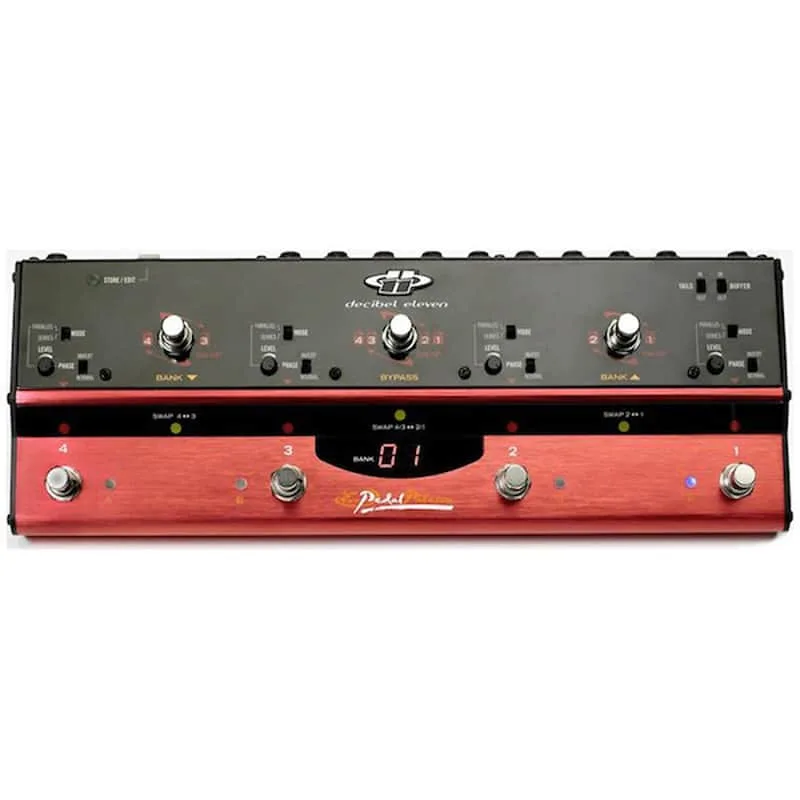
A conventional loop switcher puts each pedal either in the signal path or out of it, always in the same order. The Pedal Palette's routing matrix goes further: each of its four loops can be configured to pass the signal in series or in parallel, and each parallel loop has its own mix Level control so you can dial in how much of that effect blends against your dry signal3.
Guitar World's reviewer found this opens sounds that series-only boards cannot get:
"Parallel processing enables the creation of many useful and unusual effects, textures and colors, such as simultaneous clean and distorted tones from a single guitar."1
Each loop carries the same small control set:
| Control | What it does |
|---|---|
| Series/Parallel switch | Sets whether that loop passes signal in series or parallel1 |
| Level control | Dials in the blend for that loop1 |
| Phase-invert switch | Flips the phase of the loop's signal1 |
The phase-invert switch matters when running parallel paths: two effects summed together can cancel each other if one inverts phase, so being able to flip a loop back into alignment is part of what makes parallel blends work1.
The controls
The front panel is organized around two rows of footswitches and a Store/Edit button13.
Lower row, four footswitches. In Direct mode, each switch engages or disengages an individual loop. In Preset mode, they select one of four presets within the current bank1.
Upper row, three footswitches. In Direct mode, these swap the order of your pedals: the first switch from the right swaps Loop 1 and Loop 2, the third switch swaps Loop 3 and Loop 4, and the middle switch swaps the first two loops with the last two3. In Preset mode, the upper row selects banks and engages master bypass1.
Buffer and tails. There are in/out switches for the buffer circuit, and a tails function that lets delay and reverb tails continue ringing after a loop is switched out1. The buffer itself is an optional Class A discrete input buffer2.
Store/Edit button. Saving a preset is a short process, as MusicPlayers.com described it3:
- Enable the loops you want to use.
- Hold the Store/Edit button.
- Select a preset location.
- Hit the button again to write the preset3
The unit stores 128 presets in total, selectable from an external controller1.
The Pedal Palette was reviewed at launch in 2013 and is a product of that era; check current availability before planning a board around one.
Bypass, buffer and connections
The four loops use true-relay (hardwire/mechanical) bypassing, so pedals switched out of the chain are kept out of the signal path entirely1. That is the core appeal of any true-bypass loop-switching system: it cleans up and preserves your guitar's tone by keeping unused pedals and their cables from loading the signal1.
For long cable runs or pedal chains that need it, the optional Class A discrete input buffer can be switched in, with its own in/out switches on the front panel12. MusicPlayers.com tested the unit with pedals from Boss, Voodoo Lab, Morpheus and TC Electronic with the buffer engaged and reported no problems3.
Connections are straightforward: a master 1/4-inch mono input and output, four loops each with its own 1/4-inch send and return jacks, and a tuner output that sends the unprocessed guitar signal directly to a tuner1. Multiple Pedal Palettes can be synced with MIDI2.
Power
The Pedal Palette runs off 9V or 12V at 300mA3. That current draw is well above what a typical 9V battery or a small daisy-chain output supplies, so it needs a proper power supply.
At 300mA, this unit needs a dedicated power output; it is not a low-current pedal that can share a daisy chain with a handful of drives.
Where it came from and what reviewers said
Decibel Eleven introduced the Pedal Palette at NAMM 2013, in January 2013, describing it as the first fully analog loop bypass switcher, router and mixer2. Chris Hern, Decibel Eleven's vice president of product development, said of the design:
"We developed the Pedal Palette to allow guitar players to create inspirational new sounds from their existing pedals."2
Guitar World reviewed it in its November 2013 issue and was positive, concluding that despite the sophisticated routing and output capabilities, it stayed simple to operate:
"Although the Pedal Palette provides very sophisticated routing and output capabilities, it's as easy to use as a basic loop switcher."1
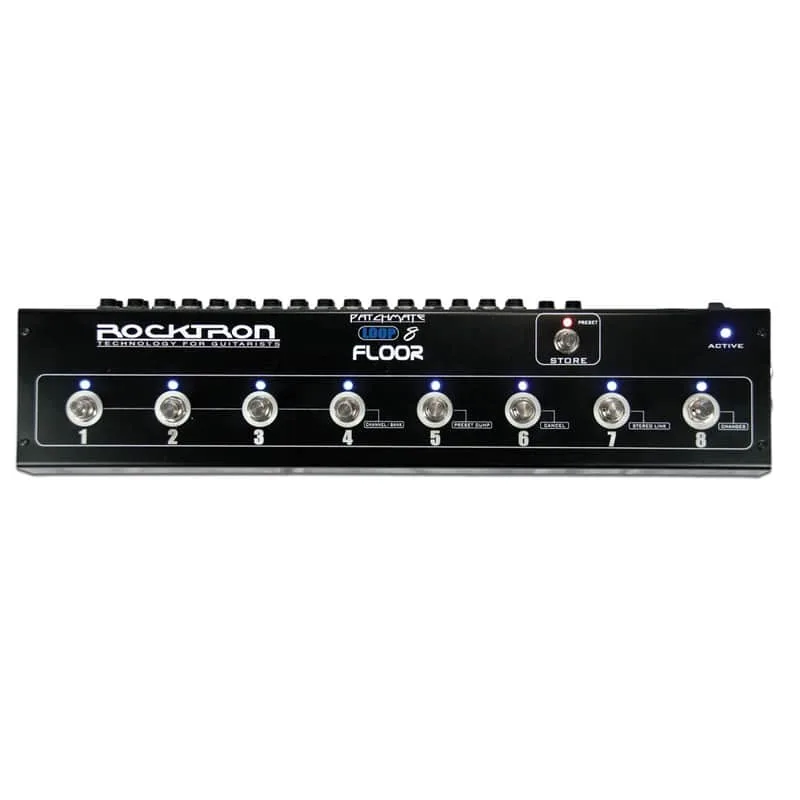
MusicPlayers.com placed it in a unique position in the floor-based looping category, comparing it against the Rocktron Patchmate Loop 8 Floor, Carl Martin Octa-Switch Mk II, Voodoo Lab Pedal Switcher and One Control Crocodile Tail Loop3. Its differentiator against those units is the parallel routing and per-loop blend, which the others do not offer in the same way.
The unit is housed in a rugged metal enclosure with Carling-style switches3. At launch it carried an MSRP of $560 and sold for approximately $4003; Guitar World listed its street price as $3991.
Videos
Premier Guitar
DecibelEleven
Best Guitar Effects
Questions
Is the Decibel Eleven Pedal Palette true bypass?
Yes. Its four effects loops use true-relay (hardwire/mechanical) bypassing, so pedals that are switched out of the chain are kept completely out of the signal path. The unit also includes an optional Class A discrete input buffer you can switch in or out as needed.
How many presets does the Pedal Palette store?
It stores 128 presets, which you can select with an external MIDI controller. In Preset mode, the lower row of four footswitches picks one of four presets in the current bank, and the upper row selects banks and engages master bypass.
Can you change pedal order on the Pedal Palette?
Yes. In Direct mode, the upper row of three footswitches swaps the order of your pedals: one switch swaps Loops 1 and 2, another swaps Loops 3 and 4, and the middle one swaps the first two loops with the last two. Pedal order can also be saved into presets.
Can two Pedal Palettes be linked with MIDI?
Yes. Decibel Eleven says you can sync multiple Pedal Palettes with MIDI, which lets a larger board share routing and preset changes across units. An external MIDI controller can also be used to select any of the 128 presets.
Does the Pedal Palette have a tuner output?
Yes. Alongside the master 1/4-inch mono input and output jacks, there is a tuner output that sends the unprocessed guitar signal directly to a tuner, so you can tune silently without the tuner loading down your main signal path.
Sources (3)
- Review: Decibel Eleven Pedal Pallette, Guitar World, 2013-09-23
- NAMM 2013: Decibel Eleven Introduces Pedal Palette Analog Loop Bypass Switcher, Router and Mixer, Guitar World, 2013-02-07
- Decibel Eleven Pedal Palette, MusicPlayers.com, 2013-09-13