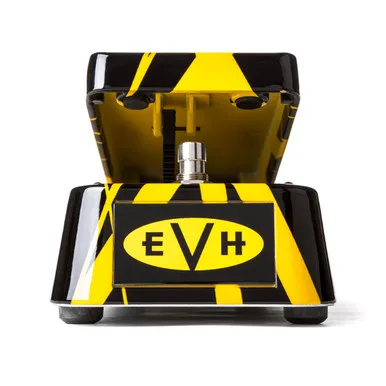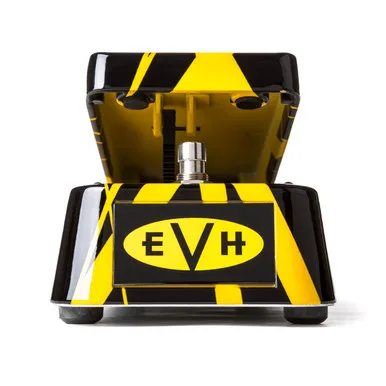


The Dunlop EVH-95 Eddie Van Halen Signature Wah Wah is a wah pedal from Dunlop's Cry Baby line, developed in what Dunlop describes as "intensive design collaboration with the legendary guitarist, Eddie Van Halen"12. Rather than a stock Cry Baby circuit, it is modeled on Eddie's own "Holy Grail" Cry Baby, a standard Cry Baby he had customized in the early Nineties with a more vocal-like, high Q inductor and a wider frequency sweep2.
Dunlop says the pedal reproduces the original through clones of the worn-in pot and hand-selected inductor from Eddie's pedal, giving the EVH-95 what the company calls the same "Holy Grail" feel and tone12. Dunlop's buying guide characterizes the result as a wide sweep with aggressive midrange3.
The Holy Grail Cry Baby
The starting point for the EVH-95 is a single pedal. Dunlop's account of the development says that early in the process, Eddie handed over his "Holy Grail" Cry Baby, a standard Cry Baby customized in the early Nineties12. The manual adds the detail that matters to players: the customization was a more vocal-like, high Q inductor and a wider frequency sweep2. A high Q inductor makes the wah's peak more pronounced, which is what players mean when they describe a wah as vocal.
Dunlop's approach was to copy the parts that gave that pedal its character. The manual states12:
"Our clones of the worn-in pot and hand-selected inductor give the new EVH Wah Wah the same 'Holy Grail' feel and tone."
The worn-in pot matters because a wah's treadle sweeps a potentiometer, and an older, worn pot can feel and respond differently from a new one. Cloning it, along with the hand-selected inductor, is how the EVH-95 carries over the original's behavior12.
Controls, connections and power
The EVH-95 is operated like a traditional Cry Baby. Per the manual, you turn it on and off by pushing the toe of the pedal down until you feel a click, and an illuminated blue LED indicates the pedal is on2. Dunlop's product page describes dual bright blue bypass LEDs1, and the buying guide lists two on/off status LEDs among the pedal's features3.
Setup is straightforward: a shielded instrument cable runs from the guitar to the EVH-95's Instrument jack, and another shielded cable runs from the Amplifier jack to the amplifier input2.
Power comes from one 9-volt battery accessed through the bottom of the pedal, a Dunlop ECB-003 AC adapter (the ECB-003E in Europe), or a Dunlop DCB-10 DC Brick power supply2. Dunlop's product page also lists the Iso-Brick and Mini Iso-Brick supplies as compatible1. The adapter input is 9V DC, center negative, with a current draw of 2mA42.
The 2mA draw is low enough that the EVH-95 is easy to power from nearly any isolated supply or even a daisy chain, but it uses a center negative plug, so check polarity before plugging in a non-Dunlop adapter.
Filter range and gain
The manual's specifications describe the sweep in terms of the filter's adjustable range and the gain the pedal adds at each end of the treadle's travel2.
| Specification | Value |
|---|---|
| Low Pass (heel down range) | 300Hz to 380Hz |
| High Pass (toe down range) | 1.9kHz to 2.3kHz |
| Maximum Gain (heel down) | +20dB at 300Hz to 380Hz |
| Maximum Gain (toe down) | +21dB at 1.9kHz to 2.3kHz |
| Maximum Input Level | -13.5dBV at the filter's center frequency |
| Maximum Output Level | +6.5dBV |
| Input Impedance | 800K |
| Output Impedance | 10K |
| Signal to Noise | Heel down >97dBV, toe down >87dBV, 'A' weighted |
The gain figures show that the EVH-95 is not a flat filter: it boosts the frequencies it emphasizes, by about 20dB at the low end of the sweep and 21dB at the top2. That boost, combined with the wide sweep Dunlop describes, is part of why the buying guide calls out aggressive midrange3.
How it differs from a standard Cry Baby
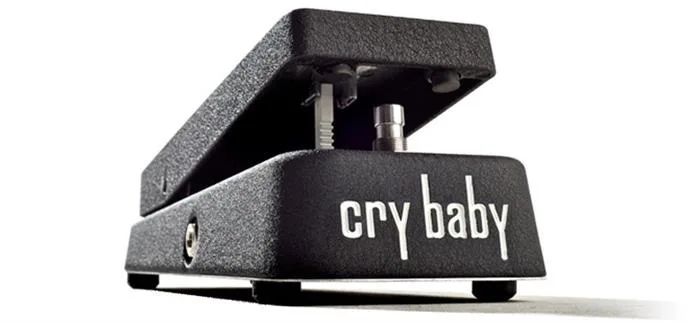
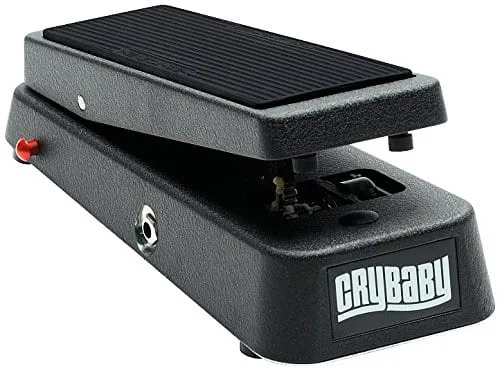
Against a stock Cry Baby such as the GCB95, the differences are the circuit's origin and its dress. The EVH-95 is built around the cloned pot and inductor from Eddie's customized pedal rather than standard Cry Baby parts, with an extra wide frequency sweep12. It carries true hardwire bypass12, dual blue on/off LEDs13, and graphics based on the black and yellow-striped guitar featured on Van Halen II1.
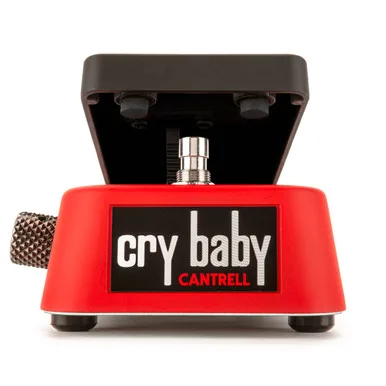
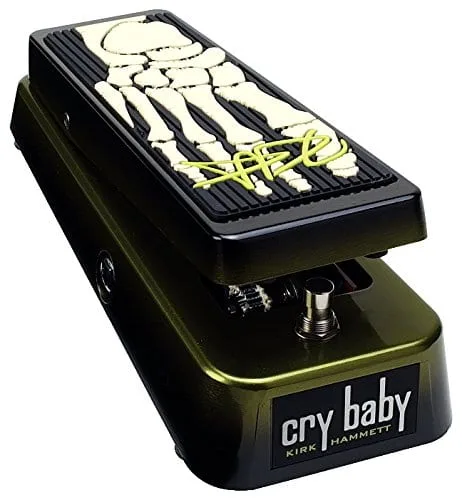
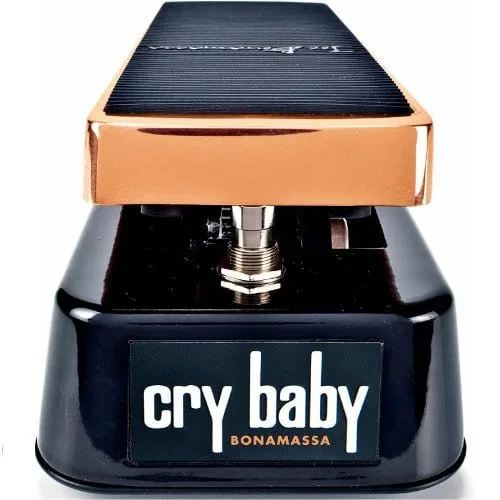
Dunlop's buying guide places it in the signature tier of the Cry Baby range, alongside models such as the 95Q, the Kirk Hammett Cry Baby and the Joe Bonamassa Cry Baby, each voiced to its player's own pedal3.
Where it came from
The EVH-95 followed Eddie Van Halen's earlier signature pedals with Dunlop. MusicRadar reported in 2008 that the wah came after his signature Phase 90 and Flanger pedals from Dunlop's MXR stable, calling it "the latest piece of gear to bear the guitarist's name"5. EVH is a registered trademark of E.L.V.H., Inc., used under license2.
The pedal has since been used in the family: in Premier Guitar's rig rundown of Mammoth WVH, the Dunlop EVH95 Eddie Van Halen Signature EVH Cry Baby is worked out for the solo of "You'll Be the One," standing in for the recorded talk box solo6.
Videos
Sweetwater
jimdunlopusa
Hollywood Rare Guitars
Questions
Is the Dunlop EVH-95 true bypass?
Yes. Dunlop lists the EVH-95 with true hardwire bypass, and the manual's specifications confirm a true hard wired bypass. When the pedal is off, the signal passes through without the wah circuit loading it down.
Does the EVH-95 take a battery?
Yes. The manual says the EVH Wah Wah can be powered by one 9-volt battery, accessed via the bottom of the pedal. It can also run from a Dunlop ECB-003 AC adapter, the ECB-003E in Europe, or a Dunlop DCB-10 DC Brick power supply.
What is the Holy Grail wah?
It is Eddie Van Halen's own standard Cry Baby, customized in the early Nineties with a more vocal-like, high Q inductor and a wider frequency sweep. Eddie handed the pedal to Dunlop during development of the EVH-95, and Dunlop cloned its worn-in pot and hand-selected inductor.
What color is the LED on the EVH-95?
Blue. The manual says an illuminated blue LED indicates the pedal is on, and Dunlop's product page describes dual bright blue bypass LEDs. The pedal carries two on/off status LEDs.
What power supply does the EVH-95 use?
It runs on 9V DC, center negative, drawing about 2mA. Dunlop names the ECB-003 9-volt adapter (ECB-003E in Europe) and the DC Brick, Iso-Brick and Mini Iso-Brick supplies as compatible, alongside a 9-volt battery.
How is the EVH-95 different from a standard Cry Baby?
It is based on Eddie Van Halen's customized 'Holy Grail' Cry Baby rather than a stock circuit, with clones of that pedal's worn-in pot and hand-selected inductor, an extra wide frequency sweep, true hardwire bypass, dual blue LEDs, and graphics based on the black and yellow-striped guitar from Van Halen II.
Sources (6)
- CRY BABY® EVH® WAH, Dunlop (jimdunlop.com)
- EVH95, Dunlop Manufacturing, Inc., 2019
- RANGE OF EXPRESSION: FIND YOUR CRY BABY® WAH, Dunlop (lifestyle.jimdunlop.com), 2021-10-08
- EVH95 EVH Wah by Dunlop, RockBoard (PedalPedia), 2026
- Jim Dunlop EVH Signature wah, MusicRadar, 2008-03-04
- Mammoth WVH Wolf Van Halen Guitar Rig Rundown, Premier Guitar, 2022-06-01