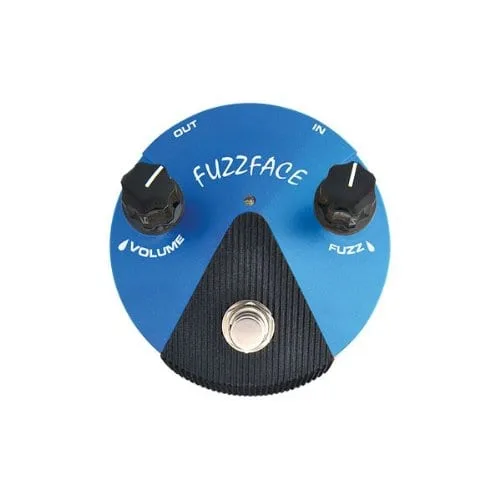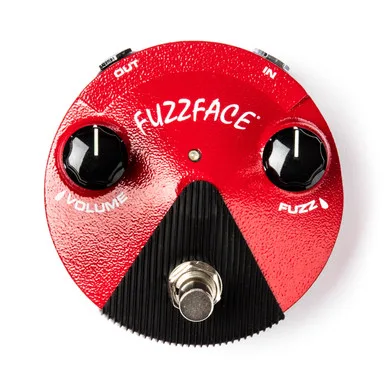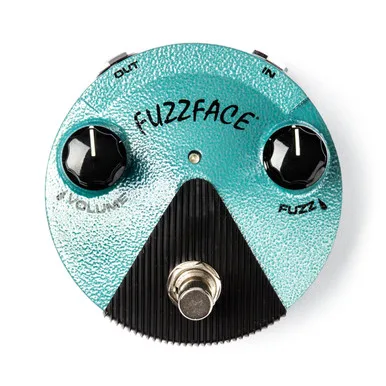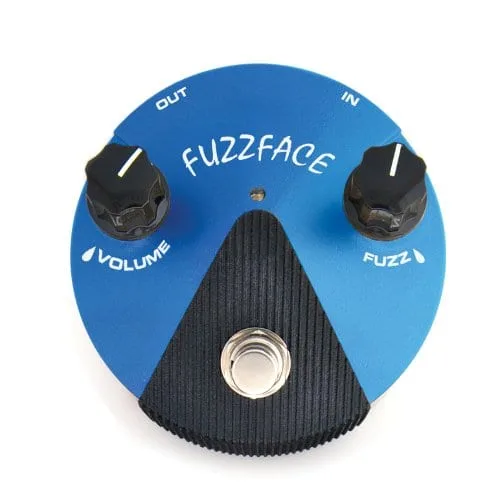


The Dunlop FFM1, sold as the Silicon Fuzz Face Mini Distortion, is a compact fuzz pedal that puts the circuit of a 1970 silicon Fuzz Face into a small, pedalboard-friendly housing. Dunlop says the pedal is spec'd from a 1970 Fuzz Face in the company's own collection, prized for its bright and aggressive character, delivered by matched BC108 silicon transistors1. It launched in 2013 alongside the other Fuzz Face Mini models2.
Where the original Fuzz Face was a large, round pedal that sat on the floor, the FFM1 keeps the same two-knob control layout in a small blue enclosure, and adds things the original never had: true bypass switching, a status LED, a power jack and a battery door1. Dunlop describes the result as "Legendary Fuzz Face tone with pedalboard-friendly size, power and on/bypass status LED"3.
Controls and how it works
The FFM1 keeps the original Fuzz Face's minimal control set. Two knobs and a footswitch are all there is to it3.
| Control | What it does |
|---|---|
| FUZZ | Controls the amount of fuzz3 |
| VOLUME | Controls overall effect volume3 |
| FOOTSWITCH | Toggles the effect on and bypass; a blue LED indicates on3 |
The manual lists a maximum gain of 55 dB, so there is a lot of range available from the FUZZ knob3. The input impedance is 10 kΩ, which is low by pedal standards and typical of Fuzz Face circuits; that low input impedance is part of why these pedals interact with the guitar's volume control the way they do3. Output impedance is listed as 66 kΩ at mid volume and under 16 kΩ at maximum volume3.
JHS, writing about the Fuzz Face Mini family, notes that the silicon FFM1 "clean up really nicely" when you back off the guitar's volume, which is the classic Fuzz Face behavior players use to move from full fuzz to a cleaner edge4.
Powering it
The FFM1 runs on 9 volts DC and draws 3.4 mA, so it is light on a power supply3. There are two ways to power it:
- Battery: one 9-volt battery, installed through a battery door on the underside of the pedal3
- Adapter: a 9-volt AC adapter such as the Dunlop ECB003/ECB003EU, or a DC Brick power supply; Dunlop's product page also names its Iso-Brick and Mini Iso-Brick supplies, none included with the pedal13
The easy-access battery door is one of the conveniences Dunlop added in the mini housing, along with the status LED and power jack1.
History: from a 1970 Fuzz Face
The FFM1 arrived in 2013, a year MusicRadar summed up as "the year the gnarly, nasty fuzz gets cute"2. Dunlop specs the circuit from the company's own prized 1970 Fuzz Face pedal3.
The circuit is not a generic Fuzz Face copy. Dunlop says it is spec'd from a specific 1970 Fuzz Face in the company's own collection, chosen for its bright and aggressive sound1. The manual puts it plainly: "Spec'd from our own prized 1970 Fuzz Face pedal"3. That matters because original Fuzz Faces varied, and silicon units from around 1970, with BC108 transistors, have a character distinct from the earlier germanium pedals. MusicRadar's history of the Fuzz Face notes that the first Fuzz Face reissue Dunlop issued was the silicon model5.
The mini format itself was the point of the release: same circuit behavior, smaller footprint, plus true bypass, LED and power options the original round pedal lacked1. MusicRadar's review describes the enclosure as blue, small and sturdy, with a shape inspired by the base of a mic stand2.
What reviewers said
MusicRadar's review of the FFM1 Silicon found it delivers what the format promises2:
"The Dunlop Mini proves the versatility of the original Fuzz Face design while adding a few modern twists to the recipe2."
Michael Astley-Brown, MusicRadar2
The review notes the pedal's "bright and aggressive" sound courtesy of its matched BC108 silicon transistors, and its true bypass switching and easy-access battery door among the modern touches2.
JHS, in its history of the Fuzz Face Mini line, is equally positive about the silicon model, saying the FFM1 "clones this effect very, very well," referring to the '70s silicon Fuzz Face sound, and adding4:
"And this thing sounds fantastic. It has this feeling that's more like a distortion4."
That distortion-like feel is, for JHS, exactly what silicon transistor fuzzes are about, and it is the character Dunlop was chasing by building the pedal around BC108s4.
For price context, MusicRadar's 2021 Fuzz Face history listed the FFM1 Silicon at £1045.
Related pedals
The FFM1 sits in a wider Fuzz Face family from Dunlop:
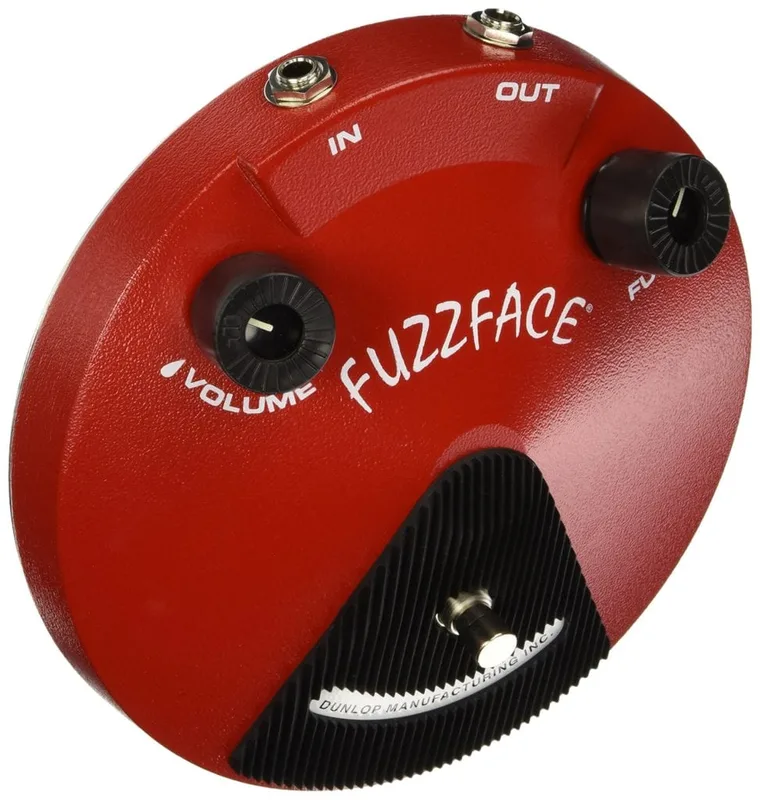
- Dunlop Fuzz Face: the full-size reissue of the original
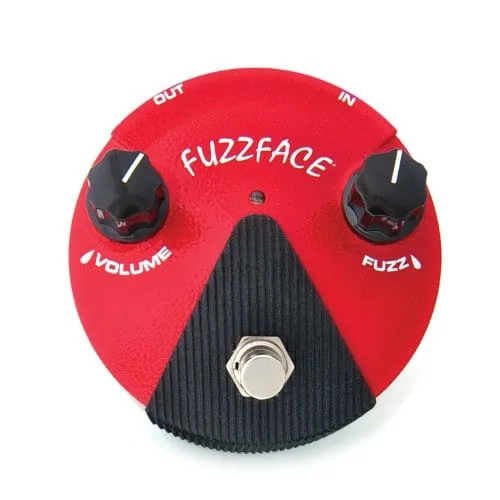
- Dunlop Germanium Fuzz Face Mini: the mini with germanium transistors
- Dunlop FFM2 Germanium Fuzz Face Mini Distortion: the germanium mini distortion variant
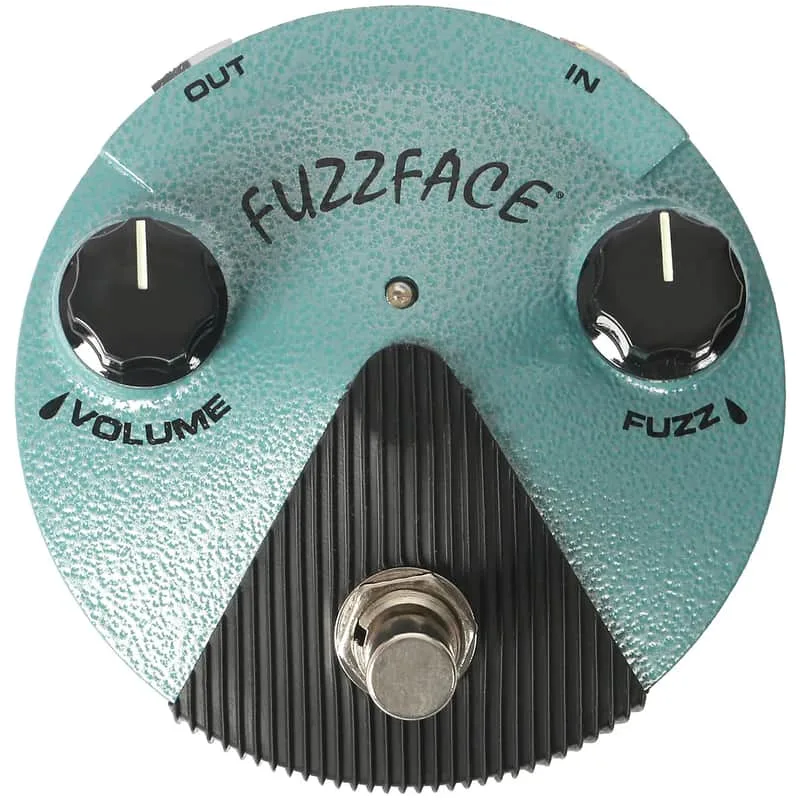
- Dunlop FFM3 Jimi Hendrix Fuzz Face Mini Distortion: the Hendrix-spec mini
- Dunlop Jimi Hendrix Fuzz Face and Dunlop Eric Johnson Fuzz Face: full-size signature versions
For the broader category, see fuzz pedals and distortion pedals.
Videos
Isurus
Harmon Music
Wat Suwat
Questions
Is the Dunlop FFM1 true bypass?
Yes. Dunlop's product page and manual both list true bypass switching for the Fuzz Face Mini line, and the manual's specification table calls it True Hardwire bypass. MusicRadar's review confirms true bypass switching, and JHS notes the pedal cleans up nicely when you roll back your guitar's volume.
What transistors are in the FFM1 Silicon Fuzz Face Mini?
Matched BC108 silicon transistors. Dunlop says the pedal's bright and aggressive character is delivered by these vintage spec silicon transistors, and the same transistors are listed in the manual's specifications. Silicon fuzzes generally behave differently from germanium ones, staying more stable with temperature.
What is the input impedance of the FFM1?
The manual lists the input impedance as 10 kΩ. That is a low input impedance, typical of Fuzz Face circuits, and it means the pedal reacts to what is plugged into it, which is part of how rolling back the guitar's volume knob cleans up the fuzz.
Does the Silicon Fuzz Face Mini take a battery?
Yes. The FFM1 runs on one 9-volt battery, installed through a battery door on the underside of the pedal. Dunlop highlights the easy-access battery door as one of the modern conveniences added to the mini housing, along with a status LED and a power jack.
What power supply does the Dunlop FFM1 use?
It runs on 9 volts DC, drawing about 3.4 mA. Dunlop recommends its ECB003 9-volt adapter or one of its DC Brick, Iso-Brick or Mini Iso-Brick power supplies, none of which are included. A 9-volt battery works too.
Sources (5)
- SILICON FUZZ FACE® MINI DISTORTION, Dunlop (jimdunlop.com)
- Dunlop Fuzz Face Mini FFM1 Silicon review, MusicRadar, 2013-07-08
- FFM1.pdf, Dunlop Manufacturing, Inc., 2019
- MINI FUZZ FACES, JHS Pedals
- Stompbox icons: Fuzz Face, MusicRadar, 2021-11-01