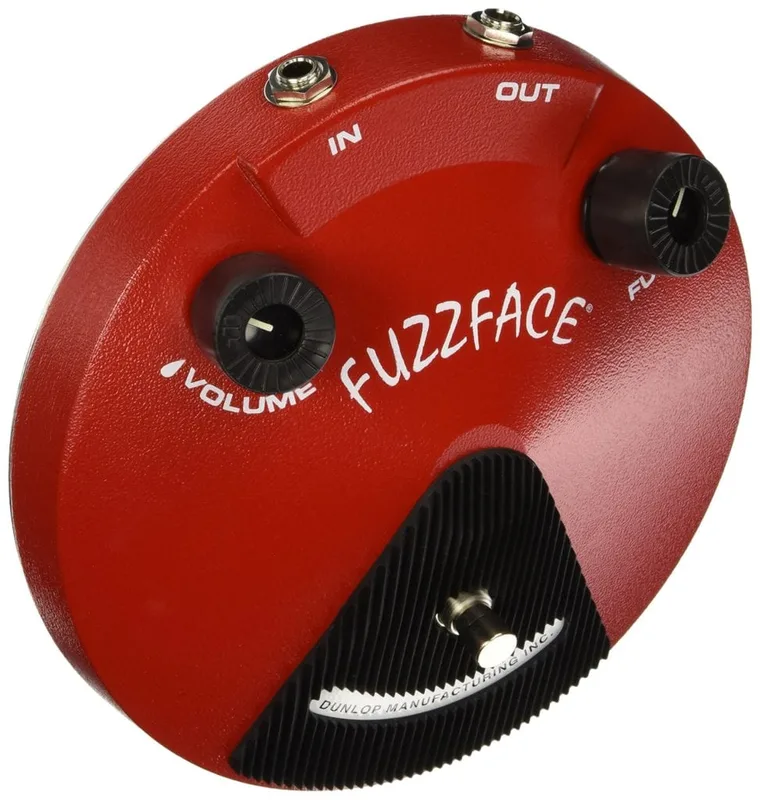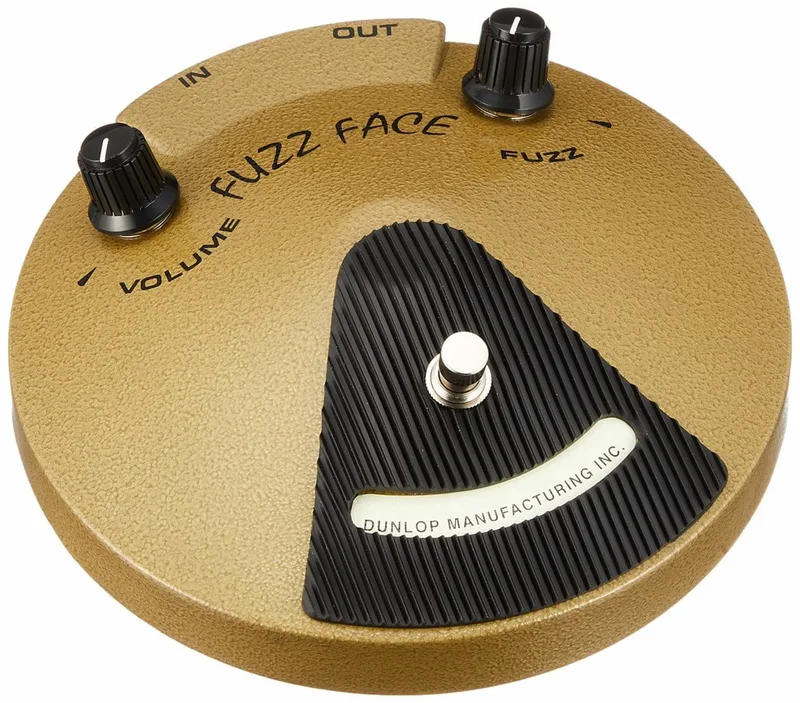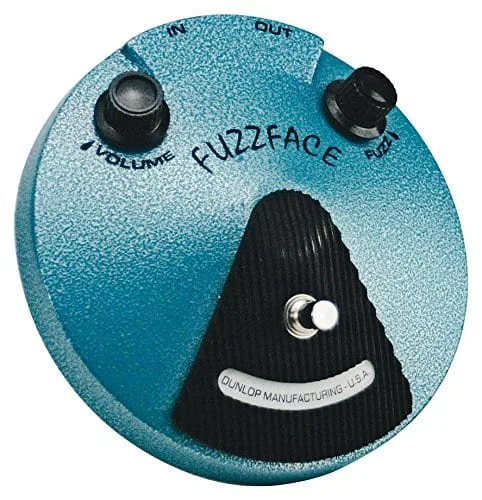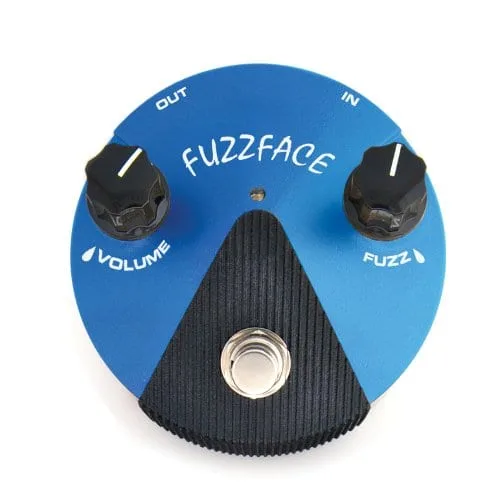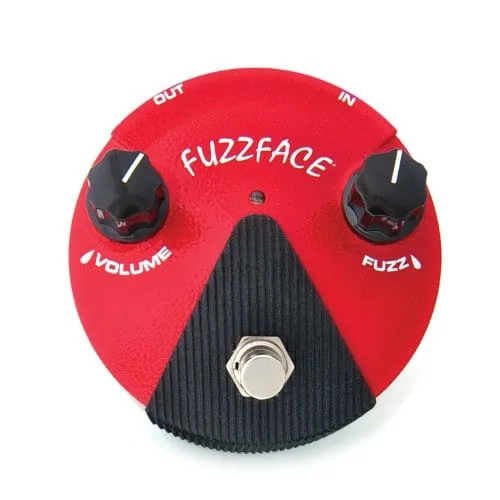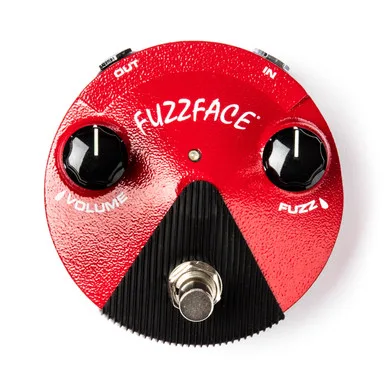


The Dunlop FFM2 Germanium Fuzz Face Mini Distortion is a compact fuzz pedal that puts the classic germanium Fuzz Face circuit into a small, pedalboard-friendly housing. It is made by Dunlop, and Dunlop describes it as based on the '66 to '68 era pre-silicon Fuzz Faces, built around slightly mismatched germanium transistors that the company says are famous for warm vintage fuzz tones1. MusicRadar's reviewer, Michael Astley-Brown, found it delivers that "warm vintage fuzz" through the same slightly mismatched germanium transistors, in a red enclosure he called small but sturdy2.
The FFM2 is one of three small-format Fuzz Faces Dunlop introduced, the others being higher-gain models with silicon transistors3. It keeps the two-knob simplicity of the original Fuzz Face but adds modern conveniences the big round pedal never had: a status LED, an AC power jack, a battery door, and true bypass switching42.
A germanium Fuzz Face in a mini enclosure
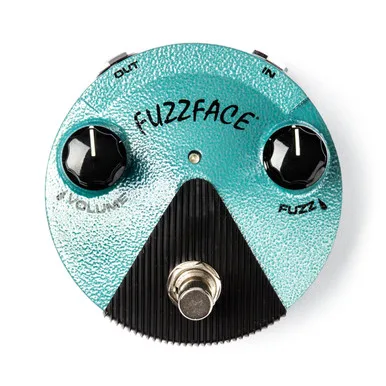
Premier Guitar's reviewer noted the practical appeal plainly: "you can buy a great-sounding germanium-transistor Fuzz Face for around a hundred bucks"3. For players who want the full-size versions, Dunlop also makes the Dunlop Fuzz Face, the Dunlop Eric Johnson Fuzz Face, and the Dunlop Jimi Hendrix Fuzz Face, along with other Mini variants such as the Dunlop FFM1 and the Dunlop FFM3 Jimi Hendrix Fuzz Face Mini Distortion.
Controls and how to set them
The FFM2 keeps the original two-knob layout. Dunlop's manual recommends a simple starting point: "Start with both controls at 12 o'clock."4
| Control | What it does |
|---|---|
| FUZZ | Controls the amount of fuzz4 |
| VOLUME | Controls overall effect volume4 |
| FOOTSWITCH | Toggles effect on/bypass, with a blue LED indicating on4 |
Setting up the pedal is a three-step process per the manual4:
- Run a cable from your guitar to the FFM2's INPUT jack.
- Run another cable from the FFM2's OUTPUT jack to your amplifier.
- Set both knobs to 12 o'clock and adjust FUZZ and VOLUME from there.
Power and bypass
The FFM2 can be powered three ways: a 9-volt battery, a Dunlop ECB003 9-volt adapter, or Dunlop's DC Brick, Iso-Brick, and Mini Iso-Brick power supplies, none of which are included with the pedal1. Current draw is a low 3.4 mA4, so a battery lasts a long time and the pedal is easy on a power brick's budget.
The power supplies are sold separately from the pedal; only the pedal itself is in the box1.
The bypass is listed in the manual as True Hardwire4, which MusicRadar's review describes as true bypass switching2. When the pedal is bypassed, it is out of the signal path entirely, unlike the original vintage units.
Specifications
| Specification | Value |
|---|---|
| Input impedance | 10 kΩ4 |
| Output impedance | 2 kΩ at max volume, 115 kΩ at -6 dB volume4 |
| Max gain | 45 dB4 |
| Current draw | 3.4 mA4 |
| Bypass | True Hardwire4 |
The 10 kΩ input impedance is part of the vintage Fuzz Face design, and it is one reason the pedal interacts the way it does with a guitar's volume and tone controls. Players who want to compare the germanium character against the higher-gain silicon versions can look at Dunlop's silicon Fuzz Face Mini family, including the Dunlop Jimi Hendrix Fuzz Face Mini and the Dunlop JHMS143.
Videos
Prymaxe
Pair of Pandas
DeuceII
Questions
Does the Dunlop FFM2 Fuzz Face Mini use germanium transistors?
Yes. The FFM2 uses slightly mismatched germanium transistors, which Dunlop says are famous for warm vintage fuzz tones. The circuit is based on the '66 to '68 era pre-silicon Fuzz Faces, and it is the germanium model in the Fuzz Face Mini line; the other Mini versions use silicon transistors.
Can the Dunlop FFM2 run on a 9V battery?
Yes. The pedal can be powered by a 9-volt battery, a Dunlop ECB003 9-volt adapter, or Dunlop's DC Brick, Iso-Brick, and Mini Iso-Brick power supplies, which are sold separately. The housing includes a battery door along with an AC power jack.
Is the Dunlop FFM2 true bypass?
Yes. The manual lists the bypass as True Hardwire, and MusicRadar's review describes it as true bypass switching. The footswitch toggles between effect and bypass, with a blue LED indicating when the effect is on.
Where should the knobs start on a Fuzz Face Mini?
Dunlop's manual recommends starting with both the FUZZ and VOLUME controls at 12 o'clock. From there, the FUZZ knob sets the amount of fuzz and the VOLUME knob sets the overall effect volume.
What is the input impedance of the FFM2?
The manual lists the input impedance as 10 kΩ. That is a low input impedance in the vintage Fuzz Face tradition, which is part of how the pedal interacts with the guitar's volume control and tone. Output impedance is 2 kΩ at maximum volume.
Which power supply does the FFM2 use?
It runs on a 9-volt battery, a Dunlop ECB003 9-volt adapter, or Dunlop's DC Brick, Iso-Brick, and Mini Iso-Brick power supplies, none of which are included with the pedal. Current draw is 3.4 mA.
Sources (5)
- GERMANIUM FUZZ FACE® MINI DISTORTION, Dunlop (www.jimdunlop.com)
- Dunlop Fuzz Face Mini FFM2 Germanium review, MusicRadar, 2013-07-08
- Dunlop Fuzz Face Mini Germanium FFM2 Review, Premier Guitar, 2013-08-25
- FFM2.pdf, Dunlop Manufacturing, Inc., 2019
- SILICON FUZZ FACE® MINI DISTORTION, Dunlop (jimdunlop.com)