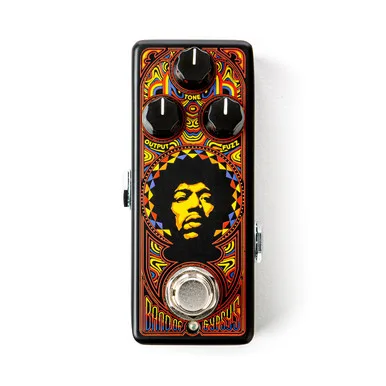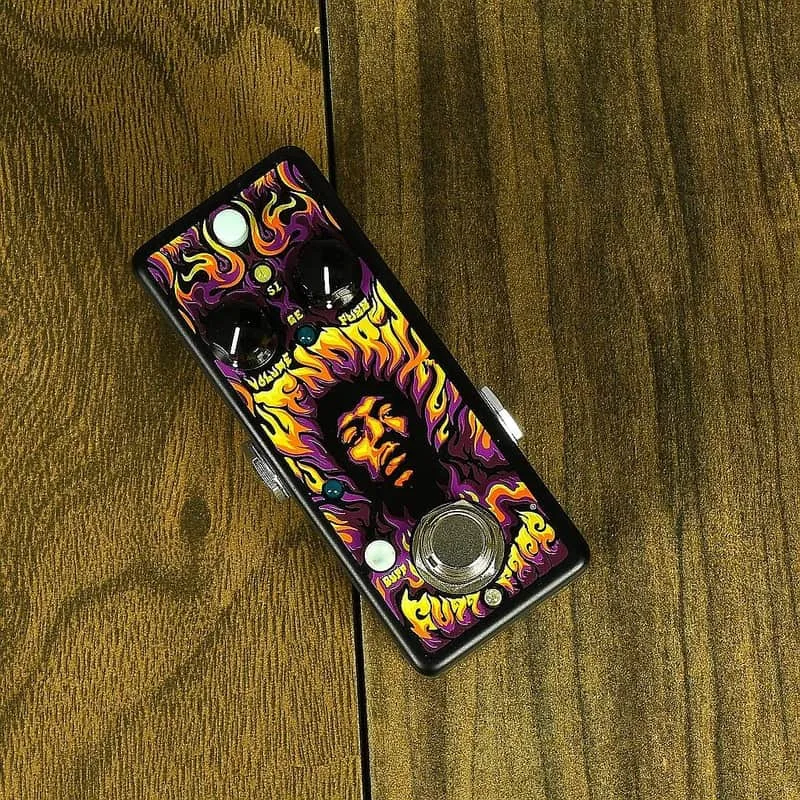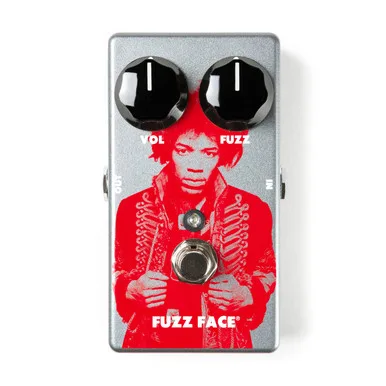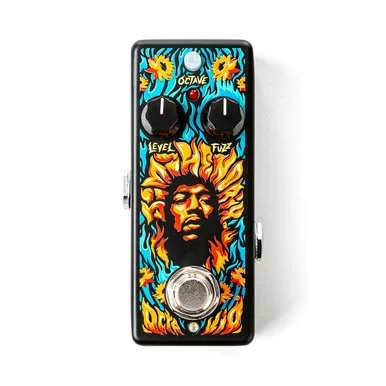

The Dunlop Jimi Hendrix '69 Psych Series Octavio Fuzz is a fuzz pedal with an octave-up mode, made by Dunlop as part of its Authentic Hendrix '69 Psych Series. It updates the circuitry of the original cheese wedge Octavio Fuzz, the effect whose octave-up sound Jimi Hendrix made famous, and puts it in a compact MXR mini housing with a switch that toggles between that octave-up fuzz and a silicon saturation mode1.
Dunlop marks this pedal as a legacy product that is no longer in production1, so it now turns up secondhand rather than new.
What it does to your sound
The pedal has two modes, set by its Octave switch. In its default mode, Dunlop describes it as snarling with super aggressive silicon saturation. Pushing the Octave switch kicks in the classic octave-up fuzz sound, the effect Hendrix made famous1. Dunlop says both modes deliver a range of touch-sensitive fuzz tones, meaning the fuzz responds to how hard you pick, cleaning up and breaking up with your attack1.
| Control | What it does |
|---|---|
| Octave switch | Toggles between the octave-up fuzz sound and silicon saturation mode1 |
An octave-up fuzz is a specific kind of fuzz: the circuit doubles your note one octave higher and folds that doubling into the fuzz, which is most pronounced on the higher frets and single-note lines. Players comparing fuzz types can read more in the octave and pitch pedals overview.
Where the circuit came from
Dunlop describes the pedal as an update of the original cheese wedge Octavio Fuzz circuitry, rebuilt for a modern mini enclosure1. The cheese wedge Octavio is the pedal associated with Hendrix's octave-up fuzz tones, and this Psych Series version carries that circuit forward with the Octave switch as its main control.
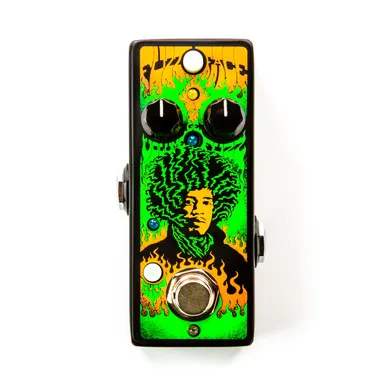
The pedal belongs to a series of downsized Jimi Hendrix effects in MXR mini housings, and the whole line has since been retired. Dunlop lists the Octavio Fuzz, the Band of Gypsys Fuzz and the Fuzz Face Distortion as legacy products no longer in production123. Series siblings include the Dunlop Jimi Hendrix '69 Psych Series Band of Gypsys Fuzz and the Dunlop Authentic Hendrix '69 Psych Series Fuzz Face Distortion (JHW1).
How it differs from the other Psych Series fuzzes
The Octavio Fuzz is the octave pedal of the series, and its two siblings take different routes to a Hendrix fuzz sound12.
| Pedal | Circuit basis | Switching | Distinctive control |
|---|---|---|---|
| Octavio Fuzz | Original cheese wedge Octavio Fuzz circuitry, updated1 | True bypass1 | Octave switch for octave-up fuzz1 |
| Band of Gypsys Fuzz | Version of the Octavio circuit without the octave-up effect3 | True bypass3 | Tone control3 |
| Fuzz Face Distortion | Fuzz Face Distortion, silicon and germanium flavors4 | Buffered bypass by default, Buffer switch for true bypass4 | SI/GE switch between silicon and germanium4 |
The Band of Gypsys Fuzz is the closest relative. Dunlop says its engineers narrowed the sound down to a version of the Octavio circuit that did not have that pedal's famous octave-up effect, tracing it to a mysterious Fuzz Face Distortion that Hendrix used at several iconic shows between 1969 and 1970, most notably the Band of Gypsys performance3. In short: same circuit family, but the octave-up mode is the Octavio's alone.
The Fuzz Face Distortion sibling takes a different approach entirely, combining two flavors of Fuzz Face Distortion tone in its mini housing: aggressive silicon-based crunch by default, with a SI/GE switch that engages the warm, smooth saturation of germanium-based fuzz Hendrix used in the early years4. It also differs on bypass, using buffered bypassing by default so it cooperates with wah pedals, with a Buffer switch for true bypass4, where the Octavio is true bypass straight away1.
Power and practical notes
This pedal is no longer in production1. It is powered through a 9-volt power jack, and Dunlop lists no battery option1.
Dunlop says the pedal can be powered by a Dunlop ECB003 9-volt adapter, or by the DC Brick, Iso-Brick, and Mini Iso-Brick power supplies, none of which are included1. The status LED and true-bypass switching round out the modern features Dunlop added over the original cheese wedge design1.
Videos
Evenstad Music
Questions
Is the Octavio Fuzz true bypass?
Yes. Dunlop lists true-bypass switching among the pedal's modern features, alongside a status LED and a 9-volt power jack. When the pedal is bypassed, the signal passes through without buffering, which matters to players who keep long cable runs or want the pedal out of the chain entirely when it is off.
What power supply does the Psych Series Octavio Fuzz need?
It runs from a 9-volt power jack. Dunlop says it can be powered by a Dunlop ECB003 9-volt adapter, or by the DC Brick, Iso-Brick, and Mini Iso-Brick power supplies, none of which are included with the pedal. No battery operation is listed.
What is the difference between the Octavio Fuzz and the Band of Gypsys Fuzz?
Both are MXR mini fuzz pedals in the '69 Psych Series, but the Octavio Fuzz has an Octave switch for the octave-up fuzz sound, while the Band of Gypsys Fuzz is a version of the Octavio circuit that Dunlop's engineers narrowed down to remove the octave-up effect, based on a mysterious Fuzz Face Distortion Hendrix used in 1969 and 1970.
What original circuit is the Psych Series Octavio Fuzz based on?
Dunlop describes it as an update of the circuitry of the original cheese wedge Octavio Fuzz, the pedal whose octave-up sound Jimi Hendrix made famous, rebuilt in an MXR mini housing with modern features such as true-bypass switching and a 9-volt power jack.
Sources (4)
- JIMI HENDRIX™ '69 PSYCH SERIES OCTAVIO® FUZZ, Dunlop (jimdunlop.com)
- Summer NAMM 2019: Dunlop debuts 4 Authentic Hendrix mini pedals, plus new Gary Clark Jr. and Dimebag Cry Baby wahs, MusicRadar, 2019-07-19
- JIMI HENDRIX™ '69 PSYCH SERIES BAND OF GYPSYS™ FUZZ, Dunlop (jimdunlop.com)
- JIMI HENDRIX™ '69 PSYCH SERIES FUZZ FACE® DISTORTION, Dunlop (www.jimdunlop.com)