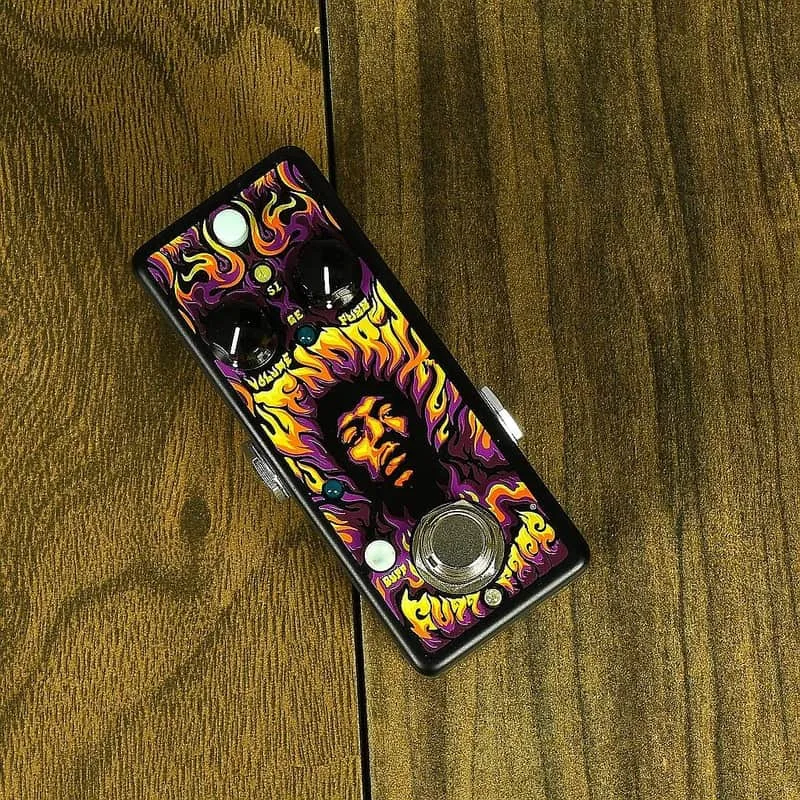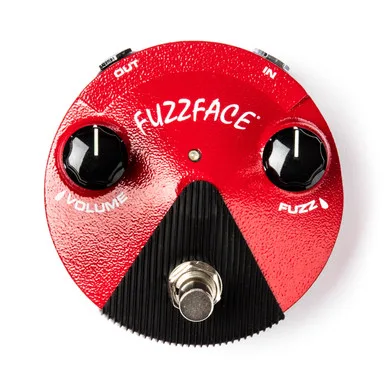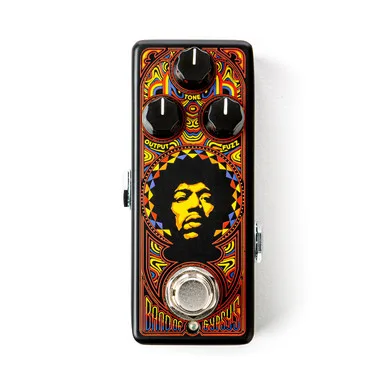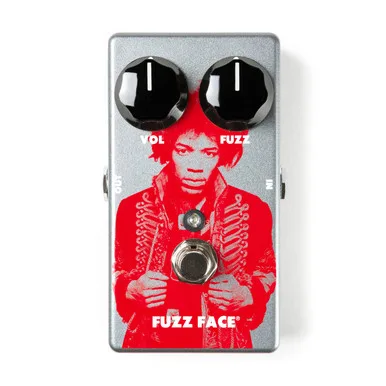


The Dunlop Jimi Hendrix '69 Psych Series Fuzz Face Distortion is a fuzz pedal from Dunlop that puts two Fuzz Face Distortion voices in one small box: the aggressive silicon-based crunch Jimi Hendrix used in his later years, and the warm, smooth germanium-based fuzz of his early years. It sits in an MXR mini housing finished in the kaleidoscopic designs of the UK design group ILOVEDUST, part of Dunlop's '69 Psych Series built around Hendrix's 1969 era12.
This is a legacy product. Dunlop lists it as no longer in production1.
What it is and where the circuit comes from
Dunlop describes the pedal as combining "the two different flavors of Fuzz Face Distortion tones, aggressive silicon-based crunch and smooth germanium-based saturation" in a mini MXR housing1. Rather than reproducing one specific vintage unit, it gives you both halves of Hendrix's fuzz history in a single pedal, selected by a switch.
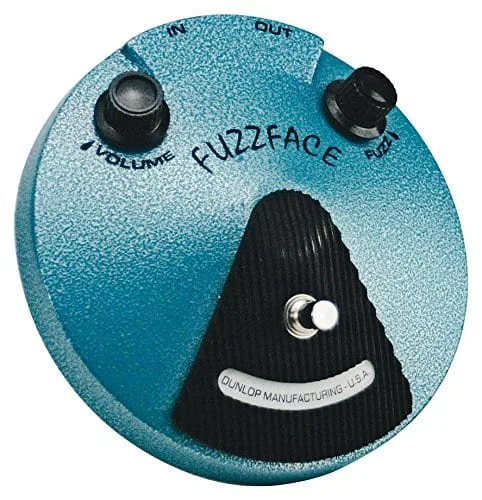
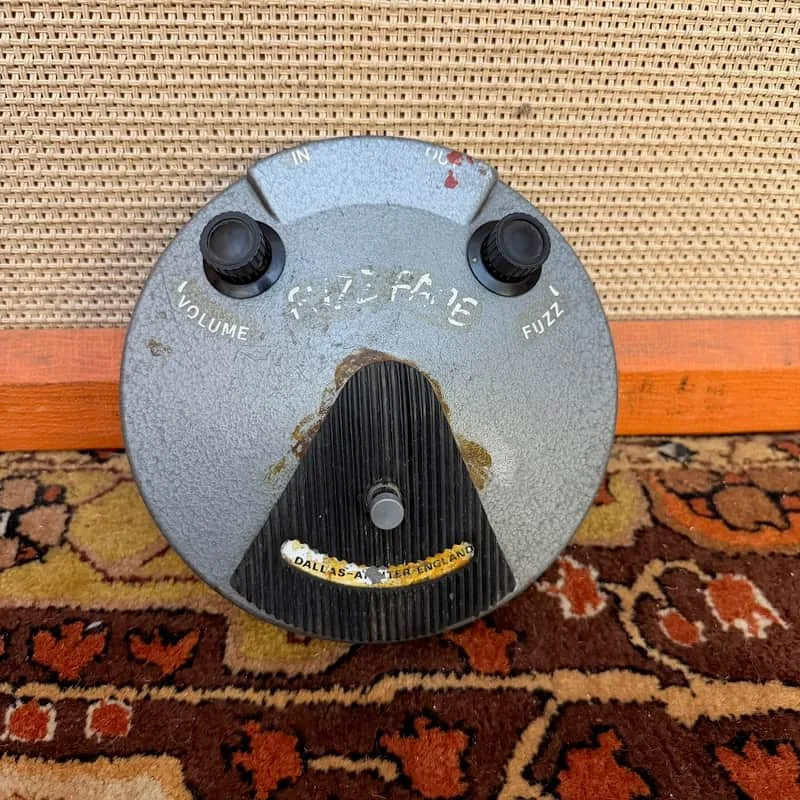
The Fuzz Face circuit itself has a long lineage at Dunlop. The standard Dunlop Jimi Hendrix Fuzz Face (JHF1) is, per its manual, a "meticulously faithful reproduction of Jimi's 1969-70 Dallas-Arbiter Fuzz Face," built on a hand-wired brown circuit board with no solder mask and circuitry matched to the original specs3. Dunlop's product page for that pedal notes Hendrix used the 1969-70 Dallas Arbiter Fuzz Face on classic albums such as Electric Ladyland4. Of the '69 Psych Series pedal, Dunlop says the Fuzz Face Distortion, in all of its incarnations, was the fuzz pedal Hendrix used more than any other1.
The '69 Psych Series also included two sibling pedals, both now legacy products as well: the Band of Gypsys Fuzz, based on a mysterious Fuzz Face Distortion Hendrix used at several shows between 1969 and 1970, most notably the Band of Gypsys performance, and the Octavio Fuzz5.
The controls
The pedal carries the classic two-knob Fuzz Face layout plus a set of switches. Dunlop's manuals for the related Fuzz Face pedals describe the core controls:
| Control | What it does |
|---|---|
| FUZZ knob | Controls the amount of fuzz3 |
| VOLUME knob | Controls the overall effect volume3 |
| FOOTSWITCH | Toggles the pedal on and bypass3 |
| SI/GE switch | Selects silicon crunch (default) or germanium saturation1 |
| Buffer switch | Switches between buffered and true bypass1 |
The two knobs follow the original Fuzz Face formula: fuzz amount and output level, nothing else. The switches are the modern additions, and they are what set this pedal apart from the standard JHF1, which has no tone shaping beyond its two knobs36.
The SI/GE switch: two fuzzes in one box
This is the pedal's main draw. In its default mode, the pedal delivers the aggressive silicon-based crunch Hendrix used in his later years. Dunlop's page puts it this way: "Hitting the SI/GE switch engages the warm, smooth saturation of germanium-based fuzz that he used in the early years"1.
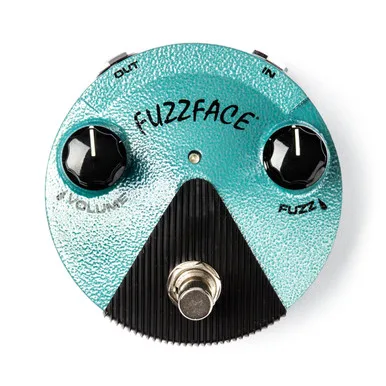
For a player, that means one pedal covers both ends of the Fuzz Face sound. Silicon fuzz is typically the brighter, harder-clipping flavor; germanium is the warmer, smoother one. If you want to compare the two circuits in dedicated pedals, Dunlop sells them separately in mini form as the Dunlop FFM3 Jimi Hendrix Fuzz Face Mini Distortion (silicon) and the Dunlop FFM2 Germanium Fuzz Face Mini Distortion (germanium).
The Buffer switch and bypass
Unlike most Fuzz Face variants, this pedal does not simply run true bypass. Dunlop says it "uses buffered bypassing by default, allowing for a greater range of tones and full cooperation with wah"1. The Buffer switch lets you defeat that and run true bypass switching instead1.
That default matters for how you place the pedal. A buffer in bypass keeps the pedal cooperating with a wah ahead of it, which suits a Hendrix-style signal chain. Players who want a completely untouched bypass signal can flip the switch. By comparison, the JHF1 and the Fuzz Face Minis are straight true bypass designs36.
Power
The pedal has a 9-volt power jack and can be powered by a Dunlop ECB003 9-volt adapter, or by the DC Brick, Iso-Brick, and Mini Iso-Brick power supplies, none of which are included1. Dunlop does not publish a current draw figure for this pedal; for reference, its manual lists the JHF1 at 500 µA and the FFM3 mini at 3.4 mA, both on 9 volts DC36, so the family draws very little current and is easy on a power supply.
Who uses the Fuzz Face circuit
The player most associated with the circuit is Hendrix himself. Dunlop documents that he used a Dallas Arbiter Fuzz Face in the late '60s, including on classic albums such as Electric Ladyland, and a mysterious Fuzz Face Distortion at several shows between 1969 and 1970, most notably the Band of Gypsys performance452. The Fuzz Face Distortion, in all its incarnations, was the fuzz pedal he used more than any other, according to Dunlop1. The circuit has since appeared across Dunlop's range in many forms, from the full-size JHF1 to the mini housings and the Eric Johnson signature model.
Videos
Guitar Bonedo
Evenstad Music
John Cevallos
Questions
Is it true bypass?
Not by default. Dunlop says the pedal uses buffered bypassing out of the box, which the company describes as allowing a greater range of tones and full cooperation with wah. A Buffer switch on the pedal lets you switch to true bypass operation if you prefer a completely uncolored signal when the pedal is off.
What does the SI/GE switch do?
It selects between the two Fuzz Face Distortion flavors the pedal contains. In the default position you get the aggressive silicon-based crunch Jimi Hendrix used in his later years. Flipping the SI/GE switch engages the warm, smooth saturation of germanium-based fuzz, the sound he used in the early years.
What does the Buffer switch do?
It switches the pedal's bypass mode. The pedal ships with buffered bypassing active, which Dunlop says allows a greater range of tones and full cooperation with wah pedals. Moving the Buffer switch to the other position gives you true bypass switching instead.
What power does it need, and how much current does it draw?
It runs from a 9-volt power jack and can be powered by a Dunlop ECB003 9-volt adapter, or by Dunlop's DC Brick, Iso-Brick, and Mini Iso-Brick power supplies, none of which are included. Dunlop does not publish a current draw figure for this pedal.
Which Hendrix Fuzz Face is it based on?
It is not a reproduction of one specific unit. It combines two flavors of Fuzz Face Distortion tone: the aggressive silicon-based crunch of Hendrix's later years and the warm, smooth germanium-based fuzz of his early years. Dunlop notes the Fuzz Face Distortion, in all its incarnations, was the fuzz pedal he used more than any other.
Sources (6)
- JIMI HENDRIX™ '69 PSYCH SERIES FUZZ FACE® DISTORTION, Dunlop (www.jimdunlop.com)
- JIMI HENDRIX® FUZZ FACE® DISTORTION LIMITED EDITION, Dunlop (www.jimdunlop.com)
- JHF1.pdf, Dunlop Manufacturing, Inc., 2019
- JIMI HENDRIX® FUZZ FACE® DISTORTION, Dunlop (jimdunlop.com)
- JIMI HENDRIX™ '69 PSYCH SERIES BAND OF GYPSYS™ FUZZ, Dunlop (jimdunlop.com)
- FFM3.pdf, Dunlop Manufacturing, Inc., 2019