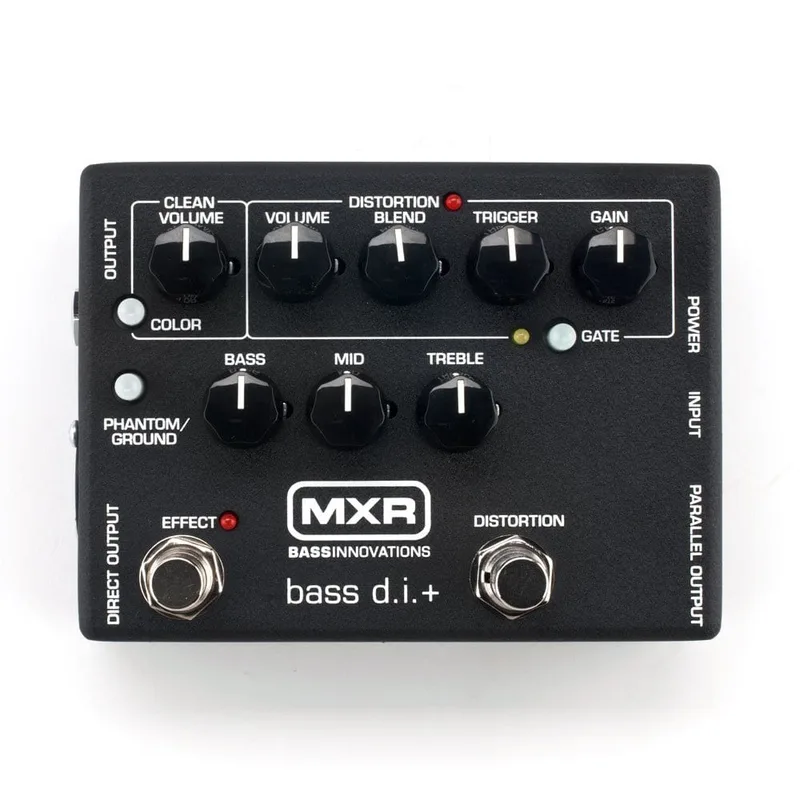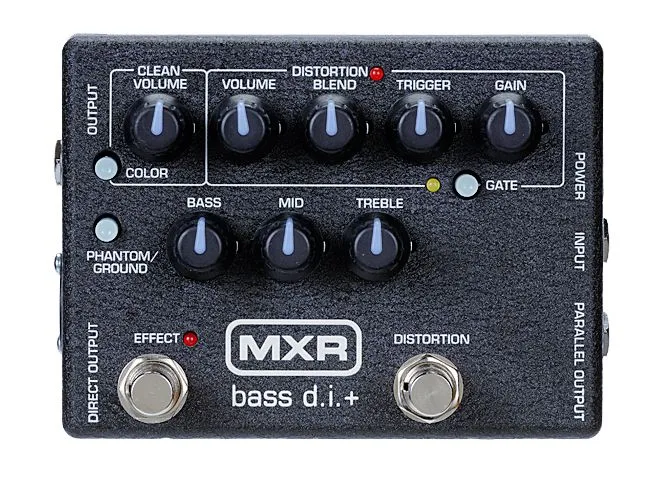


The MXR M80 Bass D.I.+ is a bass DI pedal made by Dunlop, which the maker's manual describes as "an incredibly flexible Bass D.I.+". Its core job is to take a bass signal and send it straight to a PA or mixing board: Dunlop's manual tells players to "run direct to the PA or straight to the mixing board for pure tone". Around that DI function it adds a three-band EQ, a preset Color switch, a distortion channel and an adjustable noise gate, all in one box that lives on a pedalboard. MusicRadar's review calls it "a robust and well set-out DI - a useful, albeit expensive tool to carry to gigs, just in case."12
Inputs, outputs and power
The input side is simple: Dunlop's manual says to run a cable from your bass to the Input jack of the Bass D.I.+. That input presents a 2.2 MΩ impedance, high enough that an active or passive bass sees no real load. On the output side the pedal offers unbalanced and balanced connections, with output impedances of 150 Ω unbalanced and 300 Ω balanced, the balanced output being the one that feeds a mixing board.1
Power comes from either a 9 volts DC supply or a single 9 volt alkaline battery, with a current draw of 9 mA. That is a light load, so the M80 fits easily on a shared pedalboard supply.1
The M80's bypass is buffered, not true bypass. Dunlop specifies the bypass frequency response as +0/-0.5 dB from 20 Hz to 20 kHz, so the buffer is designed to leave the signal flat across the full audio range.1
Controls
The EQ section gives each band a generous range, set at frequencies that suit bass1:
| Control | What it does |
|---|---|
| Bass | ±18 dB at 60 Hz1 |
| Mid | ±10 dB at 850 Hz1 |
| Treble | ±12 dB at 4 kHz1 |
| Color switch | A preset EQ; MusicRadar calls it "a tasteful preset EQ"2 |
| Gate switch and Trigger knob | An adjustable noise gate; the Trigger knob sets the noise floor threshold to cut hum and hiss from the distortion signal1 |
| Phantom/Ground switch | Enables Phantom Power or Ground Lift on the Direct Output connection1 |
The gate is aimed squarely at the distortion channel: with the Gate switch engaged, the Trigger knob sets how quiet the signal has to get before the gate closes, and Dunlop specifies a gate trigger range of 28 dB. The pedal's overall sensitivity is given as -66 dBV at 1 kHz, and the volume control has a 40 dB range.1
Distortion and switching
Beyond clean DI duty, the M80 carries a second voice. MusicRadar's review notes that "as an extra, this unit also offers highly controlled distortion and super quiet switching between straight DI and effect", meaning the distortion channel can be brought in without pops or clicks, and the clean DI path stays available underneath.21
What reviewers said
MusicRadar's verdict on the M-80 Bass DI+ was that it is "a robust and well set-out DI - a useful, albeit expensive tool to carry to gigs, just in case", praising the build and layout while flagging the price. The same review credited the pedal's "highly controlled distortion and super quiet switching between straight DI and effect" as a genuine extra on top of its DI function.2
Videos
PopMusicRu
The Bass Channel
ANTENNA565
Questions
Does the MXR M80 Bass D.I.+ run on a battery?
Yes. According to Dunlop's manual, the M80 Bass D.I.+ requires a single 9 volt alkaline battery, and it can also be powered from a 9 volts DC supply. Its current draw is low at 9 mA, so it sits comfortably on a pedalboard power supply alongside other pedals.
Is the MXR M80 Bass D.I.+ true bypass?
No. Dunlop's manual lists the bypass as buffered rather than true bypass. A buffered bypass sends your signal through a low-impedance output stage when the pedal is off, which helps keep the signal strong over long cable runs, and the M80's bypass frequency response is specified at +0/-0.5 dB from 20 Hz to 20 kHz.
How much current does the M80 Bass D.I.+ draw?
Dunlop's manual gives the current draw as 9 mA at 9 volts DC. That is a light load by pedal standards, so the M80 can share a standard daisy-chained or isolated pedalboard power supply output without trouble, and a single 9 volt alkaline battery is also an option.
What does the Phantom/Ground switch do on the M80?
The Phantom/Ground switch works on the Direct Output connection. According to Dunlop's manual, it enables Phantom Power or Ground Lift. Ground Lift removes noisy ground loops that can appear when the pedal feeds a PA or mixing board, while the phantom setting lets the unit take power from a mixing console that supplies it.
Does the M80 have a noise gate?
Yes. The M80 has an adjustable noise gate built in. Dunlop's manual says the Gate switch and Trigger knob work interactively, with the Trigger knob setting the noise floor threshold to cut hum and hiss from the distortion signal. The manual specifies a gate trigger range of 28 dB.
Can the M80 Bass D.I.+ go straight to a PA or mixing board?
Yes, that is what it is built for. Dunlop's manual says you can run direct to the PA or straight to the mixing board for pure tone, using the balanced Direct Output. The Phantom/Ground switch handles phantom power and ground lift on that connection, so it works as a gig-ready DI box as well as a pedal.
Sources (2)
- M80.pdf, Jim Dunlop, 2019
- MXR M-80 Bass DI+ review, MusicRadar, 2010-04-12