

The Uni-Vibe is a modulation effect that, despite its name, is really a phaser: a four-stage optical phase shifter originally built to imitate the Doppler effect of a Leslie rotating speaker cabinet12. It was designed in Japan in the late 1960s and became famous through Jimi Hendrix, who used a vintage Shin-ei unit from 1969 to 197034. Today the Uni-Vibe name belongs to Dunlop, which sells current versions under the Dunlop and MXR names5.
What sets the circuit apart from a standard phaser is how it shifts phase. Each of the four stages has its own unique corner frequencies, thanks to uneven capacitor values, and the sweep is driven optically, by a light bulb and photoresistors, giving a unique LFO curve126. The result is the throbbing, hypnotic pulse players associate with the effect7.
What a Uni-Vibe does
The Uni-Vibe was conceived as a pedal alternative to a Leslie speaker: an electronic attempt to simulate the way a spinning horn shifts pitch and volume as it rotates94. Instead of moving air, the circuit shifts the phase of the guitar signal in four staggered stages, each with its own corner frequency, and sweeps those stages with an LFO12.
Unlike most commercially produced phase shifters, the Uni-Vibe does not use op-amps; it is built from discrete components, which is part of why players describe its sweep as lo-fi and organic compared with a modern phaser9. Function f(x) puts it bluntly: the Dunlop Univibe "is a vibe pedal, but it's really an optical phaser with no dry signal" in vibrato operation12. In its simplest form it is a staggered phase shifter known for its throbbing, hypnotic pulse and lo-fi sweep7.
The controls
The original pedal kept its control set small, and most versions since have kept it that way:
| Control | What it does |
|---|---|
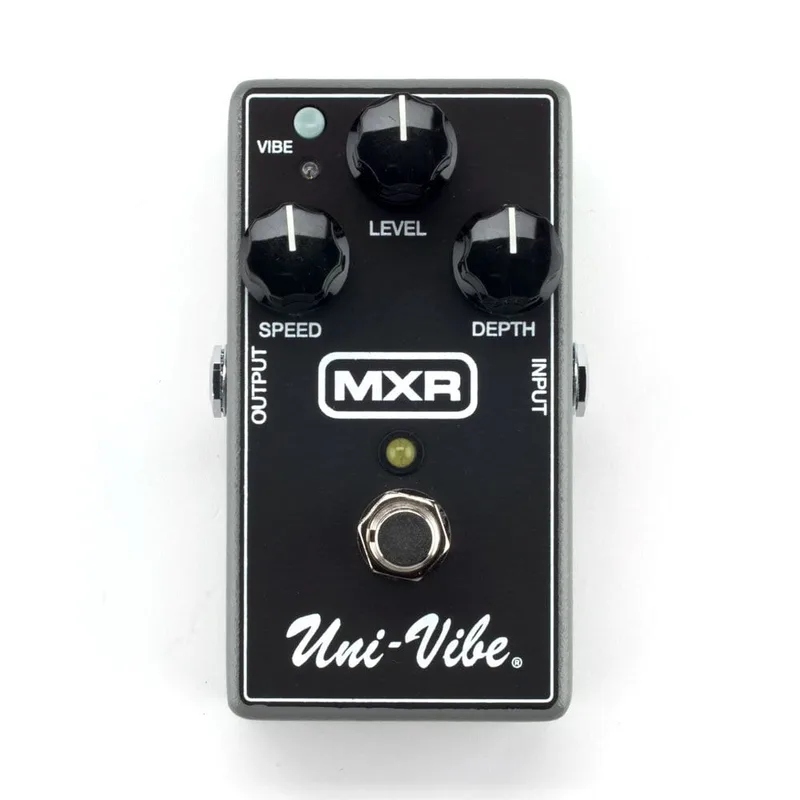
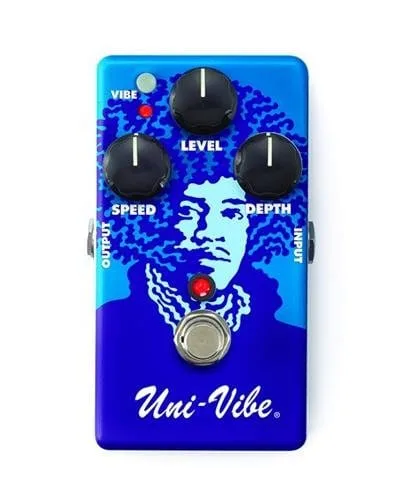
| Speed | Sets how fast or slow the sweep is; the sweep rate1314 |
| Intensity / Depth | Governs the depth of the sweep, the overall intensity of the effect913 |
| Volume / Level | A simple output attenuation potentiometer; controls the overall volume of the effect93 |
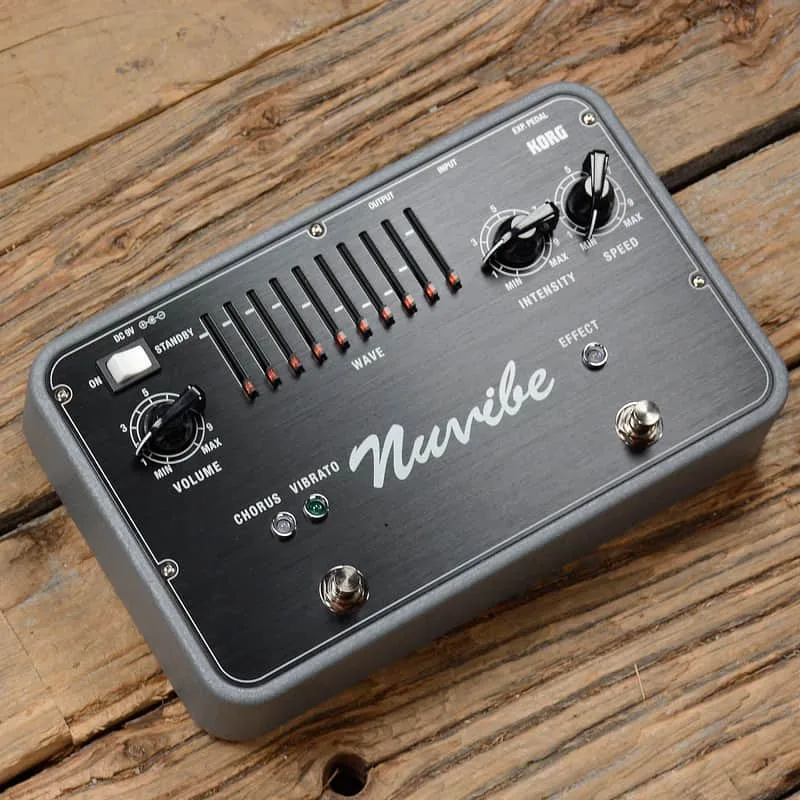
| Chorus/Vibrato switch | Selects between the two modes43 |
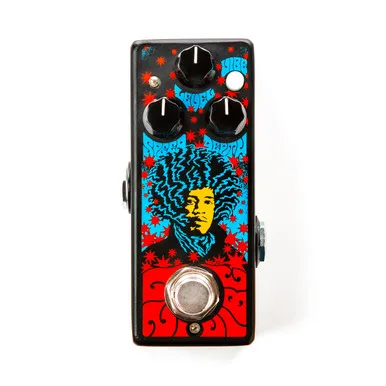
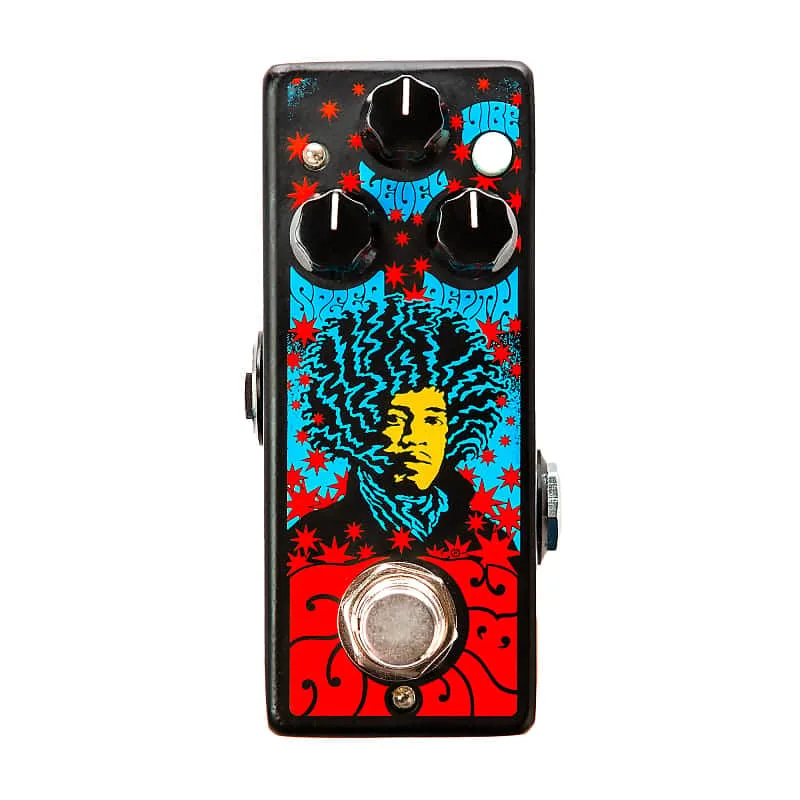
The original also shipped with a foot treadle for rotational speed and a rocker switch for the two modes2. Dunlop's current pedals follow the same layout: the Authentic Hendrix '68 Shrine Series Uni-Vibe has three knobs for Speed, Level and Depth plus a Vibe button15, and Dunlop sells a separate Uni-Vibe Foot Control that manipulates the Speed and effect/bypass functions of the Uni-Vibe Chorus/Vibrato by foot16.
One detail worth knowing: the volume control is not transparent. The pedal contains a transistor-based preamp circuit, so even the dry input signal is colored and amplified9.
Chorus mode and vibrato mode
The Chorus/Vibrato switch is where the two personalities of the circuit live, and the difference is simple:
- Chorus mode: the dry signal is mixed with the phase-shifted signal, producing the unique asymmetrical phase shifting that is the classic Uni-Vibe sound414.
- Vibrato mode: only the pitch-shifted signal is heard, with the dry signal taken out of the path1413. MusicRadar describes it as thinner and quieter, with a more pronounced pitch warble9.
Dunlop's own description of the MXR Uni-Vibe Chorus/Vibrato is the same: the VIBE switch selects either Chorus Mode, "dry signal mixed with pitch-shifted signal," or Vibrato Mode, "only pitch-shifted signal"14. On the JHMS3 Shrine Series pedal, the switch out is chorus and pushing it in engages vibrato mode, indicated by an LED3.
The naming is a piece of history in itself. Tru-Fi notes the original makers found the phase sound so distinctive that "they actually labeled Chorus" what was really phase shifting17. Reviewing the Authentic Hendrix '69 Uni-Vibe for Guitar.com, Richard Purvis called the chorus mode the Uni-Vibe sound: "an insistently pulsing, not-quite-whining throb that sounds almost like a phaser but with a dash of Leslie and harmonic" character18.
History: Shin-ei, Fumio Mieda and Univox
The story starts in 1967, when a Japanese company called Honey, later known as Shin-ei, designed the first Univibe8. The engineer behind it was Fumio Mieda, a Japanese designer also known for other legendary products1911. According to Shin-ei designer Fumio Mieda, his inspiration came from the sound of shortwave radio signals, powerful signals that bounced off the ionosphere204.
The unit was originally manufactured as a stand-alone effect with no footswitch, by Shin-ei21. From 1968 onwards it was manufactured and distributed in North America by Univox9, which is why vintage units are usually called the Univox Uni-Vibe9.
Its fame came fast. Jimi Hendrix used the effect on his Band of Gypsys record and in his landmark Woodstock performance of "The Star Spangled Banner," on songs such as Machine Gun221. David Gilmour then grew fond of it and used it live and on records, as did Robin Trower2111.
Original versions and later clones
There were two main versions of the original unit9:
- The first version has a gray power cord and hand-painted "Uni-Vibe" on the front; this is the true "Jimi" version9.
- The later version has a stencilled logo that is more silver in color9.
Original Univibe pedals are highly sought after today for their vintage sound and character23. The clone tradition goes back decades: Dave Fox of Foxrox was the first person to come out with a clone of the Univibe, reverse engineering one24. Modern Univibe pedals come in compact, pedalboard-friendly enclosures with true bypass switching, and many offer compatibility with expression pedals for real-time control of speed or depth23.
Dunlop's current range carries the circuit forward under the trademark it owns5:
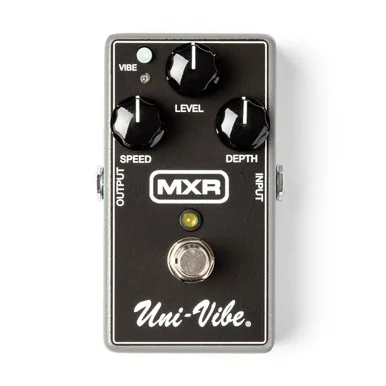
- MXR Uni-Vibe Chorus/Vibrato: a compact chorus/vibrato pedal with Chorus and Vibrato modes and true bypass13.
- Authentic Hendrix '68 Shrine Series Uni-Vibe Chorus/Vibrato: three knobs (Speed, Level, Depth) and a Vibe button toggling chorus and vibrato modes153.
- Uni-Vibe Stereo Chorus (UV1SC): a stereo chorus pedal inspired by the original classic Uni-Vibe, with left and right outputs and a variable mix from spatially wide to classic mono25.
The original Uni-Vibe does not have true bypass. It handled bypass by deactivating the LFO, so the signal still passes through the static phase-shift stages and picks up a subtle coloration1. Modern versions such as the MXR Uni-Vibe Chorus/Vibrato add true bypass switching26.
Videos
JHS Pedals
ProGuitarShopDemos
AskAGuitarPro
Questions
Is a Uni-Vibe a phaser or a chorus?
It is really a phaser. The circuit is basically a four-stage optical phase shifter, but the original makers labeled its phase-shifting sound Chorus because it was built to imitate a Leslie rotating speaker. In Chorus mode the dry signal is mixed back with the phase-shifted signal, which is what gives it that pulsing, swirling character.
Did Jimi Hendrix use a Uni-Vibe?
Yes. Hendrix used a vintage Shin-ei unit from 1969 to 1970, and the effect can be heard on the Band of Gypsys record and his Woodstock performance of The Star Spangled Banner, on songs such as Machine Gun. David Gilmour and Robin Trower also used it, live and on records.
Does the Uni-Vibe go before or after fuzz?
The Uni-Vibe is a vintage-style effect with a transistor preamp that colors the signal even when the modulation is off, so placement matters more than with a modern true-bypass pedal. Players typically run it after fuzz in the modulation section of the signal chain, the way Hendrix did with his vintage unit.
Does the original Uni-Vibe have true bypass?
No. The original handled bypass by deactivating the LFO, so the signal still passes through the static phase-shift stages and picks up a subtle coloration. Modern versions such as the MXR Uni-Vibe Chorus/Vibrato add true bypass switching.
Who invented the Uni-Vibe?
Fumio Mieda, a Japanese engineer, designed it for a company called Honey, which became Shin-ei. He reportedly said his inspiration came from the sound of shortwave radio signals, and the unit was built to emulate the Doppler sound of a Leslie speaker.
Who owns the Uni-Vibe trademark?
Uni-Vibe is a registered trademark of Dunlop Manufacturing, Inc. Dunlop makes current Uni-Vibe pedals under its own name and its MXR brand, including the MXR Uni-Vibe Chorus/Vibrato and the Authentic Hendrix series.
Sources (26)
- Straylight Chorus Vibe / Univox Uni-Vibe®, Aion FX, 2024-07-04
- Black LTD. Phaser Vibe, Mr. Black
- JHMS3.pdf, Jim Dunlop (jimdunlop.com), 2023
- What was the original univibe effect?, Strymon, 2015-06-30
- VIBERATOR Stereo Uni-Vibe, Dawner Prince Electronics
- Review: Greuter Audio Moonlight & Vibe, guitar.com, 2021-02-02
- Angels Univibe, Jed's Peds (jedspeds.co.uk)
- LEGENDARY PHASERS, JHS Pedals
- The FX files: Uni-Vibe, MusicRadar, 2019-04-10
- UNDERSTANDING MODULATION PEDALS, JHS Pedals
- All About… Modulation, Guitar.com, 2016-04-18
- Guitar Phaser Pedal Types: JFET, Optical, OTA, and Others, Function f(x), 2022-03-18
- Dunlop MXR Uni-Vibe Chorus / Vibrato, Pedal of the Day (pedal-of-the-day.com), 2014-12-20
- MXR® UNI-VIBE® CHORUS/VIBRATO, Dunlop (jimdunlop.com)
- Dunlop honors Jimi Hendrix's iconic effects with Authentic Hendrix '68 Shrine mini pedals, Guitar World, 2023-02-02
- UNI-VIBE® FOOT CONTROL, Dunlop (jimdunlop.com)
- The Ghost Vibe, tru-fi.com
- Review: Dunlop Authentic Hendrix ’69 Psych Series Pedals, Guitar.com, 2019-11-12
- HD-S - PÉDALES D'EFFET EN KIT | KORG (Canada - FR), KORG Inc.
- Modulation Nation: Chorus, Phasing, and Flanging, Premier Guitar, 2018-09-20
- The 9 Best Uni-Vibe Pedals In 2024: A Guide To UniVibe Clones, Delicious Audio (delicious-audio.com), 2024-02-16
- Micro Vibe (NOS), Voodoo Lab, 2026-10-14
- The Swirl Start of the Univibe vintage guitar pedal, tru-fi.com
- http:, ToneQuest Report (republished on analogman.com), 2001-11
- UV1SC Uni-Vibe Stereo Chorus by Dunlop, RockBoard (rockboard.de), 2026
- M68.pdf, Jim Dunlop, 2019