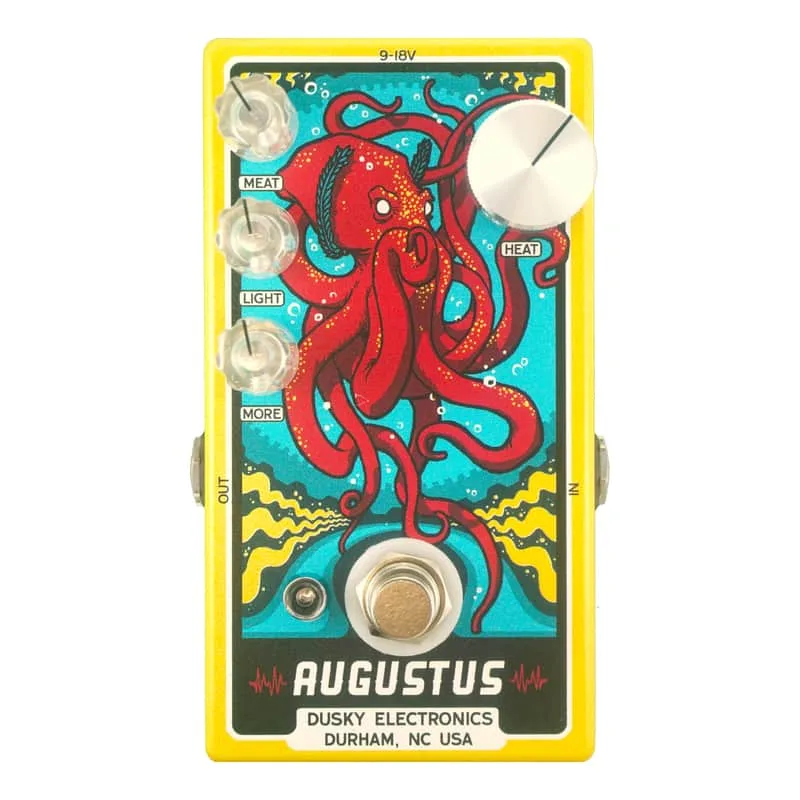


The Dusky Electronics Augustus is an octave fuzz pedal from a North Carolina maker, hand built in Durham by Chris Rossi, who owns the company and designed the pedal12. It was announced in September 2020, became available on September 29 of that year at a list price of $2003, and went on to become Dusky Electronics' best selling pedal to date, according to a 2022 Premier Guitar news piece4.
Like the Octavia designed by Roger Mayer in the late 1960s, the Augustus works by rectifying the audio signal fed into it, folding each wave in two to double its frequency2. That is what gives an octave fuzz its doubled-up overtone on top of the fuzz. Dusky describes the result as "severely mangling the waveform in the process"1, and Delicious Audio's product page lists the territory it covers: "Soaring leads, synth-like timbres, echoes of ring mod, giant robot power chords, percussive stabs"2.
An octave-up fuzz that folds the wave
An octave fuzz is not a pitch shifter. Instead of measuring the note and generating a new one, it distorts the signal so hard that the waveform gets folded over on itself, and the folding doubles the frequency of what you play. The Augustus rectifies the incoming audio signal and folds each wave in two, which produces the octave-up component2. Because the effect comes from mangling the wave rather than tracking it, the doubled octave sits on top of a fuzz tone rather than replacing your clean note.
Guitar World's reviewer, Paul Riario, called it "a multilayered octave fuzz that can throw your guitar sound into some gnarly post-Octavia shapes," and his overall verdict was that it is "a sea monster stompbox that many a rock player would want on their pedalboard"1.
The Augustus is not a vintage reissue. Delicious Audio describes it as "a reimagined octave fuzz" whose MOSFET input and output amplifiers and high impedance input buffer make it more flexible, responsive, and dynamic than the circuits it descends from2. Guitar World likewise notes a MOSFET input for increased response and dynamics1.
The controls: Meat, Light, Heat and More
The pedal has four knobs, and their names map to familiar jobs. MusicRadar's Jonathan Horsley broke them down at launch5:
| Control | What it does |
|---|---|
| Heat | Dials in how much fuzz you want; also sets the octave level56 |
| Meat | Controls how much bass is in your signal5 |
| Light | Treble, the high-frequency content5 |
| More | The output volume5 |
Guitar Pedal X's roundup of 2020's new fuzz pedals summarized the same layout as "4 smart controls," with Heat handling gain plus octave level, Meat and Light acting as the two EQ controls for tone sculpting, and More setting output level6. Dusky's own announcement pitched it as "a versatile set of controls, enabling a wide range of tones"7.
Having separate bass and treble controls is worth noting on an octave fuzz. Classic designs of this type tend to be all-or-nothing in their voicing, and the octave-up component is most audible in the upper register. On the original Octavia, Coda Effects notes, "This octave effect is more pronounced around the 12th fret, so it is more hear-able during solos"8. With Meat and Light on separate knobs, a player can keep low-end weight under chords while still pushing the highs where the doubled octave lives.
How it relates to Roger Mayer's Octavia
The family resemblance is real but the circuit is not. Delicious Audio calls the Augustus "an octave fuzz in the spirit, though not at all the same design, as the Octavia designed by Roger Mayer" in the late 1960s2. Premier Guitar makes the same point in its vintage octave fuzz coverage: Dusky follows the same principle of folding the input frequency in two to create an octave-up sound, but "Dusky uses a different circuit to achieve the same effect"9. Guitar World's review is categorical: "Neither an 'Octavia' clone nor a sub-octave fuzz, the Augustus is an original design"1.
The original Octavia has its own history. Roger Mayer's product page notes that in the space of less than a year, at least 15 variations and evolutions of the design had been produced, and that the unit manufactured today represents the latest evolution of the Octavia that Jimi Hendrix used, with feedforward and gating10. Coda Effects describes its character: "It has quite an aggressive sound, which can be slightly dissonant (because the octave is never perfect in terms of pitch)"8. Mayer's company is still going today, building its classic effects with studio-grade components and a focus on recording applications, according to Delicious Audio's buying guide11.
The Augustus differs from that lineage in two practical ways. First, its MOSFET input and output amplifiers are a modern touch aimed at responsiveness and dynamics2. Second, and more unusual for the type, it has a buffer.
Does the Augustus have a buffer?
Yes, and it is one of the pedal's distinguishing features. The Augustus has a specially designed high-impedance input buffer, which Dusky says allows for flexible placement in the signal chain7. Delicious Audio spells out what that means for a player: "a high impedance input buffer lets Augustus sound the same wherever it is in your pedal chain"2.
That matters because octave fuzzes of the classic Octavia type are notoriously placement-sensitive; their wave-folding circuits interact with whatever feeds them. A buffered input decouples the fuzz circuit from the rest of the board, so the pedal behaves consistently whether it is first in line or after other pedals. Players comparing it against an unbuffered vintage-style octave fuzz should expect that difference in how each reacts to its neighbors. Guitar World's review confirms the high-impedance input buffer and the MOSFET input among the pedal's features1.
Power, build and where it came from
The Augustus runs on a 9V battery or a 9 to 18V DC adaptor, with 9V recommended1. A battery power option was listed among its features at announcement7. Connections are a standard input and a standard output1.
The pedal is hand built in Durham, North Carolina by Chris Rossi, and Delicious Audio's product page notes it is "sporting a truly beautiful illustration" on the enclosure2. Guitar World describes the build as solid1. The name, per Delicious Audio, was inspired by a Roman emperor with a knack for territorial expansion as well as by the Octavia circuit2.
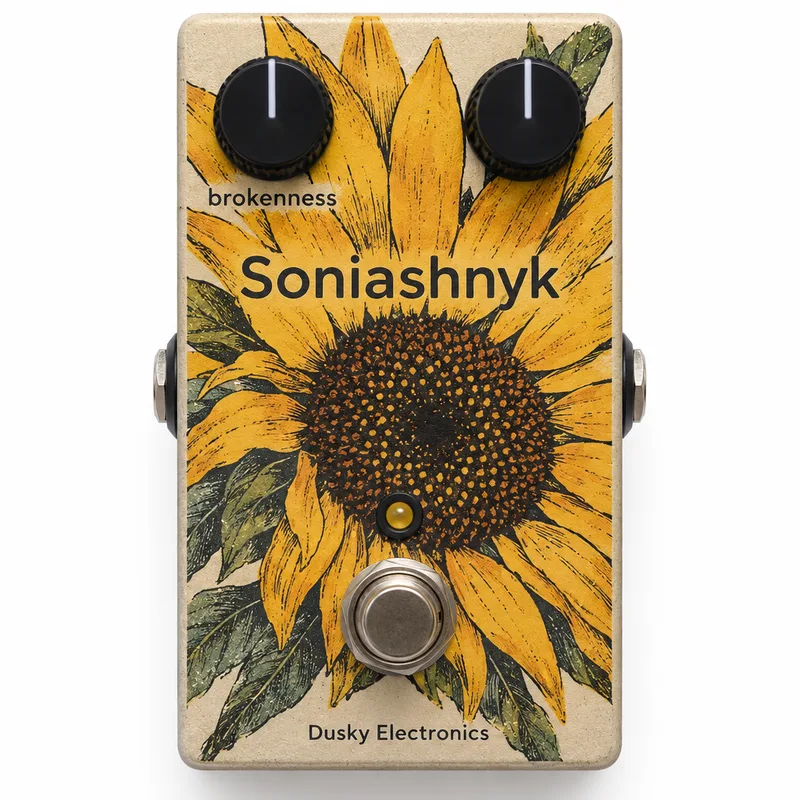
Dusky Electronics announced the Augustus on September 29, 2020, with shipping starting the same day72. GuitarPlayer reported the launch price as $200, available starting September 293, and Guitar World's later review lists the same $200 price1. By 2022, Premier Guitar reported that the Augustus was the company's best selling pedal to date, and that Dusky's follow-up, the Soniashnyk, was based on it4.
Videos
Premier Guitar
Dusky Electronics
Noise Generator
Questions
Is the Dusky Augustus an Octavia clone?
No. Guitar World's review states plainly that it is neither an Octavia clone nor a sub-octave fuzz, but an original design. It follows the same principle as Roger Mayer's Octavia, folding the input wave in two to double its frequency, but Dusky uses a different circuit to achieve the effect, with MOSFET amplifiers and a buffered input.
Does the Augustus run on a 9V battery?
Yes. The pedal can be run with a 9V battery or from a 9 to 18V DC power source, with 9V recommended. A battery power option was listed among its features when Dusky Electronics announced the pedal in September 2020.
Can the Dusky Augustus run at 18 volts?
Yes. Guitar World's spec listing gives the power requirement as a 9V battery or a 9 to 18V DC adaptor, with 9V recommended, so the pedal accepts anything in that range.
Does the Augustus have a buffer?
Yes. It has a specially designed high-impedance input buffer, which Dusky says lets the pedal sound the same wherever it sits in your signal chain. That is unusual for an octave fuzz, since classic designs of this type are famously sensitive to placement.
Who designed the Dusky Augustus?
Chris Rossi, owner of Dusky Electronics, designed the Augustus and hand builds each one in Durham, North Carolina. The pedal became the company's best selling pedal to date, according to a 2022 Premier Guitar news piece.
Sources (11)
- Dusky Electronics Augustus Octave Fuzz review, Guitar World, 2021-08-25
- Dusky Augustus Octave Fuzz, Delicious Audio, 2021-01-14
- Dusky Electronics Introduces New Augustus Fuzz Pedal, GuitarPlayer, 2020-09-23
- Dusky Electronics Releases the Soniashnyk Fuzz, Premier Guitar, 2022-04-19
- Add depth, dirt and harmonics with the Dusky Electronics Augustus octave fuzz, MusicRadar, 2020-09-23
- Guitar Pedal X, Guitar Pedal X, 2020-12-18
- Dusky Electronics Announces the Augustus, Premier Guitar, 2020-09-29
- Coda Effects, Coda Effects, 2015-08
- Vintage Octave Fuzz ... Without the Fear, Premier Guitar, 2021-01-14
- Guitar Effects Pedals by Roger Mayer, roger-mayer.co.uk, 1967
- The Best Octavia Fuzz Pedals In 2023: Clones And Evolutions, Delicious Audio, 2023-03-09