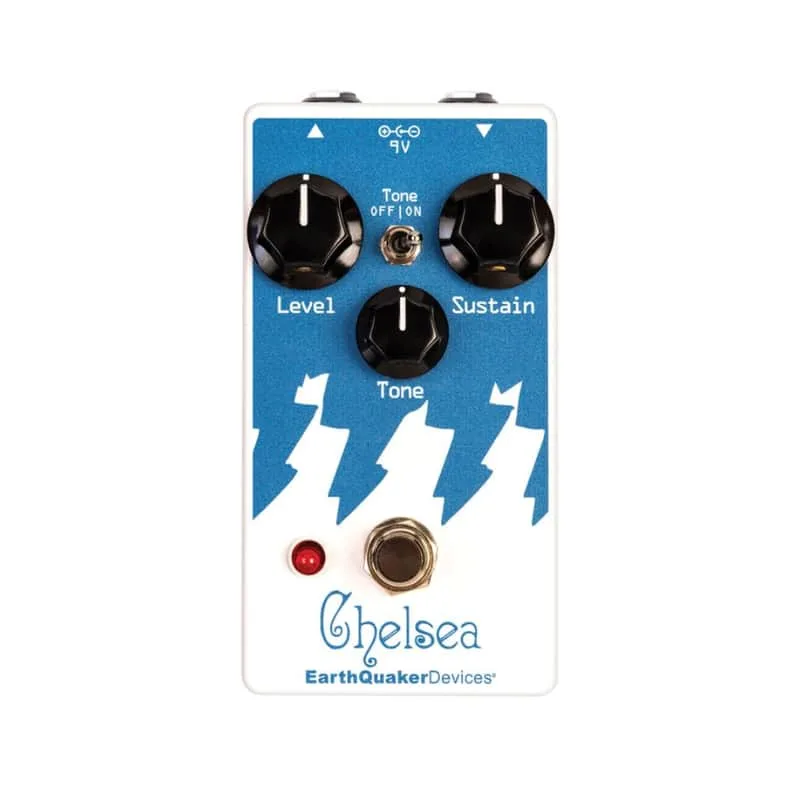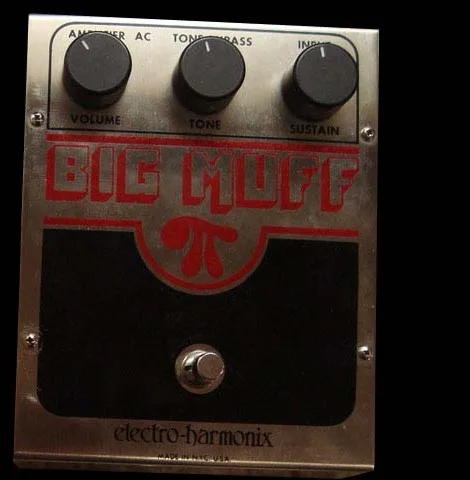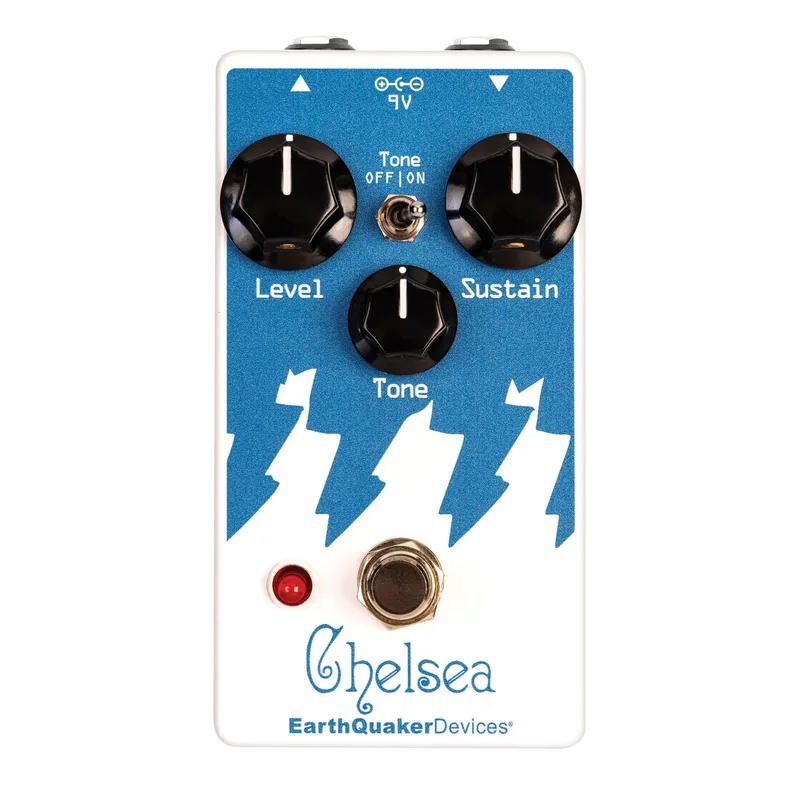


The EarthQuaker Devices Chelsea is a Low End Fuzz Driver, a three-knob analog fuzz pedal built in collaboration with James Murphy of LCD Soundsystem. It is a recreation of a specific vintage Big Muff Pi that Murphy bought in 1989, a unit that shaped LCD Soundsystem's bass tones for decades12. EarthQuaker describes the range as everything from light overdrive to full-on distortion, "heavy without being too heavy, clean but not too clean"1.
Guitar.com's reviewer placed its voice close to a slightly lower-gain vintage Big Muff, without the extreme saturation and razor-sharp mid-scoop of the modern NYC Muff, and Premier Guitar heard a Big Muff-style voice that "leans more Ram's Head than Sovtek"23. It was announced in March 2025 and is handmade at EarthQuaker Devices headquarters in Akron, Ohio, carrying the company's limited lifetime warranty14.
A Big Muff voiced for low end
The Chelsea is a signature recreation of one particular pedal: a V6 transistor Big Muff Pi that James Murphy purchased in 19892. Guitar World's reviewer traced the circuit further, calling it "a part-changed version of the rare transistor Big Muff version 3, the Muff that introduced a tone bypass prior to the version 4 and 5 op-amp Muffs"5. That lineage explains the pedal's most distinctive feature, its Tone On/Off switch, which echoes the tone bypass of those early transistor Muffs.
Where many Muff-style pedals lose bottom end under fuzz, the Chelsea was designed to keep it. Guitar.com rated the pedal 8 overall and listed its low-end response as "better than a lot of other Muff-style pedals," with great fuzz sounds across both guitar and bass2. Premier Guitar's reviewer came away calling it "a source of rich and blistering tones, and a distinctive alternative to early Triangle-, Ram's Head-, and V6-style Big Muff sounds"3.
"It's heavy without being too heavy, clean but not too clean."
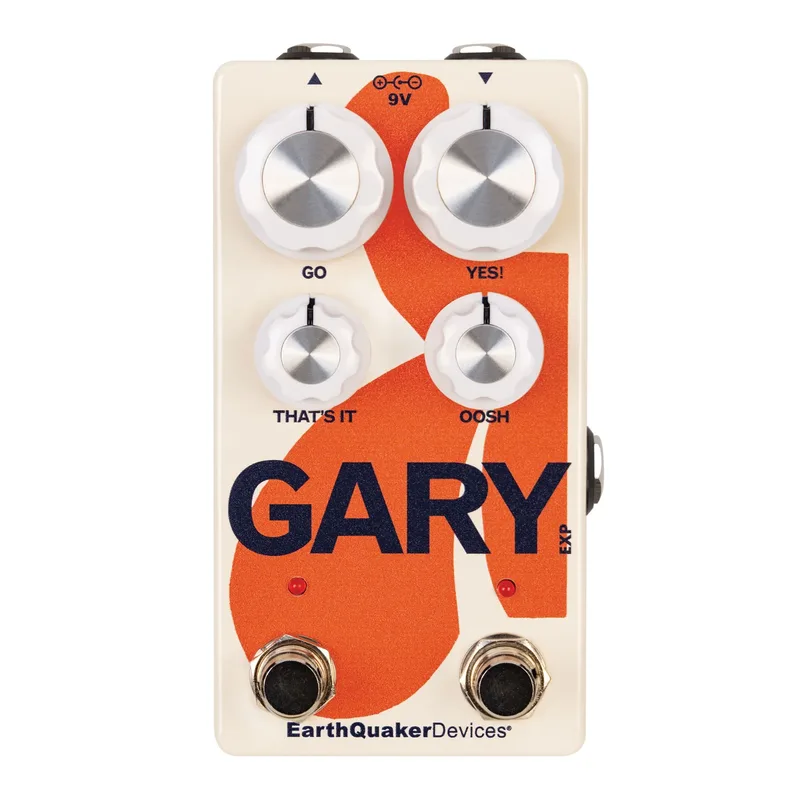
The pedal sits in a line of EarthQuaker collaboration fuzzes: it followed the Gary, made with Joe Talbot of Idles, as the latest collaboration fuzz circuit from the company7. Guitar World's reviewer also found it offers "more usable gain range than many Big Muffs," which matters if you want fuzz that cleans up into overdrive rather than living at one saturated setting5.
The controls
Three knobs and one mini-switch run the whole pedal8.
| Control | What it does |
|---|---|
| Sustain | Adjusts the amount of distortion and sustain, shaping distortion intensity and note decay16 |
| Tone | Clockwise boosts treble; counterclockwise enhances bass6 |
| Level | Sets output volume6 |
| Tone On/Off switch | Removes the Tone control from the circuit for a more mid-focused response1 |
The Tone switch is the feature that sets the Chelsea apart from a standard three-knob Muff clone. With the tone circuit in, you get the familiar Big Muff voicing; switch it out and Delicious Audio describes the result as "a raw, mid-forward roar"6. Gearnews noted the switch adds versatility, offering a mid-focused grind when the tone circuit is bypassed, which helps a fuzzed bass or guitar cut through a mix where a scooped Muff would disappear7.
Power and bypass
The Chelsea takes a standard 9V DC power supply with a 2.1mm negative center barrel and draws 10 mA14.
The Chelsea uses relay-based true bypass switching and requires power to pass signal1. Unlike a mechanically switched true bypass pedal, it will not pass your dry signal if it loses power, so it needs a live 9V DC supply on the board at all times.
The switching itself is a soft-touch momentary footswitch operating the relay true bypass, which EarthQuaker uses for silent, press-friendly engagement2. Input, output and power jacks round out the connectivity5.
Where it came from
The pedal's name comes from its origin story. Murphy bought his vintage Big Muff in 1989 from a guitar shop in the Chelsea neighborhood of New York City, and EarthQuaker named the recreation after that shop16. The company set out to recreate "all the idiosyncrasies" of that specific, battered unit rather than a generic Muff circuit1.
EarthQuaker Devices founder Jamie Stillman designed the pedal with Murphy's collaboration, writing in his design notes that Chelsea is based on "a very special kind of pedal"9. The unit it recreates was owned and used by Murphy throughout LCD Soundsystem's career, making the Chelsea a signature pedal in the strict sense: a copy of the actual fuzz on those records10.
What reviewers said
Published reviews were positive across the board:
- Guitar.com (Cillian Breathnach, July 2025): rated 8, praising great fuzz sounds across guitar and bass, low-end response better than many Muff-style pedals, and the versatility of the tone bypass2.
- Premier Guitar (June 2025): found it a distinctive alternative to early Triangle-, Ram's Head- and V6-style Big Muff sounds, with rich and blistering tones for guitarists3.
- Guitar World (Alex Lynham, 2026): highlighted its more usable gain range than many Big Muffs, at a price of $1795.
- Guitar World (news, March 2025): reported it sounds "just as epic when paired with an electric guitar" as it does on bass8.
Delicious Audio summed up the pedal's range as delivering "everything from tight overdrive to blown-speaker chaos" in a roadworthy enclosure6.
Videos
EarthQuakerDevices
Long & McQuade Musical Instruments
B's Music Shop
Questions
Does the EarthQuaker Chelsea pass signal without power?
No. The Chelsea uses relay-based true bypass switching, and EarthQuaker Devices states that it requires power to pass signal. If your power supply fails or is unplugged, the pedal goes silent rather than falling back to a hard-wired bypass, so it needs a working 9V DC supply on your board at all times.
Is the Chelsea good on bass?
Yes. It was designed as a Low End Fuzz Driver with bass in mind, and Guitar.com's reviewer found its low-end response better than a lot of other Muff-style pedals. EarthQuaker describes it as heavy without being too heavy, and it also works with electric guitar, so it covers both instruments.
What Big Muff is the Chelsea based on?
It is based on a V6 transistor Big Muff Pi that James Murphy of LCD Soundsystem purchased in 1989. Guitar World describes the circuit as a part-changed version of the rare transistor Big Muff version 3, the Muff that introduced a tone bypass before the op-amp versions 4 and 5.
Why is it called the Chelsea?
It is named after the guitar shop in New York City where James Murphy bought the original vintage Big Muff back in 1989. EarthQuaker Devices kept the shop's name for the pedal that recreates the idiosyncrasies of that specific well-worn unit.
Is the EarthQuaker Chelsea analog?
Yes. Delicious Audio describes it as a fully analog three-knob fuzz, and the circuit is a recreation of a vintage transistor Big Muff rather than a digital model. The only modern touches are the relay-based true bypass switching and the soft-touch momentary footswitch.
Sources (10)
- Chelsea Low End Fuzz Driver, EarthQuaker Devices
- EQD Chelsea Low-End Fuzz Driver review: a bass-friendly big muff, Guitar.com, 2025-07-21
- EarthQuaker Chelsea Low End Fuzz Driver Review, Premier Guitar, 2025-06-12
- EarthQuaker Unveils LCD Soundsystem Chelsea Low End Fuzz Driver, Bass Magazine, 2025-03-05
- EarthQuaker Devices Chelsea Low End Fuzz Driver Pedal review, Guitar World, 2025-06-30
- Earthquaker Devices Chelsea Fuzz, Delicious Audio, 2025-07-24
- EarthQuaker Devices Chelsea: LCD Soundsystem Fuzz, gearnews.com, 2025-03-04
- EarthQuaker Devices & LCD Soundsystem release Chelsea Low End Fuzz Driver, Guitar World, 2025-03-11
- “I'm going to guess that you have heard this pedal”: EarthQuaker Devices and LCD Soundsystem join forces for a “one-of-a-kind” pedal based on James Murphy's vintage fuzz, MusicRadar, 2025-03-04
- A guide to the best Big Muff-style pedals, from classic reissues to boutique oddities, Guitar.com, 2025-07-30