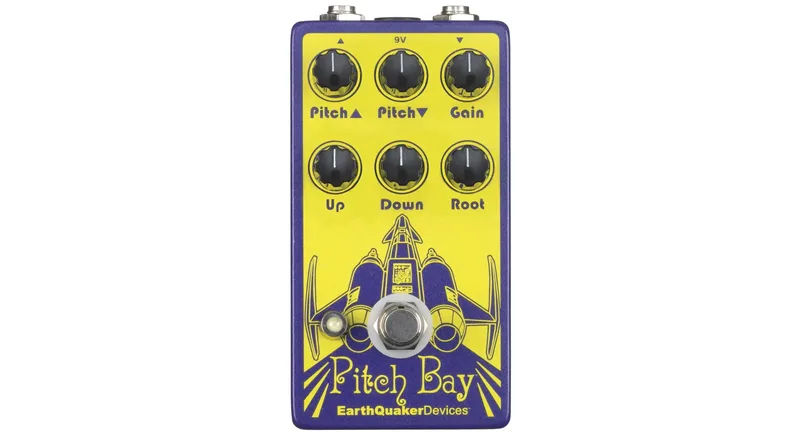


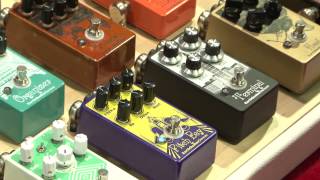
The EarthQuaker Devices Pitch Bay is a three-part polyphonic harmonizer and overdrive in a compact pedal. It takes your note, keeps an analog copy of it, and adds two pitch-shifted voices on top: one tuned above the root and one below, each adjustable in semitones. A gain control runs the whole thing from clean to heavily distorted, so it works as a subtle harmony tool or a full-on harmonized distortion box12.
EarthQuaker Devices positions it as a sound-shaping tool with a wide range. The maker describes everything from "rumbling sub-octaves, dissonant tone clusters, soaring octave-up lead sounds, to ripping NWOBHM lead guitar harmonies"1. The Pitch Bay is no longer in production, so it is a secondhand buy today1.
What it does and how it works
The Pitch Bay generates three voices at once. The root voice is your original note, and EarthQuaker keeps it all-analog through the mixer section1. The other two voices are produced by a digital pitch shifting engine: as Premier Guitar put it, "While the root-note signal moves through an all-analog signal path, the two octave signals are digitally processed"3. Each voice has its own level control that can be cut or boosted, so you can dial a harmony far back in the mix or mute the root entirely and hear only the shifted notes6.
The two harmonizers are labeled Pitch Up and Pitch Down. Each is tunable in semitones from one octave below the root to one octave above, in stepped positions from 1 to 12 semitones17. Premier Guitar's reviewer found the two pitch knobs also sweep continuously, covering "all 12 semitones and the microtones in between," which opens up detuned and dissonant intervals that stepped controls would skip3.
Because the pitch shifting is polyphonic, chords track as well as single notes, which is what separates a harmonizer like this from a simple octave pedal that only doubles or halves a note12.
Controls
| Control | What it does |
|---|---|
| Pitch Up | Selects the upper harmony, 12 semitones starting at 1 above the root1 |
| Pitch Down | Selects the lower harmony, 12 semitones starting at 12 below the root1 |
| Gain | Turn clockwise to increase the gain, from clean to heavily distorted12 |
| Down | Level control for the lower harmony1 |
| Up / Root | Level controls for the upper harmony and the analog root signal7 |
The pedal has six knobs total, mono in and out, and a single true-bypass stomp switch15. The enclosure carries one of EarthQuaker's painted designs, a sci-fi rocket ship in purple and yellow5.
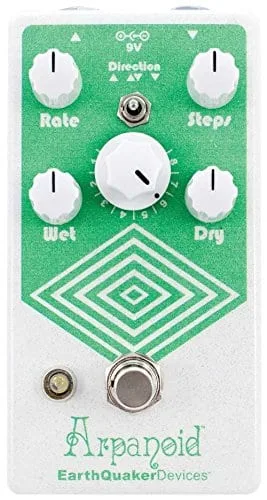
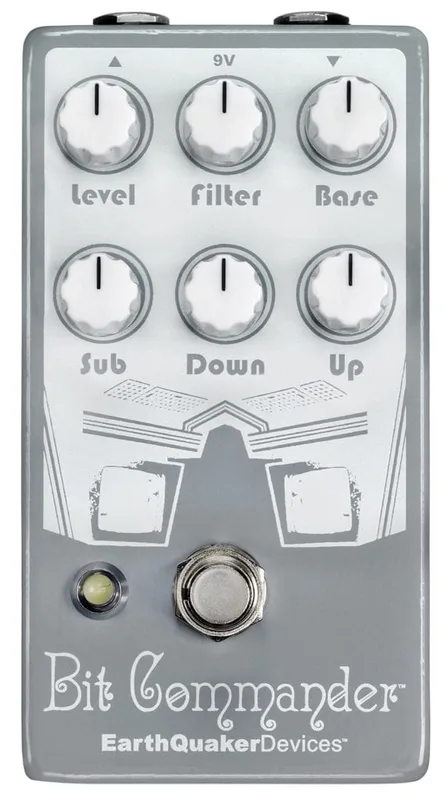
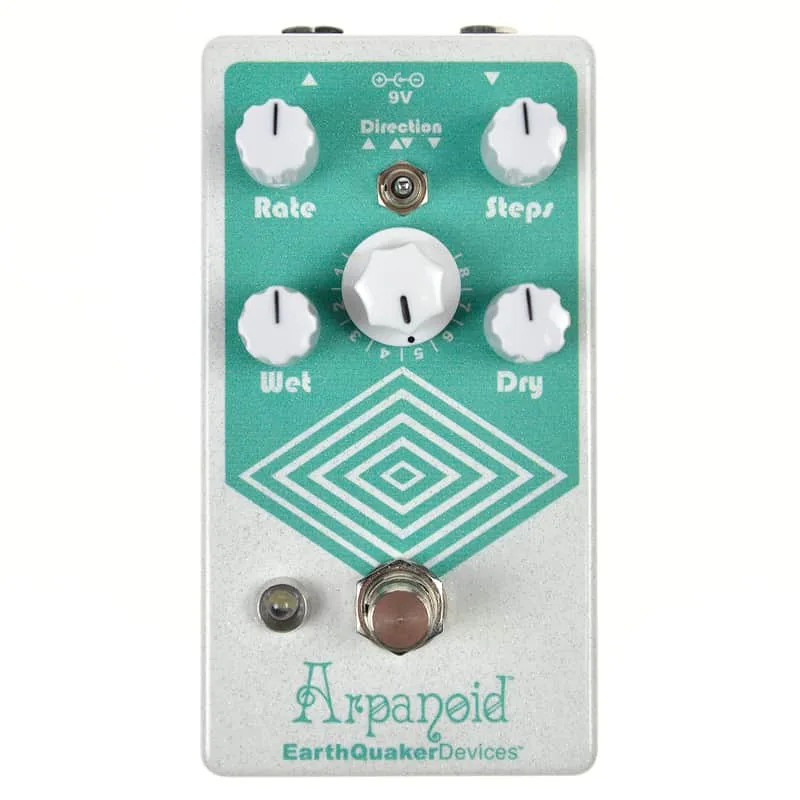
The gain stage is the part that makes the Pitch Bay more than a pitch shifter. Guitar World described it at launch as "an adjustable input gain that goes from clean to heavily distorted," so the harmonies can stay pristine or get pushed into harmonized fuzz territory2. For players who want the pitch side without the drive, EarthQuaker's line also includes the Arpanoid V2 arpeggiator and the Bit Commander V2, which stack octaves in a different way.
Where it came from
The Pitch Bay comes from EarthQuaker Devices3. It is built as a three-voice machine: a pitch-up voice adjustable from 1 to 12 semitones above the root, a pitch-down voice adjustable from 1 to 12 semitones below it, and the root itself on an all-analog dry path7. The two top and left-most knobs give sweepable pitch adjustment covering all 12 semitones and the microtones in between, dedicated to the octave below the root3. EarthQuaker Devices describes the range as "everything from rumbling sub-octaves, dissonant tone clusters, soaring octave-up lead sounds, to ripping NWOBHM lead guitar harmonies"1. The enclosure carries one of the maker's signature artful paintings, a sci-fi rocket ship in purple and yellow5.
What reviewers said
Premier Guitar's review was positive on both the practical and experimental sides, calling it3:
"A harmonizer that's easy to tune. Lots of practical applications and unconventional sounds. Even slightly out-of-tune harmonies sound cool."3
The same reviewer noted it "sounds fantastic with other effects," meaning it holds up in a chain rather than needing to sit last3. Bass Gear Magazine reviewed it alongside the Hoof and Reaper, confirming the $225 price and the 9.4 oz weight4. Delicious Audio's write-up highlighted the six-knob layout and the rocket ship artwork as typical of EarthQuaker's presentation5.
Videos
ProGuitarShopDemos
Premier Guitar
Guitar World
Questions
Is the EarthQuaker Pitch Bay still made?
No. EarthQuaker Devices lists the Pitch Bay as no longer in production, so it is only available secondhand. It sold for $225 when it was current, and used prices now depend on the market. Players looking for a new EarthQuaker pitch pedal will find other models in the company's octave and pitch line.
Is the Pitch Bay analog or digital?
It is a hybrid. The root note, your dry signal, moves through an all-analog signal path, while the two pitch-shifted voices are produced by a digital pitch shifting engine. The gain stage that drives the whole thing is part of the analog side, so your original note stays analog from input to output.
What intervals can the Pitch Bay play?
Each of its two harmonizer voices is tunable in stepped semitones from 1 to 12 semitones, a full octave, above and below the root. Premier Guitar's reviewer also found the pitch knobs sweep continuously through the microtones between semitones, so detuned and dissonant intervals are available too.
Is the EarthQuaker Pitch Bay true bypass?
Yes. EarthQuaker Devices states that each Pitch Bay is true bypass, so with the pedal off your signal passes through without buffering or coloration. It runs on a standard 9V DC supply with a 2.1mm negative center barrel and draws 65 mA.
Sources (7)
- Pitch Bay, EarthQuaker Devices
- NAMM 2014 Video: Earthquaker Pitch Bay & Terminal, Guitar World, 2014-01-28
- EarthQuaker Devices Pitch Bay Review, Premier Guitar, 2014-09-18
- Bassic Review, Bass Gear Magazine, 2019-08-27
- Pedal Reviews: Earthquaker Devices Pitch Bay, Delicious Audio, 2014-04-04
- EarthQuaker Debuts Pitch Bay, Terminal Fuzz, Vintage Guitar magazine, 2014-01-13
- New EarthQuaker Pitch Bay & Terminal Fuzz Released, Premier Guitar, 2014-01-13