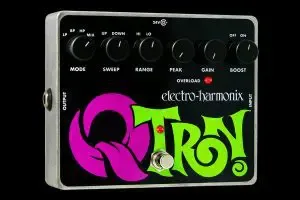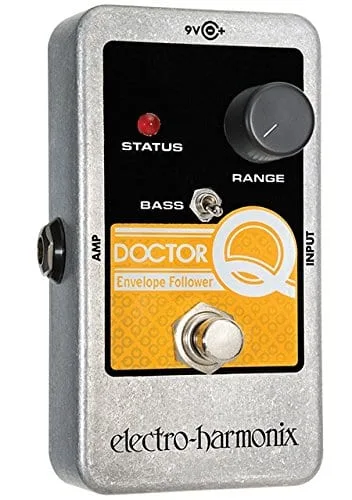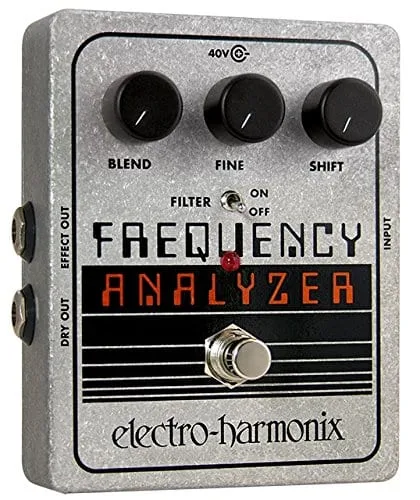


The Electro-Harmonix Blurst is a modulated filter pedal released in 2017. Where an envelope filter such as the EHX Q-Tron sweeps its filter in response to how hard you play, the Blurst drives its filter from an internal low frequency oscillator (LFO), which acts similar to a phaser or tremolo1. The result is a repeating, rhythmic filter sweep you can sync to your tempo rather than one triggered by every note.
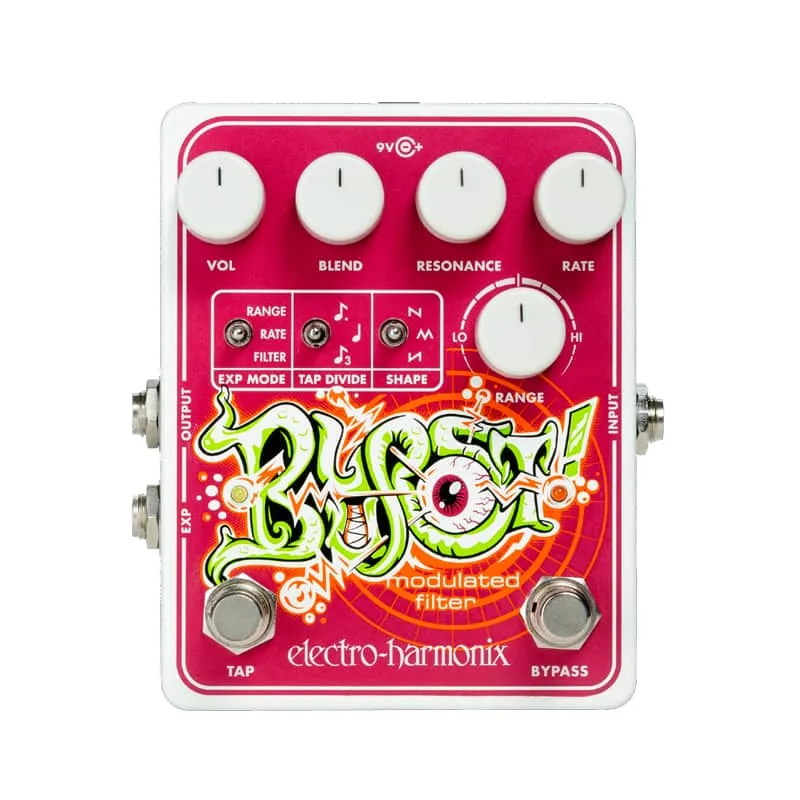
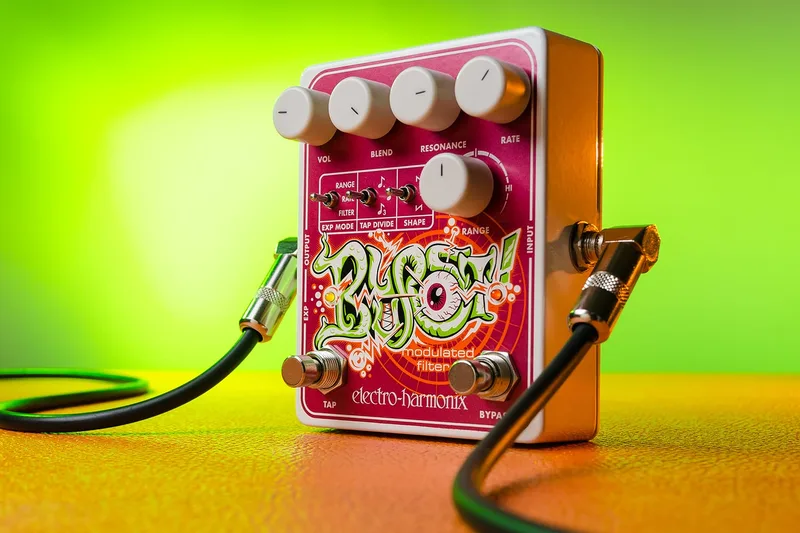
The pedal is built around an analog low pass filter with adjustable resonance2, and Electro-Harmonix describes it as "an expressive modulated filter bridging the worlds of guitar effects and modular synthesis"3. MusicRadar's reviewers noted the family resemblance to a wah, with one distinction worth knowing: a wah is a bandpass filter, while the Blurst is a low pass4. It was announced at NAMM 2017 in a pink and green enclosure with a lurid graphic on the front, which gearnews.com called "unique-looking"5.
What the Blurst does to your sound
The Blurst modulates an instrument's sound like an envelope filter, but instead of the filter's response being controlled by your playing, it is driven by the internal oscillator26. That makes it closer in spirit to a slow phaser or tremolo: the sweep repeats continuously at whatever rate you set, and you shape its character with the knobs and switches rather than with your attack.
Because the sweep is periodic, it suits rhythmic parts where you want the filter to pulse in time. Performer Magazine's Chris Devine found that with an expression pedal added, "it becomes a cross of a hyper tunable wah wah and a Univibe"8.
The controls
The front panel keeps it simple: three knobs, three switches and a tap footswitch3.
| Control | What it does |
|---|---|
| Rate knob | Controls the speed of modulation3 |
| Range knob | Sets the frequency range of the filter's modulation3 |
| Volume knob | Sets the output volume in effect mode3 |
| Shape switch | Sets the waveform shape of the LFO3 |
| Tap Divide switch | Sets the note type based on tapped-in quarter notes3 |
| EXP mode switch | Determines which parameter the expression pedal controls3 |
| Tap footswitch | Taps in a tempo for the LFO3 |
| Bypass footswitch | Engages and bypasses the effect |
Rate, Range and Volume are the core sound-shapers: Rate sets how fast the filter sweeps, Range sets where in the frequency spectrum it sweeps, and Volume compensates for level changes when the effect is on3. The modulation itself works off LFOs, and the Shape switch sets the waveform from triangle to rising and falling sawtooth forms8. A triangle wave gives a smooth, even sweep; the sawtooth settings produce a sharper rise or fall, which reads as a more vocal, wah-like motion.
Tap tempo, note divisions and LFO shapes
The Tap footswitch lets you set the speed or rate hands-free, tapping quarter notes to lock the sweep to your tempo1. The Tap Divide switch then sets the note type based on those tapped quarter notes3, with repeats settable to quarter notes, dotted eighths or triplets8. Premier Guitar's launch coverage described it as "a combination of the tap footswitch and tap divide toggle switch offering quarter, dotted eighth and triplet rhythms"2.
That combination is what separates the Blurst from a plain auto-wah: you can place the sweep on the beat, on an off-beat dotted-eighth pulse, or in a triplet shuffle, and it stays there as long as the tempo holds328.
Expression pedal and CV control
The quarter-inch EXP jack takes a TRS expression pedal or another control voltage device, such as the EHX 8-Step Program sequencer3. The EXP mode switch selects which of three parameters the pedal controls: range, rate or filter32.
MusicRadar's reviewers found this is where the pedal opens up: "It really comes into its own though when used with an expression pedal, and range, rate or filter can be controlled externally"4. With a sequencer like the 8-Step Program driving it, the Blurst produces what Premier Guitar's press coverage called "syncopated shuddering"2, stepping the filter through patterns rather than sweeping it smoothly. Delicious Audio also listed the Blurst among its recommended pedals for synths with CV in and out7.
Power and connections
The Blurst comes equipped with a standard EHX 9.6VDC-200mA power adapter, included in the box329. RockBoard lists its current draw as 56mA6. Audio in and out are on quarter-inch jacks, with the Output jack carrying the pedal's audio signal3.
The Blurst draws 56mA, so it needs a place on a powered pedalboard supply rather than sharing a low-current daisy chain with the rest of your pedals.6
What reviewers said
MusicRadar's overall verdict was short and positive: "A great pedal blessed with a vast array of options"4. Performer Magazine's Chris Devine highlighted the expression pedal pairing as the pedal's strongest suit, turning it into that tunable wah and Univibe hybrid8. Pedal of the Day emphasized the tap tempo workflow, noting the Tap switch sets the speed hands-free while Rate, Range and Filter can all be controlled from the Expression jack1.
Videos
Premier Guitar
Andertons Music Co
EHX
Questions
Is the EHX Blurst analog?
Yes and no. The filter itself is an analog low pass filter with adjustable resonance, but Electro-Harmonix lists the pedal as analog with digital control, and RockBoard classifies its circuit as hybrid. The audio path is analog; the control side is digital.
Does the Blurst have tap tempo?
Yes. A dedicated Tap footswitch lets you tap in a tempo for the LFO in quarter notes, and a Tap Divide switch sets the note type to quarter notes, dotted eighths or triplets, so the sweep can lock to your tempo.
Can you use an expression pedal with the Blurst?
Yes. A quarter inch EXP jack takes a TRS expression pedal or a control voltage device such as the EHX 8 Step Program sequencer. An EXP mode switch selects whether the pedal controls range, rate or filter.
What power supply does the Blurst need?
It runs on the included EHX 9.6VDC-200mA power adapter. RockBoard lists its current draw as 56mA. There is no battery option in the listed specifications.
Is the Blurst an envelope filter?
No. It modulates your sound like an envelope filter, but the filter's response is driven by an internal low frequency oscillator rather than your picking dynamics, so the sweep repeats on its own cycle like a phaser or tremolo.
Sources (9)
- Electro-Harmonix Blurst Modulated Filter, Pedal of the Day, 2018-07-16
- Electro-Harmonix Launches Blurst & Operation Overload, Premier Guitar, 2017-02-09
- Blurst! | Modulated Filter - Electro-Harmonix, Electro-Harmonix (ehx.com)
- Electro-Harmonix Blurst review, MusicRadar, 2017-12-27
- NAMM 2017: Electro-Harmonix launch Blurst modulated filter pedal, gearnews.com, 2017-01-18
- Blurst! by Electro-Harmonix, RockBoard PedalPedia, 2026
- The Best Pedals For Synths With CV In/out In 2022, Delicious Audio, 2020-10-01
- Electro-Harmonix Blurst Pedal Review, Performer Magazine, 2017-05-23
- NAMM 2017: Electro-Harmonix unveils Blurst modulated filter pedal, MusicRadar, 2017-01-18