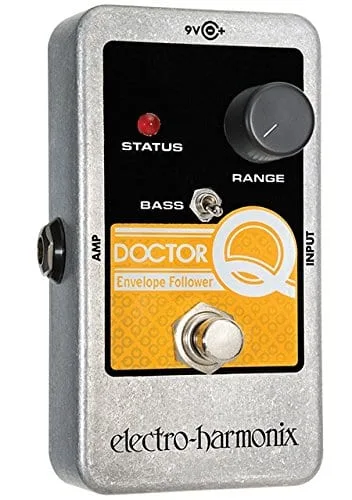


The Doctor Q is an analog envelope filter from Electro-Harmonix: a pedal that sweeps a filter in response to your picking, so the sound opens up when you play harder and closes down when you play softer. Electro-Harmonix describes it as a way to "create percussive punchy filter sweeps for a rhythmic groove and super-funky wah-like tones"1. The company positions it as "the classic 1970's funk box now available in a pocket-sized case," a reissue of its original Doctor Q envelope follower in a small modern enclosure1.
The pedal was released in 2006 and discontinued in 2020, so it is no longer made and is found only on the used market1.
How it works and how it is controlled
An envelope filter listens to the level of your signal and moves a filter up or down with it. Unlike a wah pedal, there is no rocker to move with your foot: the sweep follows your attack, which is what gives envelope filters their automatic, vocal funk character. The Doctor Q keeps this to a minimum of controls.
| Control | What it does |
|---|---|
| RANGE knob | Controls the frequency range in which the filter moves1 |
| BASS switch | In the up position, allows more low frequencies to pass; useful to boost lower frequencies when the pedal is set for little or no filter sweep1 |
| FOOTSWITCH | Selects whether the effect is engaged or in bypass; the LED lights when the pedal is engaged1 |
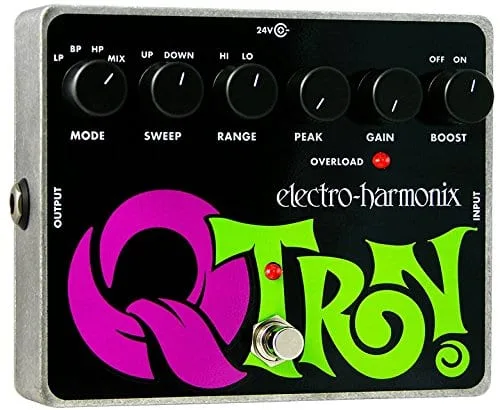
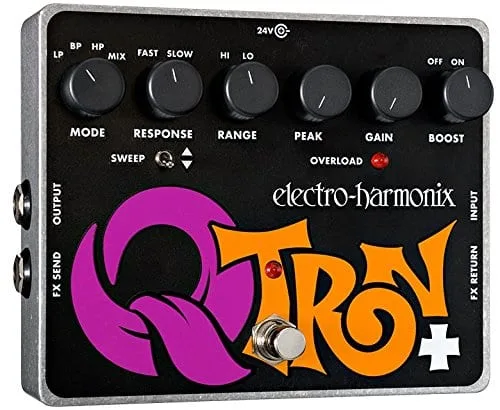
That is the whole interface: one knob, one switch, one footswitch. Electro-Harmonix calls it a "simple one-knob range control"1. For players who want more shaping, the company's larger envelope filters, such as the Q-Tron and Q-Tron Plus, offer more control over the sweep.
Power and connections
The Doctor Q runs on the 9V battery that came in the box, or on an optional 9.6VDC-200mA power adapter that was not included1. Its 2mA current draw is low enough that a battery lasts a long time and the pedal is easy on any power supply1. Signal connections are simple: a 1/4 inch input jack on one side and a 1/4 inch AMP output jack on the other1.
Electro-Harmonix lists the Doctor Q's bypass as Buffered Bypass, but the same product page describes the footswitch as selecting "True Bypass." The two statements disagree, so check the individual unit if bypass behavior matters to your rig1.
Where it came from
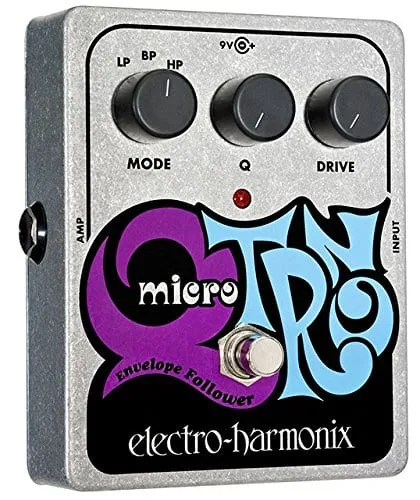
The Doctor Q name goes back to Electro-Harmonix's original 1970s envelope follower, which the company calls "the classic 1970's funk box." The 2006 version brought that circuit back in a pocket-sized enclosure measuring 4.5 x 2.75 x 2.1 inches, and it stayed in the lineup until it was discontinued in 20201. Within the Electro-Harmonix filter family it sat alongside compact options like the Nano Q-Tron and Micro Q-Tron, which remain the closest alternatives in the company's range for players seeking a small envelope filter today.
Videos
EHX
TheJRGuitars
goodfreshie
Questions
Does the Doctor Q take a 9V battery?
Yes. The Doctor Q shipped with a 9V battery included, and it can also run on an optional 9.6VDC-200mA power adapter, which was not included. For a player buying one used today, the battery route needs no extra equipment.
Is the Doctor Q true bypass or buffered?
Electro-Harmonix lists the Doctor Q's bypass as Buffered Bypass, though the product page's footswitch description refers to True Bypass. The two statements come from the same page, so treat the buffered listing as the official specification.
Is the Electro-Harmonix Doctor Q discontinued?
Yes. Electro-Harmonix discontinued the Doctor Q in 2020. It was first released in 2006 as a reissue of the classic 1970s funk box in a pocket-sized case, so it is now found only on the used market.
How much current does the Doctor Q draw?
The Doctor Q draws 2mA, which is very little even by pedal standards. A single 9V battery lasts a long time at that draw, and the pedal places almost no demand on a power supply.
Sources (1)
- Doctor Q, Electro-Harmonix, 2020