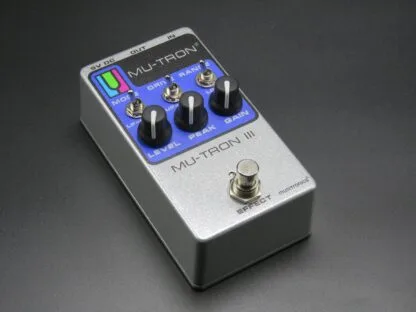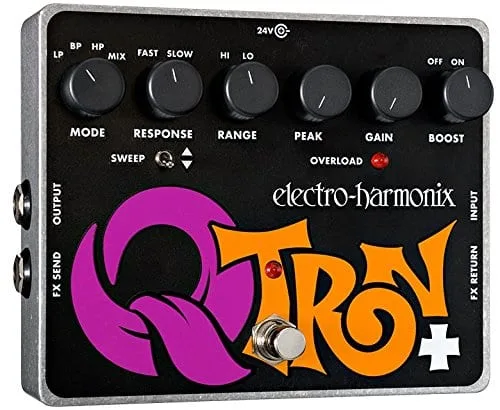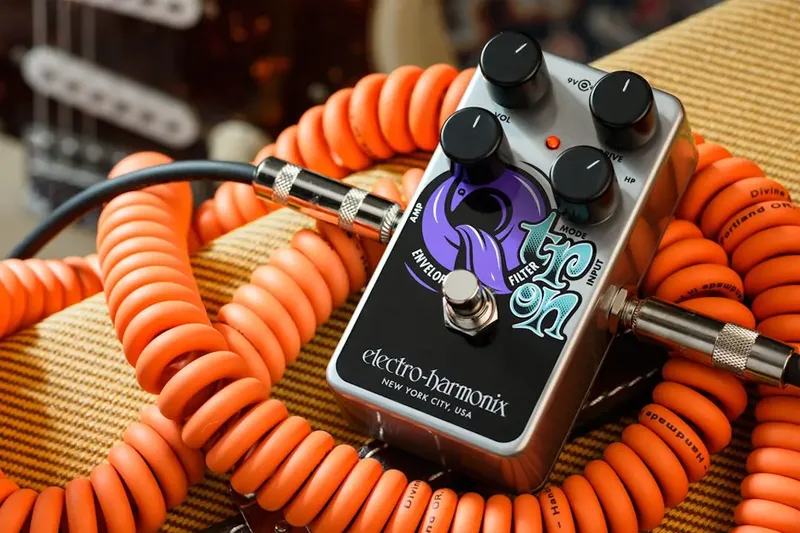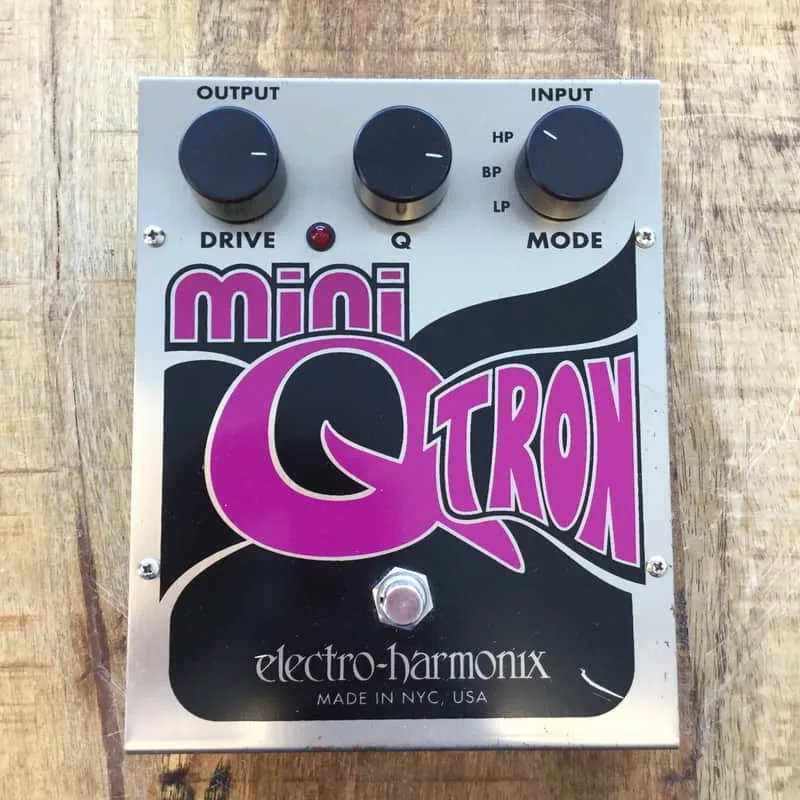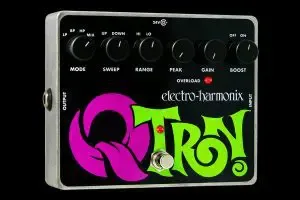


The Electro-Harmonix Q-Tron is an analog envelope filter pedal, a circuit that sweeps a filter in response to how hard you play, in the same family as an auto-wah. It first appeared in 1996 as an updated take on the Mu-Tron III, using the same opto-electronic design as the 1970s original12. Electro-Harmonix describes it as "The phattest, funkiest envelope filter ever made!"3. It was the first all-new Electro-Harmonix product in 15 years when it arrived4.
The original Q-Tron was discontinued in 20173, but the design lives on in the Q-Tron+ and Micro Q-Tron, both of which have remained in production5, and in the smaller Nano Q-Tron added in 20212.
An envelope filter based on the Mu-Tron III
An envelope filter, also called an auto-wah, tracks the volume envelope of your playing and moves a filter's peak frequency up and down with it: play harder and the sweep goes further. The Mu-Tron III, designed by Mike Beigel and Aaron Newman, defined the category in the 1970s784, and its patent describes a voltage-controlled filter "whose peak response frequency is varied in accordance with the envelope of the input signal." The Q-Tron carries that opto-electronic design forward in pedal form8.
Where a wah pedal moves the same kind of filter with your foot, the Q-Tron does it automatically from your attack, which is why the design has appealed to funk and bass players. The pedal offers selectable low pass, band pass and high pass filters, plus hi and lo frequency response modes, so you can aim the sweep at the bass, midrange or treble part of your tone3. It also carries two outputs, normal and effected4.
The controls
The original Q-Tron's control set follows the Mu-Tron layout. The core controls, as described across the Q-Tron line, are:
| Control | What it does |
|---|---|
| Drive | Sets the filter sweep sensitivity, how strongly your playing drives the sweep94 |
| Drive switch (up/down) | Selects the direction of the filter sweep: up (wah) or down (ow)4 |
| Q / Peak | Sets the filter's peak bandwidth and resonance; more Q gives a more dramatic, more resonant sweep1011 |
| Mode | Selects low pass, band pass or high pass filter3 |
| Volume | Sets the output level (on later versions)12 |
The Q-Tron+ adds two things the original lacks: an effects loop and an attack response switch, on top of the same core design10. A Sweep toggle on the Q-Tron+ lets you choose the direction of the filter sweep11.
Analog Man also offers a mod for these pedals: an added MIX knob that sets the blend of dry versus effected sound, functional only in MIX mode. The mix knob is available on the classic Q-Tron or the XO version of the Q-Tron and Q-Tron+, but not on the classic Q-Tron+6.
Power: 24V AC adapter
The original Q-Tron is not a standard 9V pedal. It comes with a 24DC-100 power supply3, a 24-volt AC adapter, and it will not run on batteries4. That power requirement rules out the common 9V daisy chain and means the pedal needs its own supply.
The later Micro Q-Tron and Nano Q-Tron are much easier to power: both ship with a 9V battery and run on an optional 9.6VDC-200mA adapter. The Nano Q-Tron requires 10mA at 9VDC on a center-negative plug and should not exceed 12VDC at the power jack92.
History and versions
The Q-Tron arrived in 1996, developed by Electro-Harmonix as the successor to the Mu-Tron legacy1. GuitarPlayer reports the pedals were developed in the mid-'90s with assistance from Musitronics co-founder and electronics engineer Mike Beigel13, the same designer behind the original Mu-Tron III7. The line then branched into several versions:
| Version | Year | Status | What changed |
|---|---|---|---|
| Q-Tron | 19961 | Discontinued 20173 | The original, updated Mu-Tron III design136 |
| Mini Q-Tron | 20001 | Discontinued14 | A smaller version similar to the original Mu-Tron1 |
| Q-Tron+ | after the original | In production5 | Same design plus effects loop and attack response switch10 |
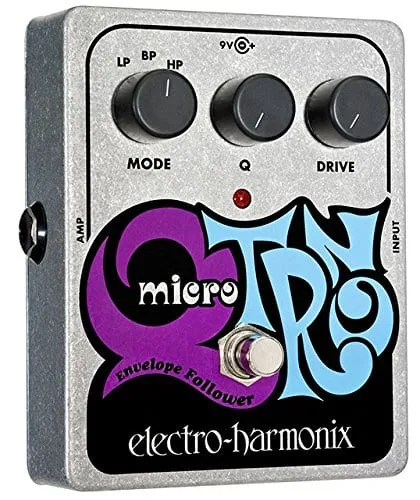
| Micro Q-Tron | 20069 | In production5 | Compact version; mode, Q and drive controls only915 |
| Nano Q-Tron | 20212 | Available16 | A more compact Micro Q-Tron with an added volume control17 |
The Micro Q-Tron trims the control set to filter mode, Q and drive15 in a tough, compact die-cast chassis9, and lists at $112.509. The Nano Q-Tron, announced in December 2021, is a shrunk and improved version of the Micro Q-Tron18, adding a volume control17, with true bypass18. Reviewers noted the Q-Tron series is known for its organic, analog sound and expressivity16.
What reviewers said
Writing about the Mu-Tron III's legacy in Guitar World, Nick Wells called the Q-Tron "a fine filter for those on a budget, and well worth considering if you can't justify the hefty price of the Mu-Tron III"19. Pedal of the Day's reviewer found the Q-Tron+ a responsive, funky envelope filter and highlighted its Peak control, which "adjusts the resonance peak (or 'Q') of the filter, creating a more dramatic effect as the control is increased"11. Of the Mini Q-Tron, Pedal of the Day's Mike B wrote that it is "super responsive and funky as can be," though noted these are now discontinued and relatively inexpensive if you can find one14. On the Nano Q-Tron, Guitar World's Trevor Curwen found plenty of control over the sound12, and gearnews' Jef found the sounds in the demo video pleasing18.
Who uses it
The Analog Man mix knob mod came about for Mark Karan, who uses the Q-Tron with RatDog6. In Premier Guitar's rig rundown of the Red Hot Chili Peppers, Flea's Electro-Harmonix Q-Tron is listed as used for "Sir Psycho Sexy"20. The Q-Tron series is documented as effective on guitar, bass, keys, horns and more21, and Premier Guitar has described the Q-Tron as a legendary Electro-Harmonix envelope filter used by guitar and bass players since its inception22.
Videos
John Mayer Gear
Vitaly Ganya
Pedal of the Day
Questions
Can the Electro-Harmonix Q-Tron run on batteries?
No. The original Q-Tron runs only on its included 24-volt AC adapter and will not run on batteries. The later Micro Q-Tron and Nano Q-Tron are different: both ship with a 9V battery and can also run on an optional 9.6VDC center-negative adapter.
What is the difference between the Q-Tron, Q-Tron+ and Micro Q-Tron?
The Q-Tron+ uses the same design as the original Q-Tron but adds an effects loop and an attack response switch. The Micro Q-Tron, released in 2006, is a compact version with a reduced control set: filter mode, Q and drive. The original Q-Tron was discontinued in 2017, while the Q-Tron+ and Micro Q-Tron have remained in production.
Is the original Q-Tron discontinued?
Yes. Electro-Harmonix lists the original Q-Tron as discontinued in 2017. The Q-Tron+ and Micro Q-Tron versions of the circuit have continued in production, and the Nano Q-Tron, a smaller version of the Micro Q-Tron, was added in 2021.
Who designed the Q-Tron?
The Q-Tron was developed by Electro-Harmonix in the mid-1990s with assistance from Mike Beigel, the Musitronics co-founder who, with Aaron Newman, designed the original Mu-Tron III envelope filter that the Q-Tron circuit is based on.
Can you add a mix knob to a Q-Tron?
Analog Man offers a mix knob mod for the classic Q-Tron and for the XO versions of the Q-Tron and Q-Tron+, but not for the classic Q-Tron+. The added knob sets the blend of dry and effected sound and works only in MIX mode. The mod was originally developed for Mark Karan of RatDog.
Is the Q-Tron true bypass?
Yes. Electro-Harmonix lists true bypass for the original Q-Tron, the Q-Tron+, the Micro Q-Tron and the Nano Q-Tron, so the whole Q-Tron line shares the same switching approach.
Sources (22)
- Mike Beigel, Musitronics Mu-Tron (mu-tron.com)
- Nano Q-Tron, Electro-Harmonix
- Q-Tron | DISCONTINUED 2017 | Envelope Filter - Electro-Harmonix, Electro-Harmonix, 2017
- electro-harmonix Q-TRON, Analog Man Vintage guitar effects, 2015
- Lumitron Resonant Filter / Mu-tron® III, Aion FX, 2023-09-08
- aNaLoG.MaN Guitar Effects Electro-Harmonix pedals, analogman.com, 2024
- How the Mu-Tron III became a vintage pedalboard icon, Guitar World, 2026-02-09
- Guitar FX Layouts: Mutron III, Guitar FX Layouts (tagboardeffects.blogspot.com), 2014-06-19
- Micro Q-Tron, Electro-Harmonix
- Q-Tron Plus, Electro-Harmonix
- Electro-Harmonix Q-Tron+ Envelope Filter, Pedal of the Day (www.pedal-of-the-day.com), 2017-03-13
- Electro-Harmonix Nano Q-Tron review, Guitar World, 2023-10-18
- Electro-Harmonix Unveils the Nano Q-Tron Envelope Filter, GuitarPlayer (www.guitarplayer.com), 2021-12-03
- Electro-Harmonix Mini Q-Tron Envelope Filter, Pedal of the Day, 2015-07-29
- The Best Wah Wah Pedals for Iconic Guitar Tones: Cry Baby and Beyond, gearnews.com, 2025-08-18
- Electro-Harmonix Introduces the Nano Q-Tron, Premier Guitar, 2021-12-06
- Electro-Harmonix shrinks the Micro Q-Tron down to the Nano Q-Tron, Guitar.com, 2021-12-02
- New EHX Nano Q-Tron Envelope Filter: Now smaller, funkier and improved, gearnews.com, 2021-12-02
- The Mu-Tron III: “Without it, there ain't no Bootsy”, Guitar World, 2023-03-17
- Rig Rundown, Premier Guitar, 2012-06-03
- New Pedal: Electro-Harmonix Nano Q-Tron Envelope Filter, Delicious Audio, 2021-12-01
- Electro-Harmonix Enigma Q-Balls Review: Bass Filter, Premier Guitar, 2009-12-10