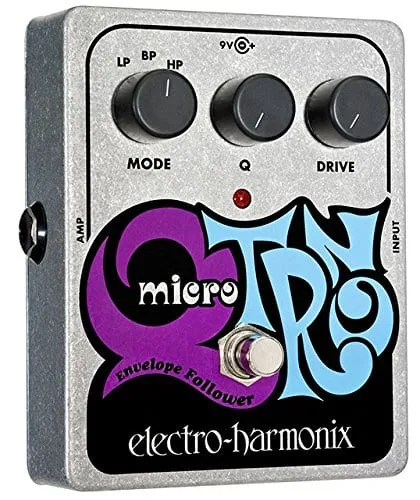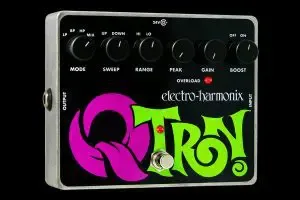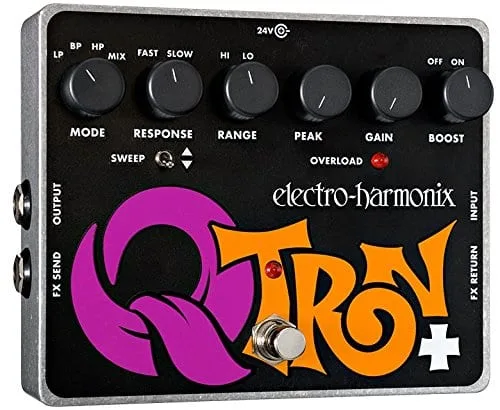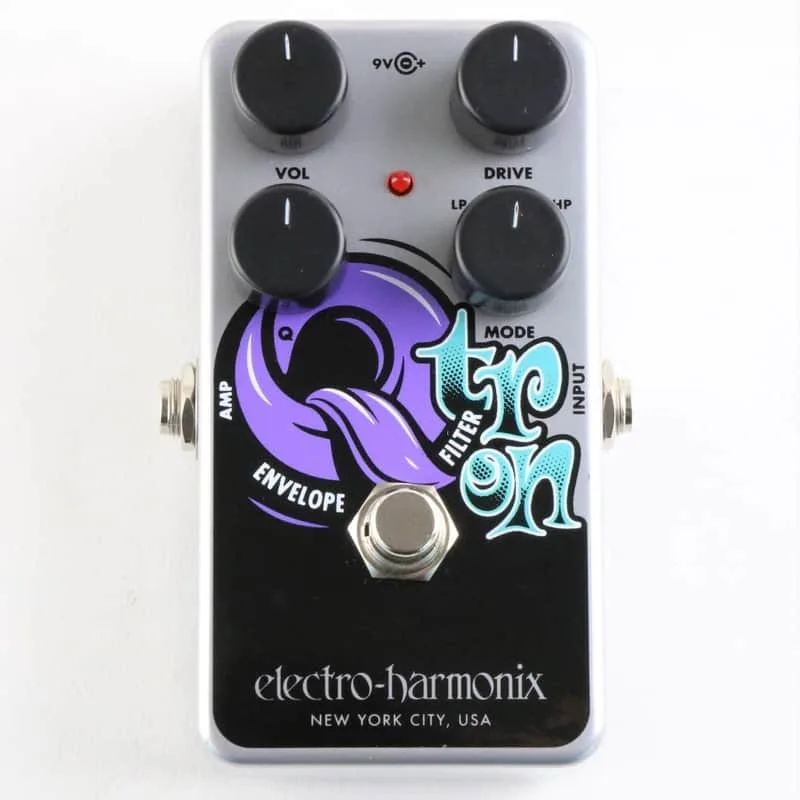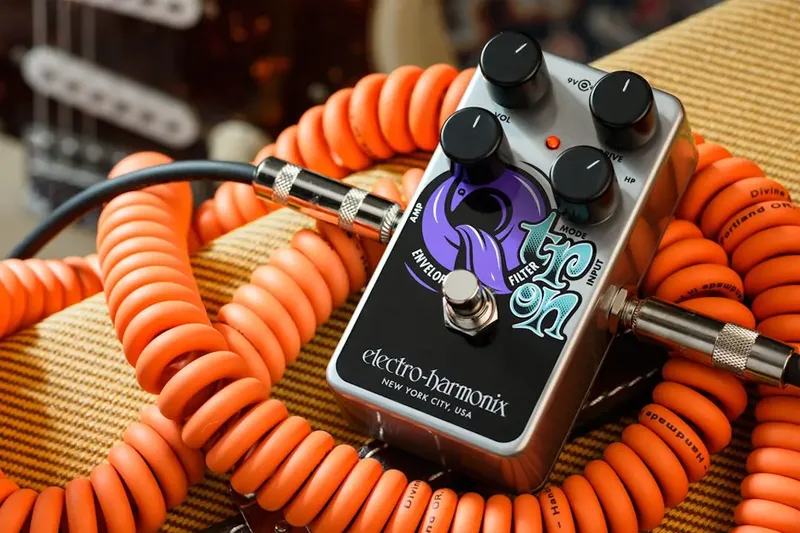


The Electro-Harmonix Nano Q-Tron is an analog envelope controlled filter, a type of filter pedal that sweeps its frequency response in response to the volume of your playing. The volume of the input signal, called the envelope, controls the cutoff or center frequency of a swept filter, so picking harder opens the filter up and playing softly closes it down. Electro-Harmonix says this creates effects ranging from subtle to dynamic, from auto-wah to ultra-funky1.
Released in 20211, it is a compact version of the Micro Q-Tron, part of Electro-Harmonix's Q-Tron Series of envelope filters, a line the company has been making since the 1970s12. It sits in a pedalboard-friendly, compact, rugged enclosure measuring 4.5 x 2.75 x 2.1 inches1.
How it works
An envelope follower tracks the volume of your incoming signal and uses it to move a filter up and down the frequency spectrum. Because the pedal reacts to your dynamics rather than a fixed rate, the effect tracks your touch: dig in and the sweep goes further, back off and it settles. The Q-Tron Series filters are known, in Premier Guitar's words, for their "organic, analog sound and expressivity"4.
The controls
The Nano Q-Tron has four knobs and switches plus a bypass footswitch3. Gearnews noted at launch that this is one more control than the previous version had, with the Vol control newly added5.
| Control | What it does |
|---|---|
| Vol | Sets the output volume. Turn it clockwise to increase the level, to match the effect volume to your bypass volume or to add a boost1 |
| Drive | Filter sweep sensitivity: how the pedal responds to your playing dynamics. Higher settings give a wider sweep; too far and the sweep maxes out at approximately 3.5kHz. Electro-Harmonix suggests starting at 12 o'clock1 |
| Q | Sets the peak bandwidth of the filter, determining how subtle or dramatic the effect is. Start around 2 o'clock for a middle-of-the-road intensity1 |
| Mode (LP/BP/HP) | Selects which frequency range the filter passes: LP (lowpass) emphasizes low frequencies, BP (bandpass) the middle frequencies and HP (highpass) the high frequencies1 |
| Bypass footswitch | Engages or bypasses the effect; the status LED lights when the effect is on1 |
Guitar World's reviewer, Trevor Curwen, summed up the control set as offering "Plenty of control over the sound"3.
"Plenty of control over the sound."
The three mode positions are where much of the pedal's range lives. Lowpass keeps the lows and cuts highs as it sweeps, bandpass isolates a moving band of midrange, and highpass does the opposite of lowpass, thinning the sound out in a way that can sit well under a busy mix361.
Power
The Nano Q-Tron ships with a 9V battery included, so it works out of the box without anything else1. For pedalboard use, an optional 9.6VDC-200mA power adapter can be connected, though it is not included1.
The pedal requires 10mA at 9VDC on a center-negative plug, and Electro-Harmonix warns not to exceed 12VDC at the power jack1. Check your power supply's polarity and voltage before plugging in.
At 10mA it draws little current, so it is easy to run alongside other pedals on a multi-output supply1.
Nano Q-Tron vs Micro Q-Tron
The Micro Q-Tron, released in 20067, is the direct predecessor. The two share the same core design: analog envelope filters with true bypass17, the same Drive control acting as filter sweep sensitivity17, and the same LP/BP/HP mode rotary switch determining what frequency range the filter passes17.
| Nano Q-Tron | Micro Q-Tron | |
|---|---|---|
| Released | 20211 | 20067 |
| Controls | Vol, Drive, Q, Mode (LP/BP/HP)3 | Drive, Q, Mode (LP/BP/HP)5 |
| Bypass | True bypass1 | True bypass7 |
| Power | 9V battery included; optional 9.6VDC-200mA adapter not included1 | 9V battery included; optional 9.6VDC-200mA adapter not included1 |
| Enclosure | Compact nano housing5 | Larger than the Nano6 |
MusicRadar described the Nano as "an upgrade to the Micro unit; a smaller case"6, and Gearnews noted the Vol control as the functional addition, giving four controls instead of the previous three5.
On bass and other instruments
The Nano Q-Tron is not guitar-only. MusicRadar's Rob Laing reported that "it's great for bass as well as electric guitar"6, and Gearnews called it "equally suitable for guitar, bass, keys, and even horns"5. Bass Gear Magazine's launch coverage positioned the space-saving envelope filter as aimed squarely at the pedalboard user2. For bass, the Drive control is the one to spend time with, since it sets how strongly the filter reacts to your instrument's output.
Where it came from
Electro-Harmonix has been making envelope controlled filter pedals since the 1970s1, a lineage that includes the full-size Q-Tron and Q-Tron Plus. The Micro Q-Tron brought the circuit to a smaller box in 20067, and the Nano Q-Tron, announced in December 2021715, shrank it further and added the Volume control5. Bass Gear Magazine reported a U.S. list price of $106.40 at launch2; the maker's current page lists it at $111.701, and Guitar World's 2026 review gives $1113.
Videos
EHX
Andrew Siemon
Tone Tailors | Guitar Shop, Lessons, & Repairs
News
Questions
Is the Nano Q-Tron true bypass?
Yes. Electro-Harmonix lists the Nano Q-Tron as true bypass, and in bypass mode the AMP output jack is wired directly to the input jack so the signal passes through untouched. The status LED lights when the effect is engaged and goes off in bypass.
Does the Nano Q-Tron come with a power supply?
No. A 9V battery is included in the box, but the optional 9.6VDC-200mA power adapter is not. If you buy an adapter separately, the pedal requires 10mA at 9VDC on a center-negative plug, and Electro-Harmonix warns not to exceed 12VDC at the power jack.
What is the difference between the Nano Q-Tron and the Micro Q-Tron?
The Nano Q-Tron is a compact version of the Micro Q-Tron envelope controlled filter in a smaller nano housing, and it adds a fourth control: a Volume knob the Micro version does not have. Both are analog, true bypass envelope filters with the same Q, Drive and LP/BP/HP mode controls.
Can I use the Nano Q-Tron on bass?
Yes. MusicRadar's coverage says it works great for bass as well as electric guitar, and Gearnews describes it as equally suitable for guitar, bass, keys and even horns. The Drive control lets you set the filter sweep sensitivity to match the stronger output of a bass.
Does the Q-Tron Nano come with a battery?
Yes. Electro-Harmonix ships the Nano Q-Tron with a 9V battery included, so it works straight out of the box. The optional 9.6VDC-200mA power adapter is sold separately.
Does the Q-Tron Nano work on bass?
Yes. Press coverage at launch highlighted bass as well as guitar, with Gearnews calling it equally suitable for guitar, bass, keys and even horns. Adjust the Drive control so the filter responds to your playing dynamics rather than maxing out.
Sources (7)
- Nano Q-Tron, Electro-Harmonix
- Electro-Harmonix Introduces the Nano Q-Tron Envelope Controlled Filter, Bass Gear Magazine, 2021-12-01
- Electro-Harmonix Nano Q-Tron review, Guitar World, 2023-10-18
- Electro-Harmonix Introduces the Nano Q-Tron, Premier Guitar, 2021-12-06
- New EHX Nano Q-Tron Envelope Filter: Now smaller, funkier and improved, gearnews.com, 2021-12-02
- Electro-Harmonix adds the Q-Tron Envelope Controlled Filter to its Nano range of effects pedals, MusicRadar, 2021-12-02
- Micro Q-Tron, Electro-Harmonix