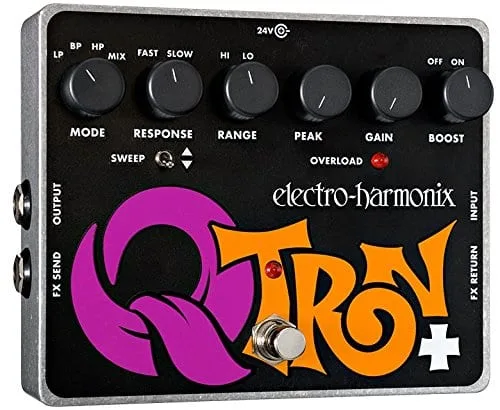


The Electro-Harmonix Q-Tron Plus is an analog envelope filter pedal: a filter that sweeps automatically in response to how hard you play, rather than to a foot pedal like a wah. Electro-Harmonix describes it as the same design as the original EHX Q-Tron, with two additions that set it apart: a dedicated effects loop and an Attack Response switch1. It was released in 2008 and carries a list price of $192.301.
An envelope follower reads the level of your playing and uses it to drive the filter's sweep, so picking harder opens the filter further and playing softly closes it down. That makes it a dynamic effect: your touch, not a knob turn, shapes the sound in real time.
The controls: Mode, Range, Response, Boost, Peak and Gain
The Q-Tron Plus front panel gives you controls over the filter's behavior: the Gain control, which in Boost mode functions as both a volume control and the filter sensitivity control; the Boost switch, which passes the input signal through the filter at its original level in Normal mode and increases the signal gain to the filter in Boost mode; the Peak control, which determines the resonance peak or Q of the filter; the Mode switch, which selects what frequency range the filter will pass; and the Response switch, which changes the sweep response between two optimized settings. A Bypass switch toggles between effect mode and bypass1.
| Control | What it does |
|---|---|
| Mode switch | Selects what frequency range the filter passes: LP, BP, HP or Mix1 |
| Range | Sets the frequency range over which the filter sweeps1 |
| Response switch | Changes the sweep response between two optimized settings, FAST and SLOW1 |
| Boost switch | Normal passes the input signal through the filter at its original level; Boost increases the signal gain to the filter according to the Gain control setting1 |
| Peak | Determines the resonance peak, or Q, of the filter1 |
| Gain | In Boost mode, works as both a volume control and the filter sensitivity control1 |
| Bypass switch | Toggles between effect mode and bypass1 |
The Mode switch is the biggest tonal decision. LP (low pass) lets lows through and sweeps the cutoff upward, BP (band pass) isolates a moving band of frequencies for the classic quack, and HP (high pass) thins the sound as the filter opens. Mix blends the filtered and dry signals1.
The Peak control is worth attention from players new to envelope filters: turning it up sharpens the resonance at the cutoff point, which makes the sweep more vocal and pronounced, while lower settings give a gentler, more subtle filter movement1.
The Gain control's dual role in Boost mode matters in practice. Because it sets both the level hitting the filter and the filter's sensitivity, a single knob adjustment changes how strongly your playing drives the sweep as well as how loud the effect is1.
What the Response switch does
The Response switch selects between two sweep responses. RockBoard's PedalPedia entry describes the two modes as "a slow, smooth, vowel-like attack" and "the fast, snaked response of the original" Q-Tron2. In FAST the filter reacts quickly to your attack, in SLOW it opens and closes more gradually, giving a rounder, more vocal character.
The effects loop
The Q-Tron Plus's defining feature over the original Q-Tron is its effects loop, which lets you place an additional effect, or a chain of effects, between the pedal's preamp and its filter section without changing the envelope drive1. In practical terms, whatever you insert in the loop colors the sound feeding the filter, but the envelope follower still reads your original playing dynamics, so the sweep stays consistent.
The loop uses two jacks:
- FX Loop Send jack: musical instrument signal output to an external effect1
- FX Loop Return jack: from an external musical effect's output back into the Q-Tron Plus filter process1
The rest of the pedal's connections are an input jack for your instrument and an effects out jack to your amplifier1.
How it differs from the Q-Tron
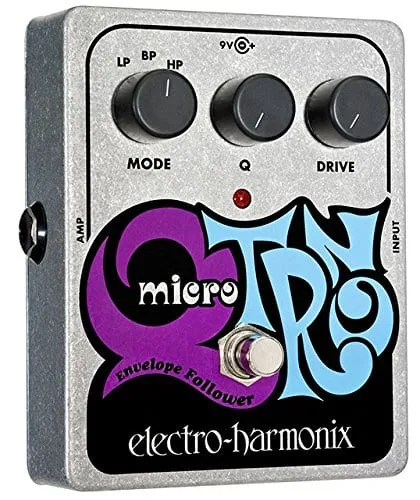
Electro-Harmonix positions the Q-Tron Plus as the same design as the original EHX Q-Tron, with the effects loop and the Attack Response switch as the additions1. If you want to insert drives or other effects ahead of the filter without disturbing the envelope, the Plus is the one that does it. Players who just want the basic envelope filter in a smaller or cheaper package also have the Micro Q-Tron and Nano Q-Tron in the EHX range.
The Q-Tron Plus runs on 24V DC rather than a standard pedalboard supply, and it draws 35mA1. Electro-Harmonix includes a 24VDC-100mA adapter with the pedal1.
Videos
EHX
EHX
Anıl Yazar
Questions
What power supply does the Q-Tron Plus need?
The Q-Tron Plus runs on a 24V DC power adapter, and Electro-Harmonix includes one with the pedal. Its current draw is 35mA. The 24V requirement means a standard 9V pedal power supply will not run it.
What can you put in the Q-Tron Plus effects loop?
The effects loop lets you place an effect, or a whole chain of effects, between the pedal's preamp and its filter section. Because the loop sits after the preamp, what you plug in does not change the envelope drive that controls the filter sweep.
Is the Q-Tron Plus true bypass?
Yes. Electro-Harmonix lists the Q-Tron Plus as true bypass, and its Bypass switch toggles between effect mode and bypass, so the dry signal passes through unprocessed when the pedal is off.
What is the difference between the Q-Tron and the Q-Tron Plus?
The Q-Tron Plus uses the same design as the original EHX Q-Tron, but adds two features: a dedicated effects loop for inserting effects between the preamp and the filter, and an Attack Response switch that selects between a fast and a slow sweep response.
What does the Response switch do on the Q-Tron Plus?
The Response switch changes the filter's sweep response between two optimized settings, labeled FAST and SLOW. RockBoard describes the two modes as a slow, smooth, vowel-like attack and the fast, snaked response of the original Q-Tron.
Sources (2)
- Q-Tron Plus, Electro-Harmonix
- Q-Tron Plus by Electro-Harmonix, RockBoard PedalPedia, 2026
 John Mayer