

The Nano Q-Tron is Electro-Harmonix's compact envelope filter, an analog effect that sweeps a filter in response to how hard you pick. It joins the company's Q-Tron series, which Bass Gear Magazine describes as "envelope filters known for their organic, analog sound and expressivity"1. Where a wah pedal moves the filter with your foot, an envelope follower reads the volume of each note you play and opens and closes the filter automatically, so the sweep follows your picking dynamics.
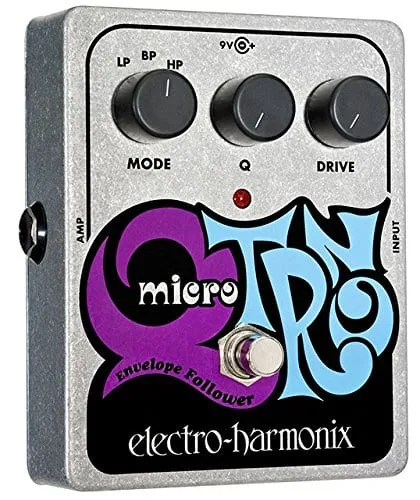
The Nano Q-Tron is a shrunken and updated version of the Micro Q-Tron, in a smaller Nano-series housing aimed at pedalboard users12. Electro-Harmonix has been making envelope controlled filter pedals since the 1970s, and the company positions the Nano Q-Tron as "a compact version of the classic Micro Q-Tron Envelope Controlled Filter"3.
An envelope filter in a Nano case
The pedal arrived in December 2021 as part of EHX's Nano range of compact effects6. MusicRadar's Rob Laing framed it as "an upgrade to the Micro unit; a smaller case," and Guitar.com's Cillian Breathnach called it "a more compact version of the Micro Q-Tron with an added volume control"64.
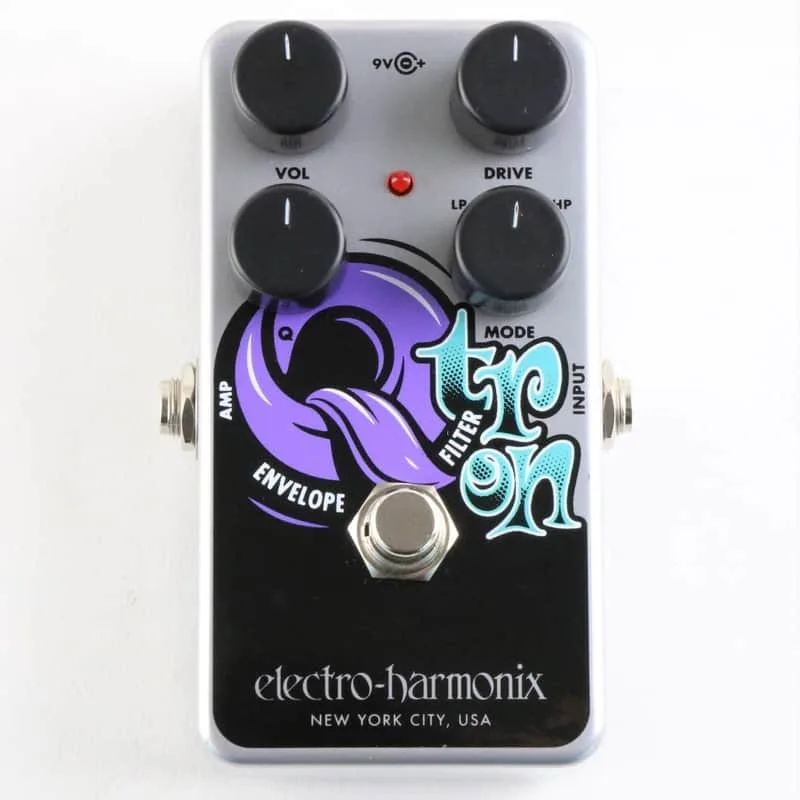
The practical difference for a player is board space and level control. The previous Micro Q-Tron carried three controls, Q, Drive and Mode; the Nano version carries four, with a Vol knob added2. Gearnews' Jef noted why that matters: on earlier versions of the effect, "it could sometimes cause you to get a little lost in the context of a band mix," and the new volume control lets you push the engaged level back up to match2.
The pedal is not guitar-only. Gearnews describes it as "equally suitable for guitar, bass, keys, and even horns," and Delicious Audio's Paolo De Gregorio calls it "equally effective on guitar, bass, keys, horns and more"27. MusicRadar's launch coverage added that "it's great for bass as well as electric guitar," as its demo video showed6.
"Now players can get that sweet funk tone in a smaller, more manageable package."
Funk is the effect's home territory, but not its only one. Gearnews points players who assume envelope filters are funk-only toward John Mayer's "I Don't Trust Myself (With Loving You)" as a cited example of the effect used in a different context2.
The controls: Drive, Q, Mode and Vol
Four knobs and a switch shape the sweep, plus the bypass footswitch5. Here is what each one does, drawing on Electro-Harmonix's own product page and Guitar World's review:
| Control | What it does |
|---|---|
| Drive | Sets filter sweep sensitivity and how the pedal responds to your playing dynamics. Higher Drive gives a wider sweep; pushed too far, the sweep maxes out at approximately 3.5kHz. EHX suggests starting at 12 o'clock3. |
| Q | Sets the peak bandwidth of the filter, determining how subtle or dramatic the effect is. Start around 2 o'clock for a middle-of-the-road intensity3. |
| Mode | Selects lowpass, bandpass or highpass filtering25. |
| Vol | Sets the output level, new on the Nano version25. |
| Bypass footswitch | Switches the effect in and out, with true bypass35. |
Guitar World's reviewer Trevor Curwen adds detail on the Q knob: it handles "further refinement of the sweep, adjusting the filter's bandwidth," and turning it clockwise gives more intensity and a more resonant sweep5.
The three Mode positions change the pedal's character more than anything else:
- Lowpass (LP): the filter sweeps the high frequencies, the most familiar auto-wah flavor.
- Bandpass (BP): the filter emphasizes a narrow band of frequencies, for a more vocal, honking sweep.
- Highpass (HP): the filter works from the bottom, thinning the sound as it sweeps.
MusicRadar described the modes as adding depth, controlling "the frequency range for the Q filter"6.
Setting it up
Electro-Harmonix gives starting points on its product page3:
- Set Drive at 12 o'clock.
- Set Q at about 2 o'clock for a middle-of-the-road filter intensity.
- Pick a Mode position and play, adjusting Drive to match how hard you attack the strings.
- Use Vol to match the engaged level to your bypassed level.
How it differs from the rest of the Q-Tron line
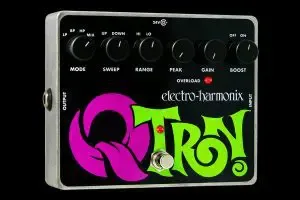
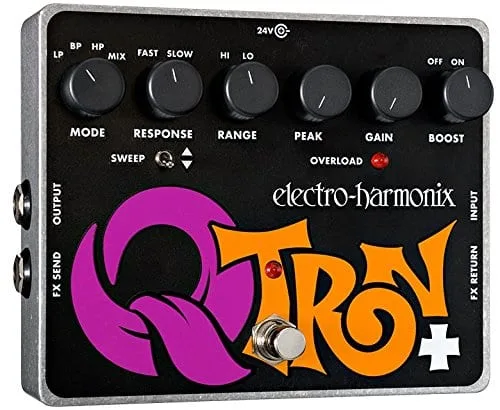
The Nano Q-Tron sits at the small end of a family that includes the full-size Q-Tron, the Q-Tron Plus and the Micro Q-Tron it was shrunk from. The Micro Q-Tron shares the same Drive control function, which its product page calls "the filter sweep sensitivity control," and also lists true bypass8. What the Nano adds over the Micro is the smaller housing and the Vol knob; what it gives up, per the press coverage, is nothing reported beyond size24.
What reviewers said
Coverage at launch was positive about the concept. Gearnews found "the sounds in the demo video are pleasing" and welcomed the added volume control as a fix for the mix-loss problem of earlier versions2. MusicRadar's Rob Laing greeted the pedal as a straightforward win: a smaller case, an upgrade over the Micro unit, and strong performance on bass as well as guitar6. Guitar World's review, published later, walked through the control set and the Q knob's role in refining the sweep5.
Videos
EHX
Andrew Siemon
Tone Tailors | Guitar Shop, Lessons, & Repairs
Questions
Is the Electro-Harmonix Nano Q-Tron true bypass?
Yes. Electro-Harmonix lists the Nano Q-Tron with true bypass, so with the footswitch off the pedal is out of the signal path entirely. Gearnews also confirmed true bypass when the pedal was announced in December 2021. A bypass footswitch on the front of the pedal switches the effect in and out.
What filter modes does the Nano Q-Tron have?
A three-position Mode switch selects lowpass, bandpass or highpass filtering. Lowpass sweeps the top end down, bandpass focuses on a narrow band of frequencies, and highpass thins the sound from the bottom up. The three modes give the pedal very different characters, from subtle to vocal-like.
What does the Q knob do on the Nano Q-Tron?
Q sets the peak bandwidth of the filter, which determines how subtle or dramatic the effect is. Electro-Harmonix suggests starting around the 2 o'clock position for a middle-of-the-road intensity. Guitar World's reviewer describes turning it clockwise for more intensity and a more resonant sweep.
Does the Nano Q-Tron have a volume control?
Yes, and it is new. The earlier Micro Q-Tron had only Q, Drive and Mode controls, and the Nano version adds a Vol knob. Gearnews noted that previous versions could leave you a little lost in a band mix, so the added level control is a practical fix for matching bypassed and engaged volumes.
Can the Nano Q-Tron be used with bass?
Yes. Gearnews describes it as equally suitable for guitar, bass, keys and even horns, and MusicRadar's demo video showed it working well on bass alongside electric guitar. Delicious Audio likewise calls it equally effective on guitar, bass, keys, horns and more.
Is the Nano Q-Tron only for funk?
No. Gearnews points to John Mayer's recording of I Don't Trust Myself (With Loving You) as an example of the effect used outside funk, arguing that anyone who thinks an envelope filter is only for funk should give it a listen. The filter modes and Q range support subtler settings too.
Sources (8)
- Electro-Harmonix Introduces the Nano Q-Tron Envelope Controlled Filter, Bass Gear Magazine, 2021-12-01
- New EHX Nano Q-Tron Envelope Filter: Now smaller, funkier and improved, gearnews.com, 2021-12-02
- Nano Q-Tron, Electro-Harmonix
- Electro-Harmonix shrinks the Micro Q-Tron down to the Nano Q-Tron, Guitar.com, 2021-12-02
- Electro-Harmonix Nano Q-Tron review, Guitar World, 2023-10-18
- Electro-Harmonix adds the Q-Tron Envelope Controlled Filter to its Nano range of effects pedals, MusicRadar, 2021-12-02
- New Pedal: Electro-Harmonix Nano Q-Tron Envelope Filter, Delicious Audio, 2021-12-01
- Micro Q-Tron, Electro-Harmonix