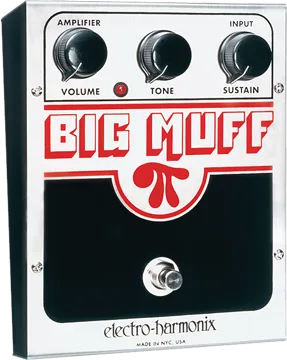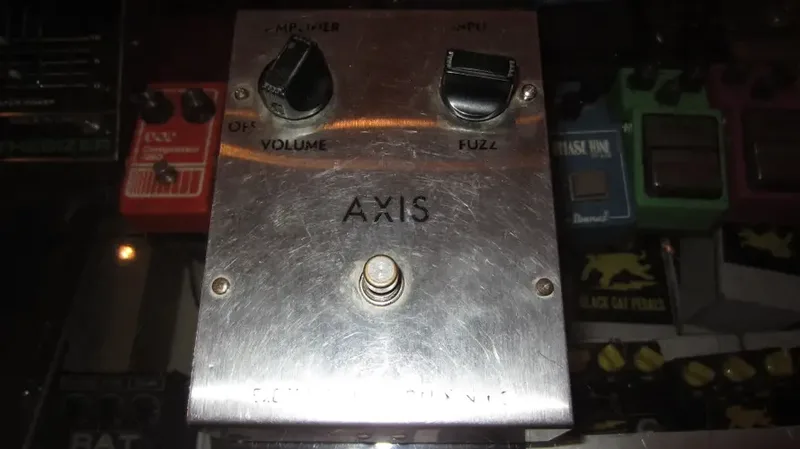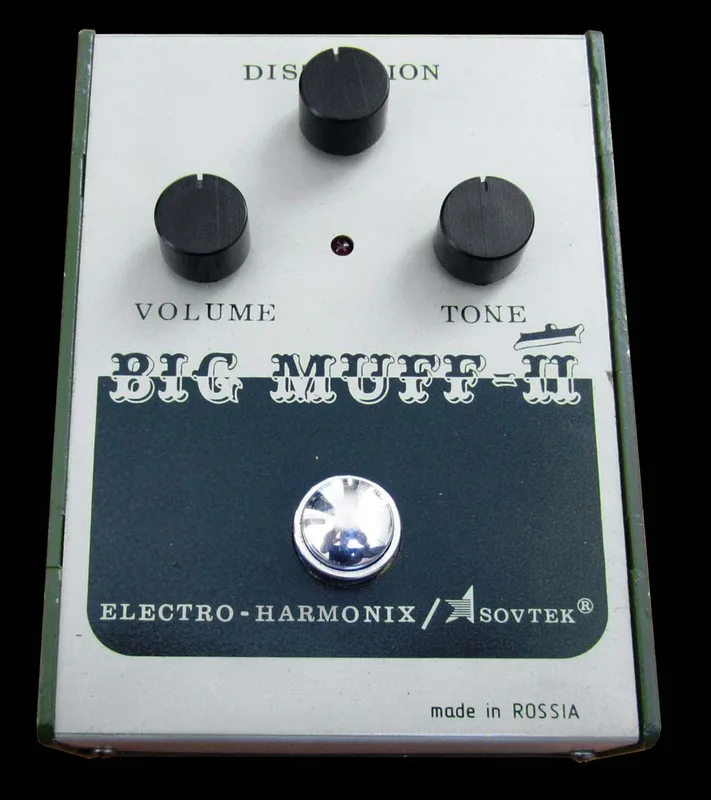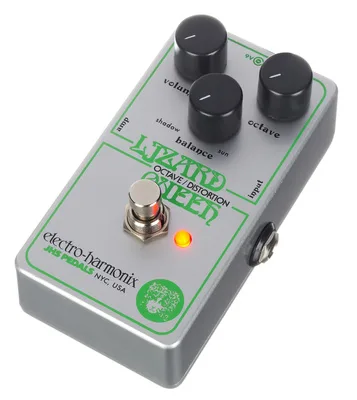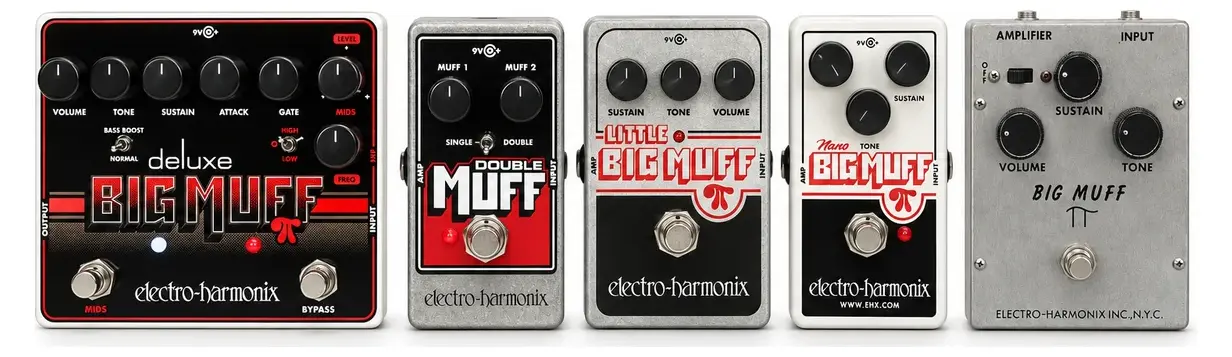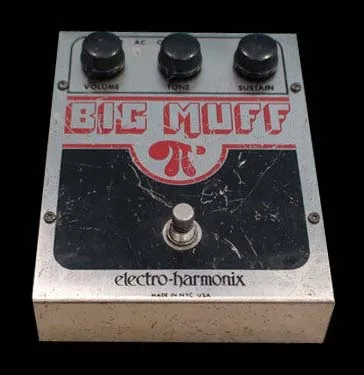


The Op-Amp Big Muff Pi is a fuzz, distortion and sustainer pedal made by Electro-Harmonix, sold as a reissue of the company's late-1970s op-amp Big Muff1. Where every other Big Muff variant generates its sustaining distortion with four transistors, this circuit relies on op-amps, the small integrated-circuit amplifier chips, and three gain stages rather than four12. The original run lasted only about two years and produced a few thousand units, and those vintage pedals now command high prices, which is what brought the circuit back as a current production pedal34.
Electro-Harmonix describes the reissue as a faithful re-creation of the original late-70s Op-Amp Big Muff Pi, sometimes also called the IC or V4 Big Muff, in a compact die-cast nano enclosure with true bypass switching15. Big Muff collector and historian Kit Rae, quoted on the maker's own page, characterizes the sound as:
"a huge, crushing Big Muff sound with more crunch… great for grungy, wall-of-sound distortion, heavy rhythm playing and heavy leads."
What the Op-Amp Big Muff is
The pedal sits in the wider Big Muff Pi family as its odd one out. Premier Guitar calls it "a true black sheep" of the family: where other Big Muffs share a common four-stage silicon transistor architecture, the 1978 Op-Amp Muff substituted op-amps for the four transistors, a short-lived experiment that produced a tone signature different enough that, in that reviewer's words, "some Muff purists don't consider it a real Muff at all"7.
MusicRadar's Trevor Curwen notes it still delivers the typical Big Muff Pi combination of fuzz and distortion, "but the devil is in the detail here"6. Guitar World's reviewers describe the Op-Amp as more saturated than its other Muff siblings, and as a completely different circuit from the original quad-transistor Big Muff, a shift driven by part availability8. Delicious Audio's history of the 1977-78 pedals records that the move to op-amps was made to reduce manufacturing costs4.
The V4 op-amp circuit
In 1978, EHX briefly switched the Big Muff Pi from its traditional four-transistor circuitry to a design based around the more cost-effective op-amp integrated circuits, with one less gain stage6. This Version 4, the rarest of the two op-amp Big Muff versions, used two op-amp chips: one RC4558NB and one of several versions of the 741 chip, such as the UA741CP, UC741TC, LM741CN, and LM741CM910. The circuit designers were Howard Davis, E-H's Manager of Analog Circuit Design from 1976 to 1981, and former EHX designer Michael Abrams10.
A few practical points distinguish the V4 for players comparing versions:
- The tone is very consistent from unit to unit, unlike the transistor versions9
- Kit Rae describes a very deep crunch, flat mids, and superb deep bass control, though they are not as good for palm muting as some earlier Big Muffs9
- The Stompbox Book's history notes these are more consistent from example to example, with a bit less gain and low end11
- Supposedly only a few thousand were made before production returned to transistor circuitry106
- The original had no LED, no true bypass, and a 1/8" (3.5mm) tip-positive power jack, the reverse polarity of typical pedals10
Two of the three circuit boards used in the V4 were also used in the Little Big Muff enclosure with the same circuits, and the late-1970s Deluxe Big Muffs used a nearly identical circuit to the V410.
The V5 Op-Amp Tone Bypass Big Muff π
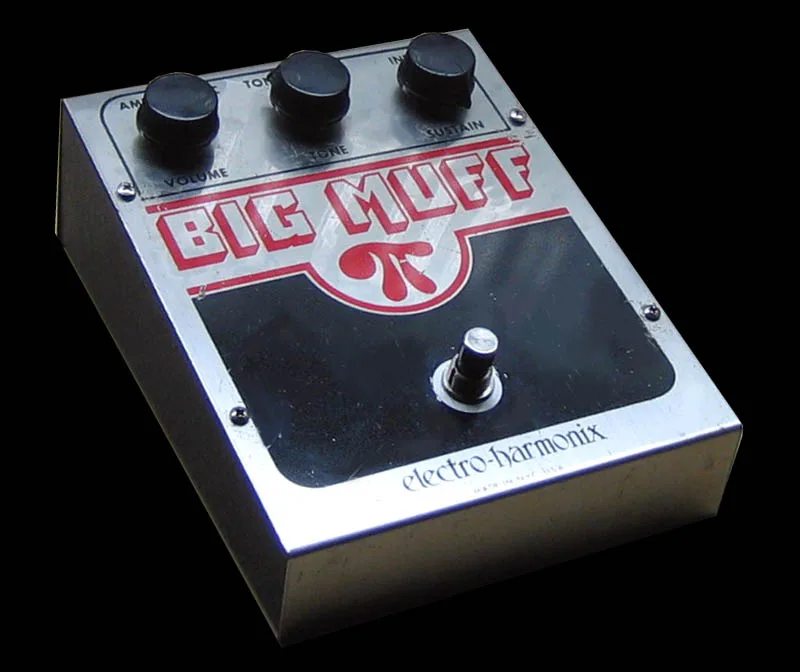
The Version 5, circa 1978 to 1981, continued the op-amp design and added a tone bypass switch, making for a brighter tone thought to have more overall presence in its ability to cut through a mix11. It is the most common of the two op-amp Big Muff versions9. The V5 used the same two op-amp chips as the V4, one RC4558NB and one of several 741 variants10.
The tone bypass switch completely bypasses the tone circuit. Kit Rae describes the result as a huge, brighter distortion tone with flatter EQ and slightly more mids, a heavy classic rock sound, with a slight 6-7 decibel volume boost in bypass mode; the non-bypass mode is very close to the traditional Big Muff sound910. The V5's low end frequencies sound slightly less tight than the V4's10. On the original V5 there was no on/off switch, and the tone knob had no effect in bypass mode10. These were the last op-amp Big Muffs made before the design was phased out around 1980 or '81 and the transistor version continued10.
Billy Corgan and Siamese Dream
The op-amp Big Muff's fame rests largely on one player. Billy Corgan used the original Version 4 briefly on the Smashing Pumpkins' Gish album, to very good effect on Siamese Dream, and on several tracks that later appeared on Pisces Iscariot, all recorded 1991 to 1993101. Electro-Harmonix's own page says the pedal "was popularized by the brilliant Billy Corgan who first used it on the Smashing Pumpkins' epic 1993 album Siamese Dream"1. Kit Rae's history records that in the Siamese Dream sessions he used a vintage USA Big Muff through a Marshall JCM 800 100 watt head10.
Once word spread of the Siamese Dream sound, resale prices of V4 and V5 Big Muffs skyrocketed and they became expensive and rare collectibles10. Guitar.com's Michael Watts notes that Corgan "played a huge role in the resurgence in popularity of the Big Muff in the 1990s"12. On the JHS Pedals YouTube channel, Josh Scott put it more bluntly: "They kind of quit selling it and then Billy Corgan uses it" and the op-amp reissue followed13.
The 2017 Op-Amp Big Muff π reissue
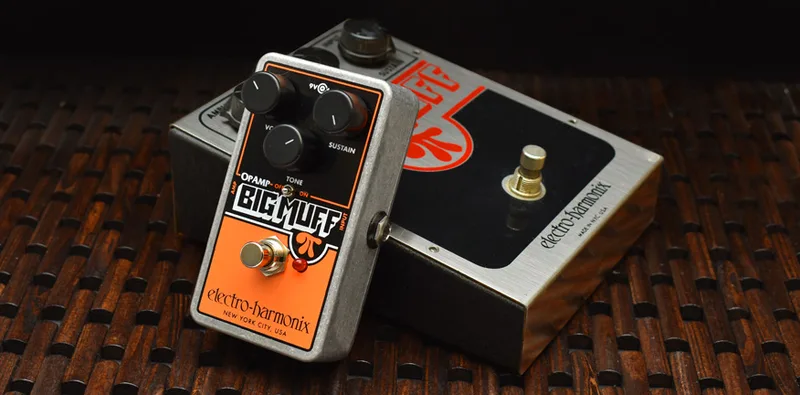
Electro-Harmonix announced the reissue in December 2017, after founder Mike Matthews reached out to Corgan about bringing the original op-amp series back1415. The reissue was engineered by Gino Maisano, based on the original Michael Abrams and Howard Davis op-amp circuit design, and was built from an original schematic rather than traced or measured from an actual vintage V4 or V510. It shipped in the standard EHX nano-sized cast metal enclosure, assembled and tested in Long Island City, New York10.
The reissue carries the standard Volume, Tone and Sustain controls plus a Tone Bypass switch, just like the V51610. Kit Rae notes the bypassed tone is brighter and harsher but missing the trademark mid scoop Big Muffs were known for10. Guitar.com's buyer's guide describes the switch as making the circuit skip the dual-filter tone control, resulting in a more full-frequency, less scooped sound17. The circuit uses through-hole capacitors and diodes with small surface-mount resistors, and "ICBM" is printed on the circuit board, a reference to the Euthymia ICBM, one of the first clones of the op-amp Big Muff10.
After Corgan was videotaped playing and talking about the reissue, he stated:
"The magic's still in the box, I can still get what I'm looking for!"
Guitar.com's review concluded simply: "It's that Siamese Dream sound, or near as damn it"12. MusicRadar's round-up praised it as a very different circuit to the standard Big Muff, easy to fit into a band mix, with "almost nothing sounds as huge"18.
Power and connections
The reissue ships with a 9V battery and can be powered by an optional 9-volt AC adapter, the EHX 9.6VDC-200 type1164. Sockets are input, output and power, and the pedal is true bypass19. Current draw is 5mA1.
| Control | What it does |
|---|---|
| Volume | Sets the output level1 |
| Sustain | Adjusts the amount of sustain and distortion1 |
| Tone | Provides a range of sounds from high treble to deep bass1 |
| Tone switch | Removes the Tone control from the circuit1 |
| Footswitch & status LED | Toggles between effect and bypass; the lit LED means the effect is active1 |
MusicRadar's review found the Tone knob "gets a little too thin and nasty at the clockwise extreme while being a little woolly at the other," with sweet spots in between6.
The 2017 reissue is a different animal from the 1978 original in one practical respect: the vintage V4 and V5 used a 1/8" (3.5mm) tip-positive power jack, the reverse polarity of typical pedals, while the reissue uses the standard EHX 9.6V DC supply101.
Price
The maker's current list price is $96.201. At launch in December 2017 the U.S. street price was $80.9016. MusicRadar's verdict on value: "Those after that particular Smashing Pumpkins experience will find it here, in a reasonably priced compact pedal from the original manufacturer"6.
Videos
Reverb
Prymaxe
Wampler Pedals
Questions
How is the Op-Amp Big Muff different from the transistor Big Muff?
The op-amp version replaces the four transistors used in every other Big Muff variant with two op-amp integrated circuits, and it uses three gain stages instead of four171. The result is a different tone signature, described as less mid-scooped and closer to distortion than fuzz, and one consistent from unit to unit, unlike the transistor versions209.
Did Billy Corgan use an Op-Amp Big Muff?
Yes. Billy Corgan used the original Version 4 op-amp Big Muff on the Smashing Pumpkins' 1993 album Siamese Dream, briefly on Gish, and on tracks that later appeared on Pisces Iscariot, recorded 1991 to 1993110. Kit Rae's history records that he ran it through a Marshall JCM 800 100 watt head10. His use revived interest in the pedal and drove up vintage prices10.
Is the Op-Amp Big Muff reissue the same as the original?
Electro-Harmonix calls it a faithful re-creation of the original circa 1978 circuitry, built from an original schematic rather than traced from a vintage unit110. It adds practical features the originals lacked: a compact die-cast nano enclosure, true bypass switching, a status LED, and a Tone Bypass switch taken from the V5 version110.
Sources (20)
- Op Amp Big Muff Pi, Electro-Harmonix, 1993
- 1979 Baja, Mojo Hand FX
- Eye See '78, Wren and Cuff
- EHX Big Muff: Op-Amp Vs. Original Transistor Muffs, Delicious Audio, 2018-01-11
- Electro-Harmonix Announces Op-Amp Big Muff Pi Reissue, Guitar World, 2017-12-11
- Electro-Harmonix Op Amp Big Muff review, MusicRadar, 2018-11-01
- Quick Hit: Electro-Harmonix Op-Amp Big Muff, Premier Guitar, 2018-10-02
- Electro-Harmonix Big Muff Pi review, Guitar World, 2026-09-09
- Big Muff Versions_Quick Identifier, Kit Rae (kitrae.net), 2026
- The Big Muff History of All Versions Part 1, Kit Rae (kitrae.net), 2024-02
- Big Muff Pi, Stompbox Book, 2020-03-21
- Electro-Harmonix Oceans 11 & Op-Amp Big Muff Pi Review, Guitar.com, 2018-10-12
- The Big Muff 2: A Lost Piece of Electro-Harmonix History, JHS Pedals (YouTube), 2025-12-10
- Electro-Harmonix Announces The Re-Release of Their Classic, Circa 1978 OP-AMP Big Muff PI, Bass Gear Magazine, 2017-12-12
- Billy Corgan is working with Electro-Harmonix on a Siamese Dream op-amp Big Muff reissue, MusicRadar, 2017-10-11
- Electro-Harmonix Reissues the Op-Amp Big Muff Pi, Premier Guitar, 2017-12-12
- A guide to the best Big Muff-style pedals, from classic reissues to boutique oddities, Guitar.com, 2025-07-30
- 5 fuzz pedals guitar players need to try, MusicRadar, 2021-03-16
- Best fuzz pedals: add some extra dirt to your guitar tone, MusicRadar, 2022-05-17
- The history of the big muff over time, anasounds.com, 2022-06-08
 Billy Corgan