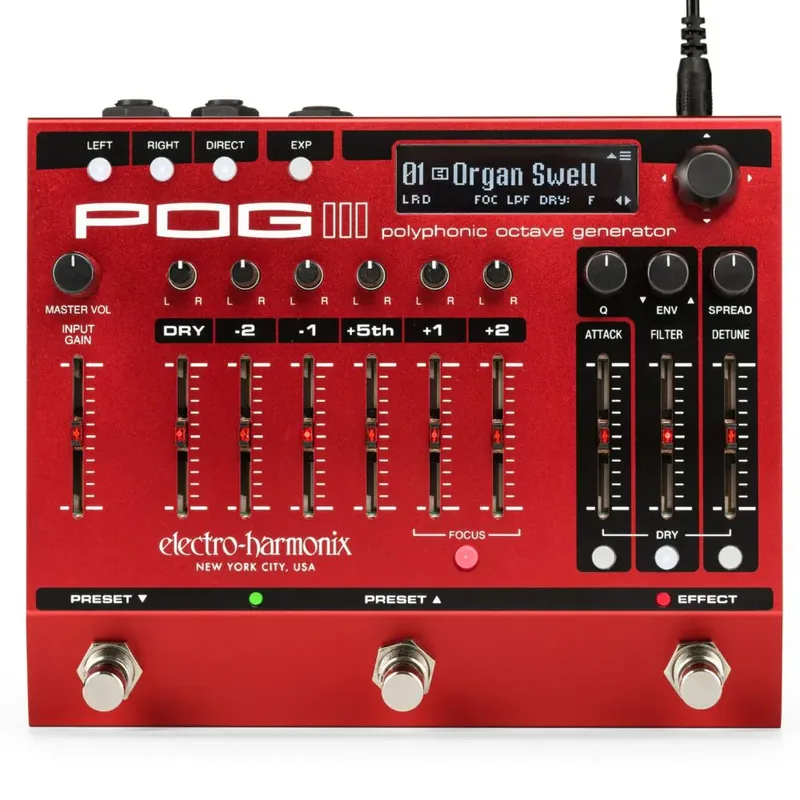


The Electro-Harmonix POG3 is a digital polyphonic octave pedal, the third generation of the company's Polyphonic Octave Generator line and its first update since 200912. It generates six separate voices from one input: DRY, -2 OCT, -1 OCT, +5TH, +1 OCT and +2 OCT, each with its own level slider and pan control1. Electro-Harmonix describes it as delivering "lightning-fast tracking and perfect polyphony over 4 octaves," covering ground from 12-string jangle to 6-voice drawbar organ sounds1.
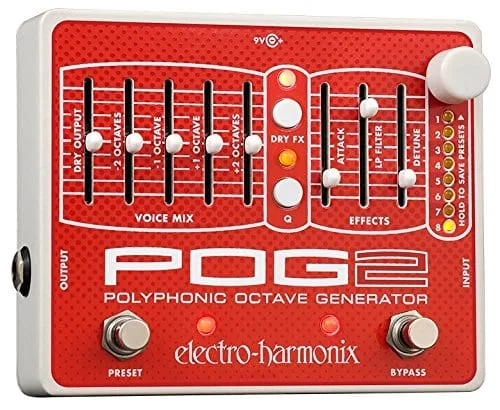
Where the POG2 was a set of sliders and eight presets, the POG3 adds an OLED display, 100 presets, MIDI over 5-pin DIN, a USB-C port with a computer editor app, a multi-mode filter, stereo output with per-voice panning, and an expression/CV input with six expression modes13. It is a large-format pedal at 7.125 x 5.75 x 2.25 inches, made in the USA, priced at $645.0014.
What it does to your sound
The POG3 takes your input signal and generates octave and harmony voices alongside it, polyphonically, meaning chords track as well as single notes. The six voices are DRY, -2 OCT, -1 OCT, +5TH, +1 OCT and +2 OCT1. Stacking -1 OCT with a little +1 OCT and detune gets a faux 12-string; adding -2 OCT and the filter moves toward bass and synth textures. Premier Guitar's reviewer found it "still excels at funky bass textures, twisted faux 12-string, and at providing ghostly, backgrounded high-harmony lines for leads"7.
Beyond the voice sliders, the pedal shapes each preset with several treatments. Guitar World's reviewer describes three of them: an Attack slider that sets the fade-in time, a Filter for tonal options or synth flavors, and a Detune control that applies a spacious chorus/doubling effect4. The filter is a multi-mode design with low pass, band pass and high pass selections, separate envelope and Q controls, and a stereo spread knob8. The stereo spread control can also create pitch modulation effects, from mellow chorus to almost rotary-speaker-like movement7.
The controls
The top panel combines sliders, buttons and footswitches. The INPUT GAIN slider sets the level of the signal at the input, with a gain range of 0.5 to 3X1. Guitar Pedal X's review also lists MASTER VOLUME and a FOCUS control for the +1 OCT and +2 OCT voices9.
| Control | What it does |
|---|---|
| Voice sliders (DRY, -2 OCT, -1 OCT, +5TH, +1 OCT, +2 OCT) | Set the level of each voice1 |
| Pan knobs per voice | Place each voice between the LEFT and RIGHT outputs17 |
| INPUT GAIN slider | Sets input level, gain range 0.5 to 3X1 |
| MASTER VOLUME | Overall output level9 |
| FOCUS | Adjusts the +1 OCT and +2 OCT voices9 |
| Attack slider | Sets the fade-in time of the effect4 |
| Filter | Multi-mode low pass, band pass, high pass with envelope and Q controls8 |
| Detune slider | Chorus/doubling effect on the +1 and +2 octave signals; at minimum it disables detune, and it can be applied to the dry signal via the DRY button4 |
| Stereo spread | Enhances stereo relationships and can create pitch modulation effects7 |
| LEFT, RIGHT, DIRECT buttons | Enable their respective outputs; states are remembered separately for EFFECT and BYPASS modes and saved to each preset1 |
There are three footswitches. The EFFECT footswitch toggles between effect mode and buffered bypass. The PRESET UP and PRESET DOWN footswitches each activate the current preset and then scroll through presets with subsequent presses; pressing and holding scrolls quickly, and pressing both together returns the pedal to LIVE mode16.
The EXP/CV input supports either an expression pedal with a 1/4" TRS plug or a control voltage from 0 to 5V on a TS plug. It accepts any expression pedal using a potentiometer from 10kΩ to 100kΩ with the wiper connected to the tip16. The pedal offers six expression modes4:
- VOLUME: controls output level for ambient swells and dynamic control5
- CROSSFADE9
- WARP9
- FILTER9
- FREEZE+GLISS9
- FREEZE+VOLUME: extra dynamic control over the freeze sound5
One caveat from a review: Guitar.com's reviewer found that with a Moog EP-3 expression pedal, the calibration process had to be repeated at every power-on, otherwise the pitch changes "went horribly" atonal, though he presumed it was a fixable bug10.
Presets, display and the NavCoder
The POG3 holds 100 onboard presets, saved and rearranged through the OLED display and the NavCoder knob1. It ships with 10 factory presets to start from47. The NavCoder is a push knob that navigates menus, parameters and presets: rotate it to scroll through values, presets and lists; center press to load or unload a preset and select menu options; center press and hold to save a preset; and push the D-pad in four directions to navigate111. MusicRadar's reviewer describes the same encoder as pushable left, right, up and down, and usable as a button to confirm selections3.
The high-visibility OLED graphical display shows the preset number, preset name, the status of outputs and buttons, and more1. It offers four home screen views11:
- STANDARD: preset number and name plus all status icons5
- GRAPHIC: a real-time graphical representation of all sliders and knobs5
- DATA: exact value settings for all controls5
- PERFORMANCE: a large preset number and name for a simplified view on stage5
Presets can also be edited on a computer. A USB-C port connects to Windows or Mac and interfaces with the EHXport app for preset editing and transfers, firmware updates and global settings16. Premier Guitar's reviewer notes that the included manual, at 23 pages, "is a must-read"7.
Power and connections
The POG3 runs on 9VDC from the factory-supplied adapter, a 9.6VDC-500mA unit that comes in the box16. The current requirement is 300mA at 9VDC, the power jack is center negative, and the maximum allowable supply voltage is 10.5 VDC16. There is no battery option. At 300mA, the pedal needs a dedicated output on a power supply rather than a low-current daisy chain tap.
The POG3 draws 300mA at 9VDC, center negative, with a 10.5 VDC maximum. It cannot run on a battery, and its draw is higher than the POG2's 200mA adapter rating1612.
Audio connections are mono in and stereo out. The single 1/4" input is unbalanced and high impedance, 2MΩ, intended for both instruments and line level signals up to +6.2dBu16. There are three 1/4" outputs: LEFT and RIGHT, each unbalanced, low impedance, 550Ω, with a maximum output level of +7.2dBu, and DIRECT OUT, a buffered output at 550Ω with a maximum output level of +12.5dBu16. Individual pan controls separate voices between the LEFT and RIGHT jacks1.
MIDI is on two 5-pin DIN jacks. MIDI IN receives Control Change, Program Change and MIDI Note messages, and every parameter on the top panel is controllable via CC and PC1. MIDI Note messages go further: they let you play the POG3 from a MIDI keyboard controller, turning it into an organ or synthesizer module6. MIDI OUT provides a MIDI Thru connection5.
Where it came from
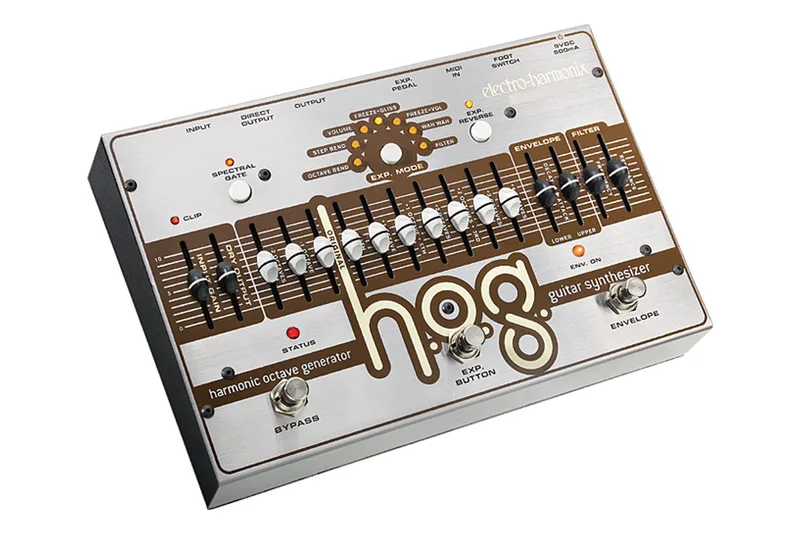
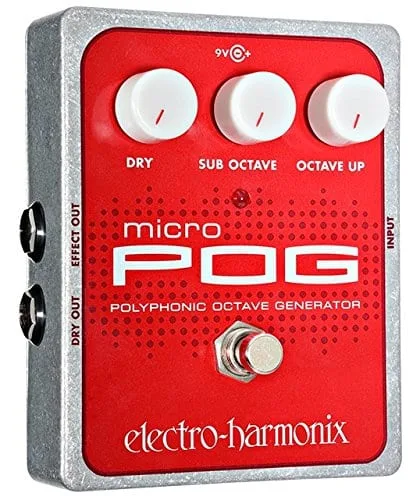
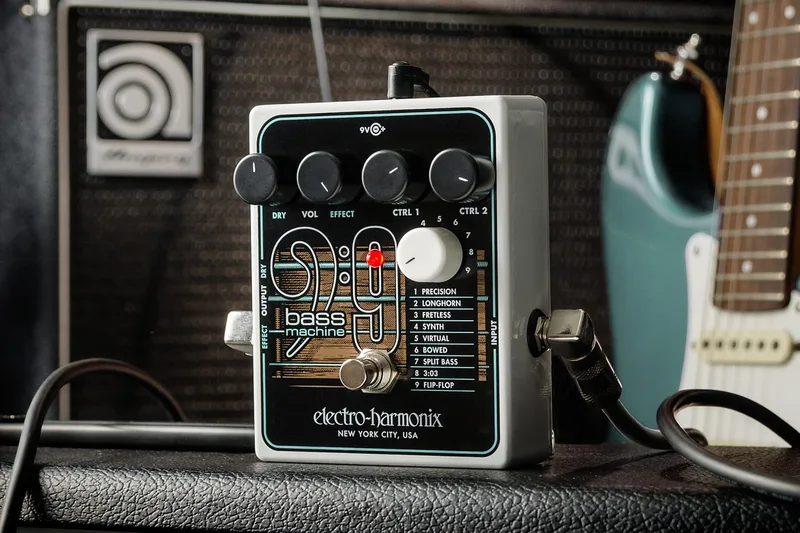
The first Polyphonic Octave Generator was released in 2005, and since then Electro-Harmonix has issued plenty of POG versions and related spin-offs, including two HOG pedals and the '9' series4. The POG3 is the third generation and the line's first update since 20092. Premier Guitar notes it costs $245 more than its predecessor, the POG2, at $64575. The related HOG2 octave generator and synthesizer was discontinued in 202413.
What reviewers said
Reviews were largely positive about tracking and capability, with price a recurring consideration. Guitar World's Trevor Curwen called it "a comprehensive reimagining of the POG with solid tracking," concluding479:
"If you like what a POG does, you'll love this! Taking things to a new level, this is sonic wizardry at its finest for those looking to get creative with sound414."
Trevor Curwen, Guitar World14
Premier Guitar's reviewer found that "the tracking is excellent, and there's a lot less fighting against artificial, cheesy sounds once you grasp the finer points," and highlighted the per-band panning knobs as "a very cool new feature"7. Guitar.com's review took a more measured view, finding it a powerful but niche and expensive evolution of the POG210.
Electro-Harmonix also hosts a set of official demo videos for the pedal, including an "Ambient Octaves" demo by Chords of Orion15.
Videos
Pete Thorn
EHX
Chords Of Orion
News
Questions
Does the POG3 have true bypass?
No. The POG3 uses buffered bypass, and the EFFECT footswitch toggles between effect mode and buffered bypass. This differs from the POG2, which Electro-Harmonix lists as true bypass. The POG3 also has a separate DIRECT OUT jack that is a buffered output.
Can the POG3 run on a battery?
No. The POG3 is powered from a 9VDC center-negative power jack and ships with a 9.6VDC-500mA adapter. Its current requirement is 300mA at 9VDC, and the maximum allowable supply voltage is 10.5 VDC. No battery option is offered.
What expression pedal works with the POG3?
The EXP/CV input accepts any expression pedal with a 1/4 inch TRS plug using a potentiometer between 10kΩ and 100kΩ with the wiper connected to the tip. It also accepts a 0 to 5V control voltage on a TS plug. One reviewer found the Moog EP-3 needed recalibration at every power-on.
Can I edit POG3 presets on a computer?
Yes. The POG3 has a USB-C port that connects to a Windows or Mac computer running the EHXport app, which handles preset editing and transfers, firmware updates and global settings. Presets can also be managed on the pedal itself using the OLED display and NavCoder knob.
Is the POG3 stereo?
Yes. It is mono in and stereo out, with separate LEFT and RIGHT 1/4 inch output jacks. Each voice has its own pan control for placing voices between the two outputs, and a stereo spread control widens the image. A third DIRECT OUT jack carries the dry signal.
Is the POG III true bypass?
No. Electro-Harmonix specifies buffered bypass for the POG3, also called the POG III. The EFFECT footswitch switches between effect mode and buffered bypass. The earlier POG2 was true bypass, so players upgrading should note the change.
Sources (15)
- Electro-Harmonix POG3, Electro-Harmonix (ehx.com)
- “You have to have a POG if you're gonna play guitar nowadays; it's the 'Jack White law'”: Electro Harmonix updates its esteemed POG pedal, calls it the “most powerful polyphonic octave generator ever”, GuitarPlayer, 2024-08-07
- “A frankly ludicrous pedal that stakes itself as the ultimate octave funhouse”: Electro-Harmonix POG 3 review, MusicRadar, 2025-02-25
- Electro-Harmonix POG3 review, Guitar World, 2025-01-10
- EHX POG3, Electro-Harmonix (ehx.com)
- EHX POG3, Electro-Harmonix
- Electro-Harmonix POG III Review, Premier Guitar, 2025-04-25
- Electro-Harmonix POG3, 360+ Looper Pico , & LPB-3 Linear Power Booster & EQ Pedal Demos, Premier Guitar, 2025-01-26
- Guitar Pedal X, Guitar Pedal X, 2024-08-07
- Electro-Harmonix POG3 review, Guitar.com, 2024-11-25
- EHX POG3, Electro-Harmonix (www.ehx.com)
- POG2 | Polyphonic Octave Generator - Electro-Harmonix, Electro-Harmonix (ehx.com)
- HOG2 | DISCONTINUED 2024 | Harmonic Octave Generator - Electro-Harmonix, Electro-Harmonix, 2024
- Best pitch shifter pedals: top picks from Digitech, Eventide and more, Guitar World, 2022-01-13
- POG3 Octave Pedal Demos, Electro-Harmonix