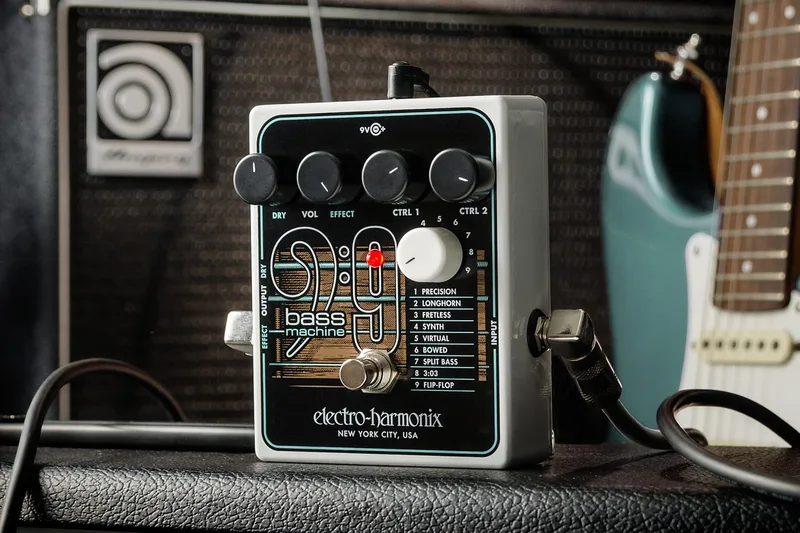


The Electro-Harmonix Bass9 Bass Machine is a pedal that transforms a guitar into nine different basses. It is polyphonic, it plugs into a standard guitar input, and Electro-Harmonix says it requires no special pickups, MIDI or instrument modifications1. Inside is a new algorithm the maker describes as "maximized for transposing one to two octaves down with superior dynamics and tracking"1, so rather than simply adding an octave-down voice, it models complete bass instruments, each with its own set of adjustable parameters.
For a player, that means one box can cover studio bass parts, live doubling, or baritone and drop-tuned territory without owning a bass. It carries a U.S. list price of $221.302, and it remains in the Electro-Harmonix lineup.
The nine programs
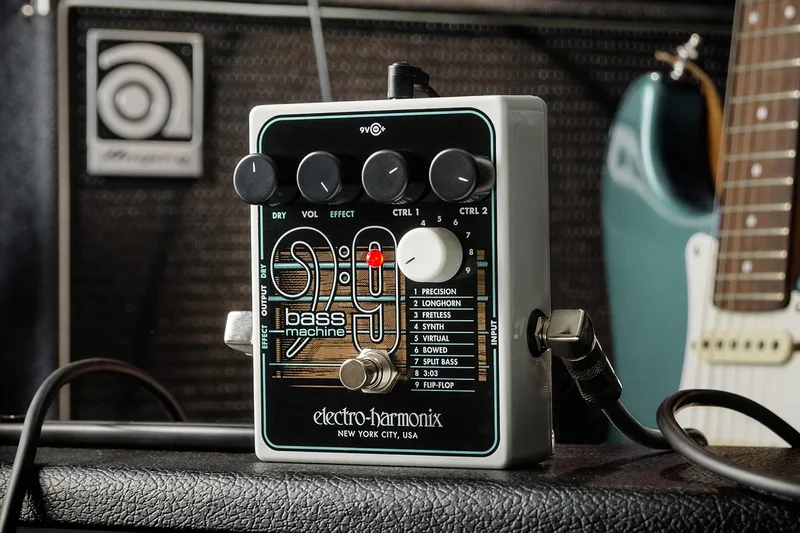
The MODE knob selects one of nine bass patches1. Premier Guitar's launch coverage listed the full set: PRECISION, LONGHORN, FRETLESS, SYNTH, VIRTUAL, BOWED, SPLIT BASS, 3:03 and FLIP-FLOP2.
| Program | What it does |
|---|---|
| PRECISION | Pays homage to the Fender P Bass2 |
| LONGHORN | Emulates the Danelectro 6-string bass4 |
| FRETLESS | Both electric and standup fretless bass guitar tones4 |
| SYNTH | Bass synth program2 |
| VIRTUAL | Bass program2 |
| BOWED | Classic bowed bass4 |
| SPLIT BASS | Bass on the lower strings (all notes below F#3), chords or melody on the higher strings4 |
| 3:03 | Bass program2 |
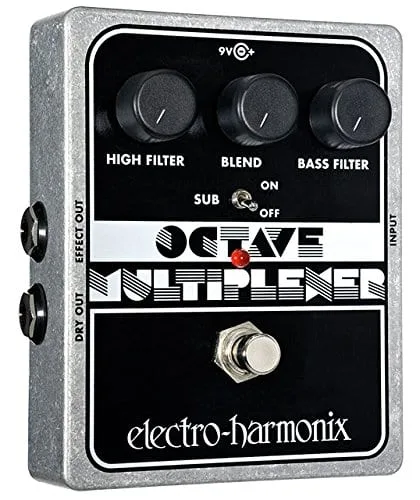
| FLIP-FLOP | Based on the EHX Octave Multiplexer, a '70s style logic driven sub-octave generator that tracks without glitches4 |
Two programs deserve a closer look. SPLIT BASS is the one that answers the chord question: instead of converting everything you play, it turns notes below F#3 on the lower strings into bass while leaving the higher strings alone for chords or melody4. And FLIP-FLOP reaches back into the company's own history, basing its sub-octave generation on the Octave Multiplexer, the analog sub-octave box Electro-Harmonix built in the 1970s4.
Guitar World's reviewer found the LONGHORN program especially practical, because its pitch can be adjusted in semitones from unity down to an octave, which gives you a range of baritone or drop-tuned sounds from a single program3.
Controls and outputs
The front panel keeps things simple: a MODE knob, two parameter knobs, and two volume knobs154.
| Control | What it does |
|---|---|
| MODE | Selects a bass patch1 |
| CTRL 1 and CTRL 2 | Assigned to various parameters, depending on which bass model you choose4 |
| DRY VOL | Controls the volume of the untreated instrument signal present at the EFFECT OUTPUT jack1 |
| EFFECT volume | Sets the effect level, so the mix at the Effect output can be tuned precisely2 |
What CTRL 1 and CTRL 2 actually do changes from program to program. Guitar.com's Daniel Ong gave a concrete example: in Precision, Ctrl 1 governs sub-octaves while Ctrl 2 mirrors the original P-Bass's tone control6.
The output side is where the Bass9 earns its place on a pedalboard. There are two outputs721:
- EFFECT OUTPUT: carries the mix you set with the Dry and Effect volume controls, so bass and dry guitar can be blended in one signal12.
- Dry output: an always-active jack that outputs the input signal at unity gain, independent of the effect7.
That second jack means you can run your clean guitar and the generated bass to two separate amps or mixer channels, which is how a guitarist would cover bass and guitar parts at once72.
Power
The Bass9 runs on the standard EHX 9.6DC-200mA power supply, which is included12. Current draw is 100mA1, the same figure Guitar World listed in its review3.
With a 100mA draw, the Bass9 is hungrier than most analog compact pedals, so plan for it on a powered pedalboard rather than a small daisy chain with limited headroom.
Part of the 9-series
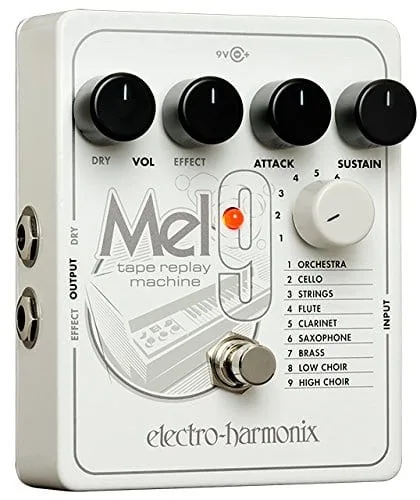
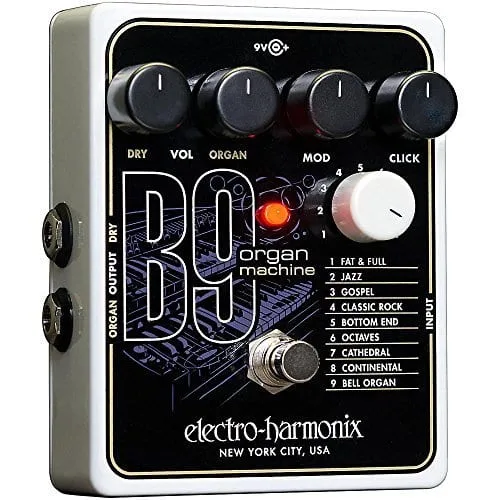
The Bass9 relies on the same technology powering all EHX 9 Series pedals, a family the maker says includes the award-winning MEL9 Tape Replay Machine1. Guitar World's Trevor Curwen placed it in sequence: "The Bass9 is the latest 9-series pedal following on from the B9, C9, Key9, Synth9 and Mel9 pedals"3. The line began with the B9 Organ Machine in 2014, which turned a guitar or keyboard into electric organ tones without a special synthesizer pickup8, and each later pedal applied the same idea to a different instrument family.
What reviewers said
Guitar World reviewed the Bass9 in March 2020, pricing it at $221.303. On the question every player asks first, tracking, the verdict was positive:
"Tracking is pretty flawless"
Trevor Curwen, Guitar World3
The same review flagged the Longhorn program as the most useful, thanks to its semitone pitch adjustment covering baritone and drop-tuning ranges3. At launch, Premier Guitar reported the pedal was available immediately at a US list price of $221.302.
Videos
EHX
Guitarist
Rock Guitar Vibes
News
Questions
Does the Bass9 need MIDI or a special pickup?
No. Electro-Harmonix says the polyphonic Bass9 requires no special pickups, MIDI or instrument modifications. It works from a standard guitar input, like the other pedals in the EHX 9-series, so you can plug straight in and switch between the nine bass programs with the MODE knob.
Is the Bass9 true bypass?
No. The maker lists the Bass9 as selectable buffered bypass, and Guitar World's review also specifies buffered bypass. This matches the rest of the 9-series, whose pedals use buffered bypass rather than true bypass switching.
Can I run dry guitar and bass separately from the Bass9?
Yes. The Bass9 has two outputs. The EFFECT OUTPUT jack carries the mix you set with the independent Effect and Dry volume controls, while a separate always-active Dry output jack passes your input signal at unity gain, so you can send clean guitar and bass to two different amps or channels.
How does the Bass9 track chords?
The Bass9 is polyphonic, and Guitar World's Trevor Curwen found its tracking 'pretty flawless'. The SPLIT BASS program takes a different approach to chords: it turns notes below F#3 on the lower strings into bass while leaving higher strings free for chords or melody.
What is the difference between the Bass9 and the POG?
The Bass9 is a 9-series pedal built around nine modeled bass programs, using an algorithm Electro-Harmonix says is maximized for transposing one to two octaves down with superior dynamics and tracking. The POG line is a separate EHX family of polyphonic octave generators, such as the POG2 and POG3, which stack octave voices rather than model specific bass instruments.
Sources (8)
- BASS9 | Bass Machine - Electro-Harmonix, Electro-Harmonix
- Electro-Harmonix Unveils the Bass9, Premier Guitar, 2019-08-08
- Electro-Harmonix Mod 11, Nano Operation Overlord and Bass9 Bass Machine, Guitar World, 2020-03-20
- Electro-Harmonix BASS9 Bass Machine: Get nine different bass tones from your guitar, www.gearnews.com, 2019-08-09
- Electro-Harmonix reveals the Bass9 bass machine pedal | MusicRadar, MusicRadar, 2019-08-08
- EHX’s Bass9 Bass Machine transforms guitars into basses, Guitar.com, 2019-08-13
- Electro-Harmonix Introduces the Bass9 Bass Machine Pedal, Guitar World, 2019-08-08
- Electro-Harmonix Unveils the B9 Organ Machine, Guitar Interactive Magazine, 2014-06-19