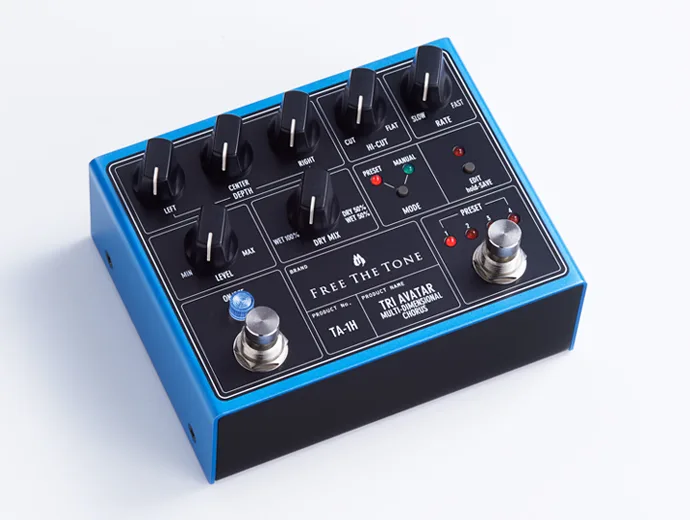


The Free The Tone TRI AVATAR TA-1H is a chorus pedal that the Japanese maker Free The Tone calls a Multi-Dimensional Chorus. Instead of the single modulated voice of a conventional chorus, it runs three independent pitch-modulation signal paths plus one dry signal path, four signal paths in total, mixed in the analog domain12.
The idea behind the three voices is phase. Free The Tone offsets the three modulation paths 120 degrees from each other, which the maker says produces a spread unique to three-phase chorus1. Pedal of the Day put the effect in player terms: "By utilizing three separate phases of chorus sound, along with your dry signal, you get more width and depth to the chorus effect"3.
A three-phase chorus with a dry signal path
Most chorus pedals modulate one copy of your signal and blend it with the dry sound. The TA-1H modulates three copies. Each of the three chorus voices is shifted 120 degrees in phase relative to the others, and the dry signal stays in the mix under its own control, the DRY MIX knob1.
In stereo use, the three phases are allocated across the outputs: phase 1 goes to the left side, phase 2 to left and right, and phase 3 to the right side1. Pedal of the Day noted that in mono operation the left and right signals both appear at Output L, while in a stereo amp setup the right phase goes to Output R and the center phase to both outputs3.
The signal conversion is where the analog and digital sides meet. Free The Tone says the pedal uses 24-bit AD/DA converters with its own signal processing and algorithms to suppress noise, creating what the maker calls a next-generation chorus sound1. Pedal of the Day characterized the design as "infusing Free The Tone's classic analog/digital mixture to provide the warmest sounds with the latest technology"3.
The controls
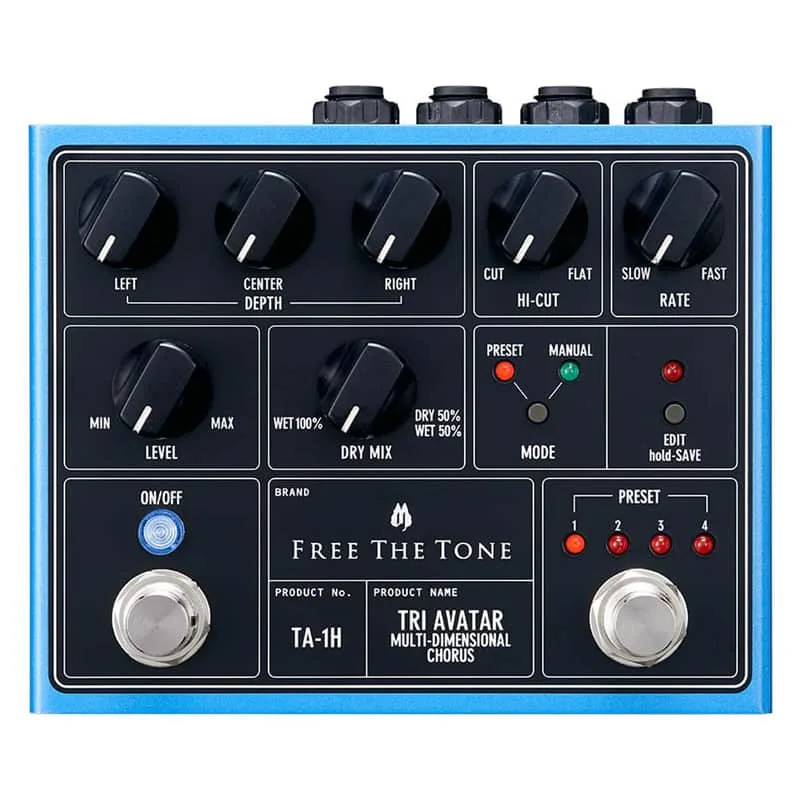
The TA-1H's knob set splits the chorus into its three voices and lets you balance each against the dry signal1.
| Control | What it does |
|---|---|
| RATE | Sets the modulation speed shared by the chorus voices1 |
| DEPTH L / C / R | Three knobs, one per phase; Pedal of the Day says they adjust the pitch vibration depth of the corresponding signal13 |
| HI-CUT | Rolls off high frequencies in the modulated sound1 |
| DRY MIX | Balances the dry signal path against the chorus voices1 |
| LEVEL | Sets the output level1 |
Beyond the knobs, the pedal holds four presets. You save one by holding down the EDIT button for 1.5 seconds, and a secondary footswitch scrolls through the presets once they are set to your specs3. The four presets can also be recalled by MIDI signal1, and Pedal of the Day confirmed the pedal "has MIDI capabilities as well"3.
The EXT jack takes an expression pedal, which can control RATE or HI-CUT in real time1. Pedal of the Day described the same jack as a way "to control either the Rate or Hi Cut parameters with an external footswitch"3.
Power and connections
Power comes from a DC9V input jack for an AC adapter, and Free The Tone specifies its dedicated FA-0905D-JA adapter, with a current draw of about 140mA1. There is no battery option, so the pedal needs a 9V supply, and the 140mA draw is worth noting when planning a pedalboard power budget.
Connections are four 1/4-inch standard phone jacks: IN, OUT/L (mono), OUT/R, and EXT1. Input impedance is 500K ohms or more, and output load impedance is 10K ohms or more1.
The TA-1H can be connected to an amp's send and return, because its maximum input level is +7dBu. Free The Tone notes that distortion gradually increases above +7dBu, so adjust the amp's send level while checking the sound1.
Where it came from and what reviewers said
Premier Guitar reported on the TA-1H's introduction in December 2015, listing its three independent pitch-modulation signal paths and one dry signal path for analog-domain mixing, at $350 MSRP2. On That Pedal Show's chorus pedal video, the TA-1H Tri-Avatar Multi Dimensional Chorus appeared in the loop of a G2 switching system5.
Pedal of the Day's 2018 feature concluded:
"Not just a simple two or three-knob chorus effect pedal, the Tri Avatar truly is a multi-dimensional pedal"
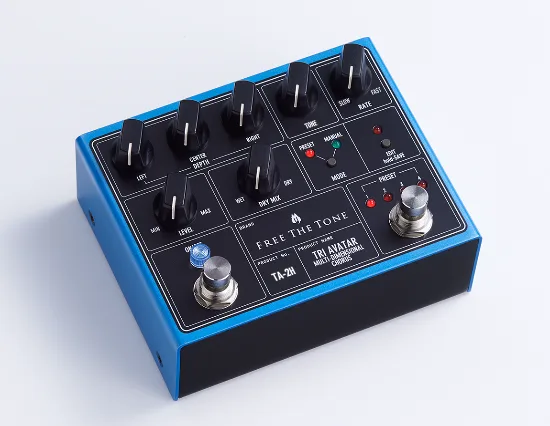
Free The Tone later released a successor to the TA-1H, the TRI AVATAR TA-2H. Firmware version 1.2 for the TA-1H itself is available for download from Free The Tone1.
Videos
Brett Kingman
Best Guitar Effects
shnobel
Questions
Can the TA-1H run in an amp's effects loop?
Yes. Free The Tone states the TA-1H accepts input up to a maximum level of +7dBu, so it can be connected to an amp's send and return. Distortion gradually increases above +7dBu, so the maker advises adjusting the amp's send level while checking the sound.
Is the Free The Tone TA-1H analog or digital?
It is a hybrid. The three pitch-modulation paths and the dry signal path are mixed in the analog domain, while the pedal uses 24-bit AD/DA converters with Free The Tone's own signal processing and algorithms, which the maker says suppress noise. Pedal of the Day described it as an analog and digital mixture.
How many presets does the TRI AVATAR TA-1H store?
Four. You save a preset by holding down the EDIT button for 1.5 seconds, and a secondary footswitch scrolls through the presets once they are set. The four presets can also be recalled by MIDI signal.
Which expression pedals work with the TA-1H?
Free The Tone recommends expression pedals of 10k to 25k ohms, and lists the Boss FV-500L, Roland EV-5, Electro-Harmonix Expression Pedal and Dual Expression Pedal, Jim Dunlop DVP-3 and DVP-4, Moog EP-2 and EP-3, and M-Audio EX-P. The pedal controls RATE or HI-CUT in real time from the EXP jack.
Does the TA-1H take a battery?
No. Power comes through a DC9V input jack for an AC adapter, and Free The Tone specifies its dedicated FA-0905D-JA adapter. There is no battery option, so it needs a 9V power supply or pedalboard power brick capable of about 140mA.
Sources (5)
- TRI AVATAR / TA-1H|Products 商品紹介|Free The Tone, Free The Tone
- Free The Tone Introduces the TA-1H Tri Avatar, Premier Guitar, 2015-12-10
- Free The Tone TA-1H Tri Avatar Chorus, Pedal of the Day, 2018-03-30
- TRI AVATAR / TA-1H|Products 商品紹介|Free The Tone, Free The Tone
- That Pedal Show, That Pedal Show, 2016-10-28