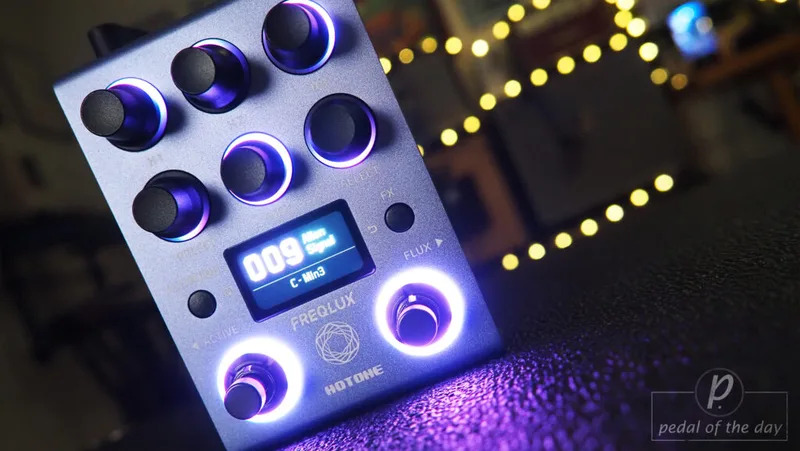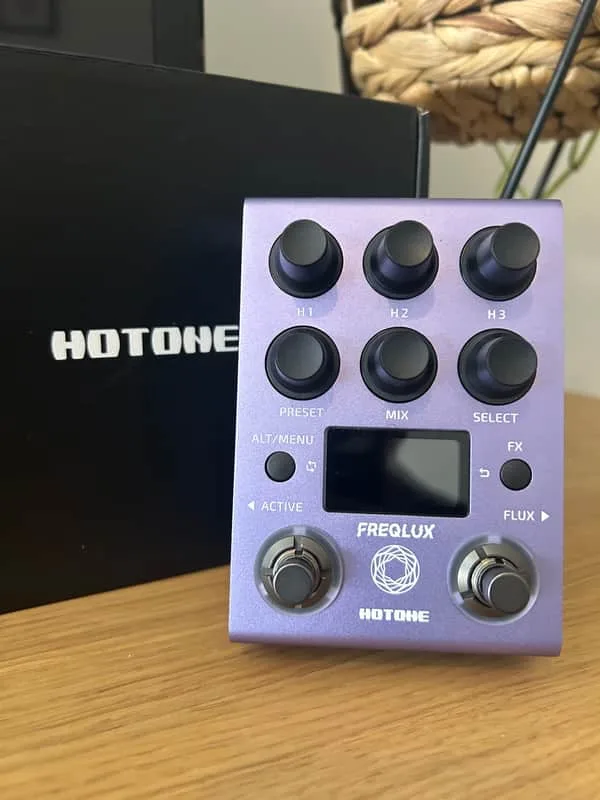


The Hotone FreqLux is a three-voice digital pitch shifting and harmonizing pedal designed for advanced real-time pitch manipulation1. It sits in the octave and pitch pedal family but goes well beyond a simple octave up or down: it runs three pitch engines at once, each with its own settings, and adds a dedicated Flux footswitch for pitch that moves in real time.
Where a basic pitch shifter gives you one shifted note, the FreqLux gives you three fully independent pitch voices, and each voice can be assigned its own interval, level, panning, attack, tonal character and operating mode2. Pedal of the Day describes the core idea plainly:
"At the core of Freqlux are three completely independent pitch engines. Each voice can run a different mode, interval, and behavior"32
Pedal of the Day, 7 May 20263
That means one voice could hold a fixed harmony below your part, another could arpeggiate, and a third could add a detuned shimmer, all at once, with independent pan and level controls for placing each voice in the stereo field3.
What it does: three independent pitch voices
The three voices are the heart of the pedal. Bass Musician Magazine's reviewer, Cláudio Ribeiro, called it a creative sound-design platform rather than a one-trick harmonizer, with each voice assignable its own interval, level, panning, attack, tonal character and operating mode2. In practice that lets you build layered parts live: a fixed interval on one voice, a moving or arpeggiated line on another, and a modulation-based texture on the third.
At the heart of the Freqlux are three fully independent pitch voices2. Each voice can run a different mode, interval and behavior, and each can be assigned its own interval, level, panning, attack, tonal character and operating mode13. Independent pan and level controls let you place each voice exactly where you want it in the stereo field3. For players coming from simpler synth pedals or octave boxes, the voice-by-voice editing is where the pedal sets itself apart.
The modes and the Flux footswitch
Each voice runs one of five modes2:
| Mode | What it does |
|---|---|
| Poly Mode | Pitch shifting suited to chords and full parts; likely the default choice for many bassists2 |
| Key Mode | Harmonies locked to a musical key2 |
| Detune Mode | Pitch offset for thickening, chorus-like doubling2 |
| Arpeggiator Mode | Shifted notes sequenced into patterns2 |
| Mod Mode | Bypasses pitch shifting entirely and runs an independent modulation engine with vibrato and modulation effects3 |
Mod Mode is worth noting for players who also want vibrato or other movement from the same box: Pedal of the Day describes it as bypassing pitch shifting entirely and using an independent modulation engine3.
The Flux footswitch is the feature reviewers singled out. Bass Musician Magazine called it one of the pedal's most distinctive features, introducing real-time pitch movement such as smooth glides, octave dives and evolving harmonic transitions2. Guitar Pedal X describes it as enabling automatic gliding pitch shifts4. There is also an Auto Flux function that responds dynamically to playing dynamics2, so the pitch movement can follow how hard you play rather than running on a fixed script.
On the drive side, Pedal of the Day reports Drive and Tone controls that let you dial in anything from subtle grit to aggressive harmonic saturation3, which puts a bit of overdrive character inside the pitch engine.
Power and connections: stereo, MIDI and expression
The FreqLux supports external control: it takes an expression pedal or MIDI for additional parameters24. That gives players a way to move the pitch engines in real time from a foot controller or a MIDI-equipped board, alongside the pedal's own footswitches.
For control beyond the two footswitches, it supports EXP or MIDI external control for additional parameters4. MusicRadar notes it supports both expression pedal control and MIDI switching5, which makes it at home on a larger MIDI-equipped pedalboard.
The FreqLux draws 500mA at 9V DC, center negative, through a USB 2.0 Type-C jack14. That current draw is well above what a typical low-current daisy chain supplies, so plan on an isolated or high-current 9V supply, and there is no battery option.
What reviewers said
Bass Musician Magazine's Cláudio Ribeiro tested it from a bass player's perspective and found the tracking held up2:
"Tracking remains impressively accurate across the instrument's range, with clean articulation on fast passages and reliable performance even on lower notes"2
Cláudio Ribeiro, Bass Musician Magazine, 15 July 20262
Pedal of the Day found the editing approachable despite the depth, calling it "extremely user-intuitive, allowing you to find brilliant sounds with ease and in a short period of time," even though the reviewer noted needing the manual3. MusicRadar described the hardware as a medium-sized, dual footswitch stompbox that feels seriously tough and well put together, with an eye-catching purple finish and bright neon LEDs5.
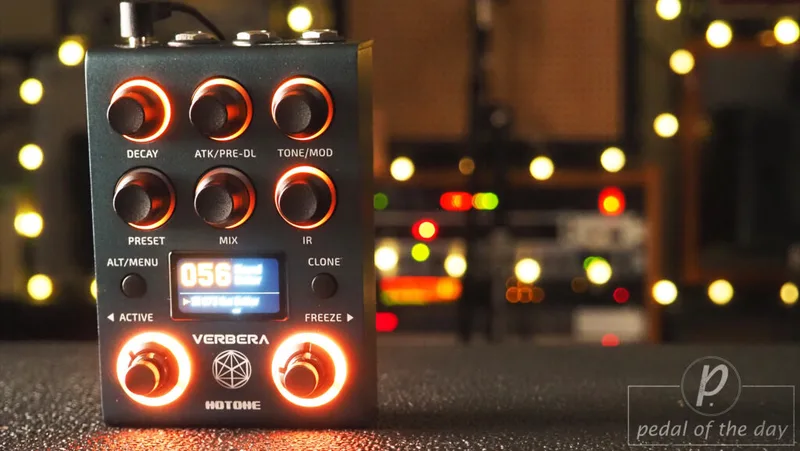
Guitar Pedal X placed it in context of Hotone's range: the Freqlux is the second pedal in the Neon Series, arriving alongside the Verbera, both priced around $299 MAP / RRP and relatively widely available4. MusicRadar gives the launch price as $299.995.
Videos
HotoneAudio
HotoneAudio
HotoneAudio
Questions
Does the Hotone FreqLux work on bass?
Yes. Bass Musician Magazine reviewed it as a bass player's tool and found that Poly Mode will likely be the default choice for many bassists, with tracking that remains accurate across the instrument's range, clean articulation on fast passages and reliable performance on lower notes. The pedal is available online at Amazon.com.
How many presets does the FreqLux have?
Bass Musician Magazine reports 95 factory presets covering organ sounds, synth basses, ambient textures and classic octave effects. MusicRadar also reports 200 user preset slots alongside the 95 factory presets, so you can store your own sounds as well as work from the built-in ones.
Is the Hotone FreqLux stereo?
Yes. It has stereo input and output with a selectable input mode, one 1/4 inch TRS input jack and two 1/4 inch TRS output jacks. Each of the three pitch voices has independent pan and level controls, so you can place each voice where you want it in the stereo field.
What power supply does the FreqLux need?
It runs on 9V DC, center negative, drawing 500mA, and connects through a USB 2.0 Type-C jack. At 500mA it needs a proper isolated or high-current supply rather than a typical low-current daisy chain, and there is no battery option.
Does the FreqLux have MIDI?
Yes. It supports EXP or MIDI external control for additional parameters, and MusicRadar notes it supports both expression pedal control and MIDI switching, so you can drive it from a pedalboard controller or an expression pedal.
Sources (5)
- FreqLux by HOTONE, RockBoard PedalPedia, 2026
- Review: Hotone Freqlux Pitch Pedal, Bass Musician Magazine, 2026-07-20
- Hotone NeonGlow Series Freqlux Tri-Pitch Engine (Stereo), Pedal of the Day, 2026-05-07
- Guitar Pedal X, Guitar Pedal X, 2026-05-11
- Hotone Freqlux Tri-Pitch Engine pedal review, MusicRadar, 2026-08-27