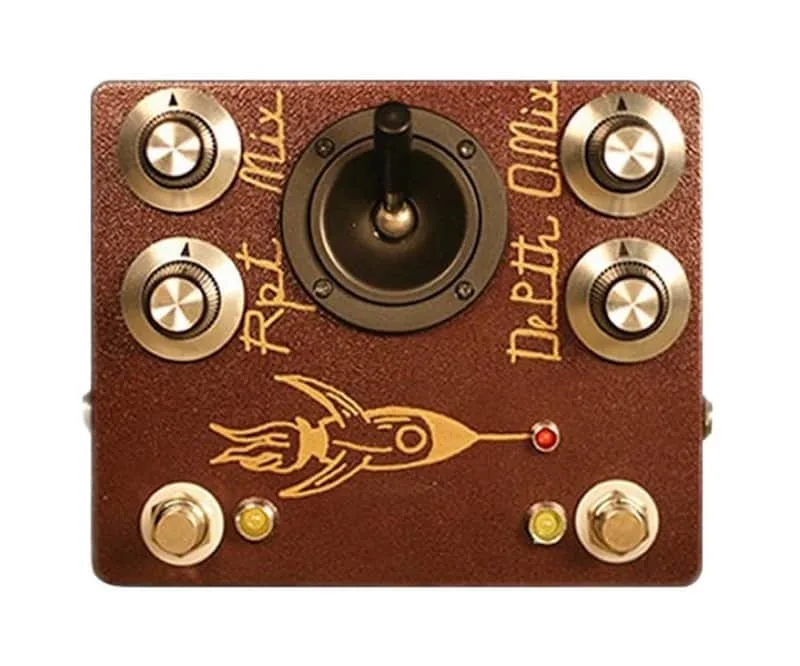



The Kármán Line is a modulating joystick delay and oscillation device from Hungry Robot Pedals1. Instead of the usual knob for delay time, it puts a joystick in the middle of the enclosure: the Y-axis (up and down) manipulates the delay time, and the delay chip creates an audible warp as you move it, while the X-axis (left and right) controls the rate of modulation1. The result is a heavily filtered, lo-fi delay line with vinyl-inspired pitch modulation, built around an all analog, light-based LFO1.
The maker describes the repeats as dark and overdriven, with a not-so-subtle grittiness aimed at creating a lo-fi wall of sound1. Delicious Audio notes it was designed for glitchy experimentalists, but can find its place in many musical settings2. MusicRadar's Alex Lynham, writing in a digital delay buying guide, reads between the lines and judges it probably based on the PT2399 digital chip, which with the right filtering can have a pleasant, almost analog timbre3.
A delay you steer with a joystick
The joystick is the heart of the pedal. Moving it up or down affects the delay time, the oscillation pitch and the warping, while moving it left and right controls the rate, or speed, of the modulation4. Because the delay chip warps audibly as the delay time changes, pushing the stick produces the kind of pitch-bending artifacts players usually get from twisting a delay time knob, but with instant, two-dimensional control1. MusicRadar describes the Y-axis as letting you create warping artifacts and glitched-out noise3.
The modulation itself is vinyl-esque pitch modulation centered on an all analog, light-based LFO1. MusicRadar notes the modulation on the delay line gives a more tape-like feel to the repeats3. The Depth knob controls how deep and present that modulation is4.
The controls
Alongside the joystick, the pedal carries four knobs: Rpt, Mix, Depth and O.Mix3. Three footswitches handle On/Off, Swell and Launch4.
| Control | What it does |
|---|---|
| Joystick Y-axis (up/down) | Delay time, oscillation pitch and warping4 |
| Joystick X-axis (left/right) | Rate of modulation1 |
| Rpt. knob | Number of repeats in normal mode; overridden in Launch and Swell modes4 |
| Mix knob | Overall delay mix |
| Depth knob | How deep and present the modulation is4 |
| O.Mix knob | Volume of the oscillation; inactive in other modes, but with Launch active it overrides the Mix knob to dampen the oscillation volume14 |
Swell and Launch: the two oscillation modes
The Swell footswitch (center) and Launch footswitch (right) provide two methods for bringing the circuit into ramping oscillation by overloading it with out-of-control repeats1.
- Swell is a momentary switch that lets you create a ramping volume swell at any time; the repeats return to normal when you release it1.
- Launch is a latching switch that creates a below the mix oscillation that can be manipulated with the joystick; while Launch is active, the joystick also acts as a pitch selector1.
Pedal of the Day describes Launch as sending the pedal into below-the-mix droning sounds4. MusicRadar summarizes the pair as a momentary swell and a latching launch switch for creating oscillation3.
Delay time, guitar and bass modes
An internal dipswitch sets the maximum delay time to either 450 ms in Guitar mode or 1000 ms in Bass mode4. The longer Bass mode setting suits low drones and slower warping, and the pedal appears in the context of both guitar and bass setups. Hungry Robot also encourages you to place this pedal first in your chain4, so its dark repeats and oscillation feed everything downstream.
What reviewers said
Pedal of the Day reviewed the pedal in December 2016 and called it an experimenter's dream4:
"The Kármán Line is yet again an experimenter's dream pedal, not really labeling itself into any certain effect-type category"
The same review found it fun and exciting in conjunction with the rest of your effects4. Delicious Audio's write-up framed it as a delay and oscillation device designed for glitchy experimentalists that can still find its place in many musical settings2, and MusicRadar included it in a roundup of digital delay pedals for guitarists, highlighting the joystick control and the tape-like modulation on the repeats3.
Videos
PedalNerds - Nathan Shafer
Eirik Stordrange
Pedals and Effects
Questions
What power does the Kármán Line need?
It runs on 9V DC from a negative center 2.1mm barrel plug, the standard pedalboard supply. Current draw is 37 mA, so it is easy to power alongside other pedals on a typical isolated supply or daisy chain with headroom to spare.
Where should the Kármán Line go in a pedal chain?
Hungry Robot encourages placing the pedal first in your chain. That position lets its dark, overdriven repeats and oscillation feed the rest of your effects, so later pedals shape the drones and warped delay tails as they move downstream.
What is the maximum delay time on the Kármán Line?
An internal dipswitch sets the maximum delay time to either 450 ms in Guitar mode or 1000 ms in Bass mode. The longer Bass mode setting gives more room for slow warping and low drones, while Guitar mode keeps the repeats tighter.
What is the difference between the Swell and Launch footswitches?
Swell is a momentary switch that creates a ramping volume swell, and the repeats return to normal when you release it. Launch is a latching switch that creates a below the mix oscillation you can manipulate with the joystick, which also acts as a pitch selector while Launch is active.
Can the Kármán Line be used with bass?
Yes. An internal dipswitch offers a Bass mode that sets the maximum delay time to 1000 ms instead of the 450 ms Guitar mode setting, giving bass players longer repeats and more space for low-end drones.
How much current does the Kármán Line draw?
The maker lists the current draw at 37 mA. That is modest by delay pedal standards, so a standard 9V DC power supply with 100 mA or more per output will run it comfortably.
Sources (4)
- The Kármán Line, Hungry Robot Pedals
- Hungry Robot, Delicious Audio, 2017-08-07
- 5 digital delay pedals guitar players need to try, MusicRadar, 2021-06-03
- Hungry Robot Pedals The Kármán Line, Pedal of the Day, 2016-12-12