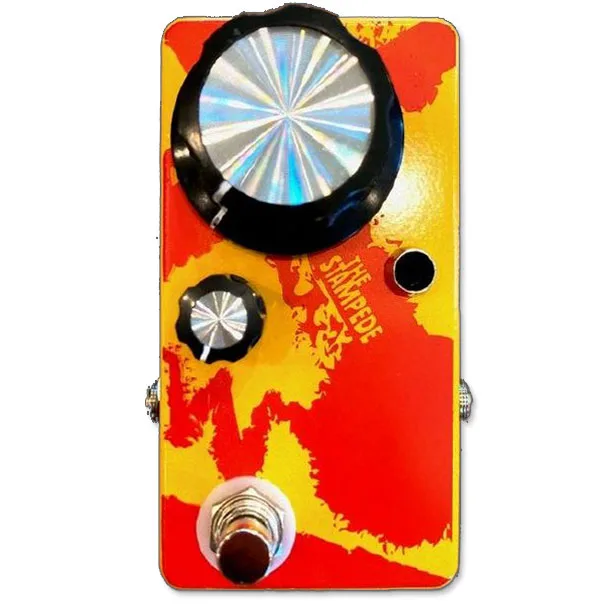



Hungry Robot The Stampede is a two-knob fuzz pedal built around a 4069 CMOS chip. Hungry Robot describes it as "a glitchy, square-wave CMOS fuzz" that produces "chaotic, synth-esque, fuzz tones"1. Rather than the saturated, compressed character of a traditional fuzz, a CMOS design reshapes the guitar into something closer to a synthesizer: the maker explains that "CMOS fuzzes work by taking your signal and transforming it into a square wave which makes it sound like a synth"1.
How it works and what the knobs do
The Stampede has two controls, laid out as a large knob and a small knob1:
| Control | What it does |
|---|---|
| Large Knob: Volume | Sets the output volume1 |
| Small Knob: Sensitivity | Dials in the volume of the signal before it hits the front end of the CMOS chip1 |
The Sensitivity control is where the pedal's character lives. Delicious Audio's Paolo De Gregorio, writing when the pedal was announced, described its range: "The latter control can produce a variety of glitchy results at lower settings, from sputtering to sub-octave hints"2. Hungry Robot puts the same control's full sweep this way: "The sensitivity knob can range from barely registering to self-oscillation"1.
"The sensitivity dials in the volume of the signal before it hits the front end of the CMOS chip."
At maximum Sensitivity the pedal self-oscillates, and De Gregorio notes that this setting also brings "extra unwanted noise" along with the oscillation2. If you run it maxed, a noise gate after it on the board is worth considering.
The fixed EQ
Beyond the two knobs, The Stampede carries a fixed three-band active EQ. Hungry Robot describes it as having "the Low Pass and High Pass running hot and the Band Pass subtly scooping out the midrange"1. In practice that means the lows and highs are emphasized while the mids are gently cut, a voicing that suits the pedal's synth-like square-wave character rather than a mid-forward overdrive or distortion sound.
Power, size and price
The Stampede runs on 9V DC with a negative center 2.1mm barrel connector and draws 97 mA1. That current draw is well above what a typical fuzz needs, so it is a pedal to plan your supply around rather than an afterthought on a shared daisy-chain output. The enclosure measures 5.7" x 4.7"1. Hungry Robot lists the price at $100 USD1, which De Gregorio also noted at the announcement: "a glitchy, square-wave CMOS fuzz that will only set you back $100"2.
Where it sits in Hungry Robot's fuzz line
The Stampede was announced in September 2023 as "the company's latest device, a 2-knob pedal"2, arriving from a maker De Gregorio noted has "got us used to very 'knobby' pedals"2. It sits alongside the maker's other fuzzes, including the Hungry Robot FZ, a more conventional fuzz design, and The Collective. Where those pedals aim at classic fuzz textures, The Stampede is the deliberately unstable, synth-leaning option in the line12.
Videos
Dennis Kayzer
Tri Pedal Reviews
Boring Gear Reviews
Questions
What kind of fuzz is the Hungry Robot The Stampede?
The Stampede is a glitchy, square-wave CMOS fuzz. Hungry Robot describes it as producing chaotic, synth-esque fuzz tones, because the 4069 CMOS chip at its core transforms the guitar signal into a square wave, which makes it sound like a synth rather than a traditional fuzz.
What does the Sensitivity knob do on The Stampede?
The Sensitivity knob dials in the volume of the signal before it hits the front end of the CMOS chip. At lower settings it produces a variety of glitchy results, from sputtering to sub-octave hints, while maxed out it delivers self-oscillation along with extra unwanted noise.
Does The Stampede self-oscillate?
Yes. Hungry Robot says the sensitivity knob can range from barely registering to self-oscillation, and Delicious Audio's Paolo De Gregorio notes that at maximum settings it delivers self-oscillation along with extra unwanted noise.
What chip is in the Hungry Robot The Stampede?
The Stampede runs off a 4069 CMOS chip. Hungry Robot explains that CMOS fuzzes work by taking your signal and transforming it into a square wave, which makes it sound like a synth.
What power supply does The Stampede need?
The Stampede runs on 9V DC with a negative center 2.1mm barrel connector and draws 97 mA. That draw is high enough that a battery or a shared daisy-chain output may not be the best choice.
How much does the Hungry Robot The Stampede cost?
The Stampede is priced at $100 USD, according to Hungry Robot's product page.
Sources (2)
- The Stampede, Hungry Robot Pedals
- New Pedal: Hungry Robot The Stampede, Delicious Audio, 2023-09-01