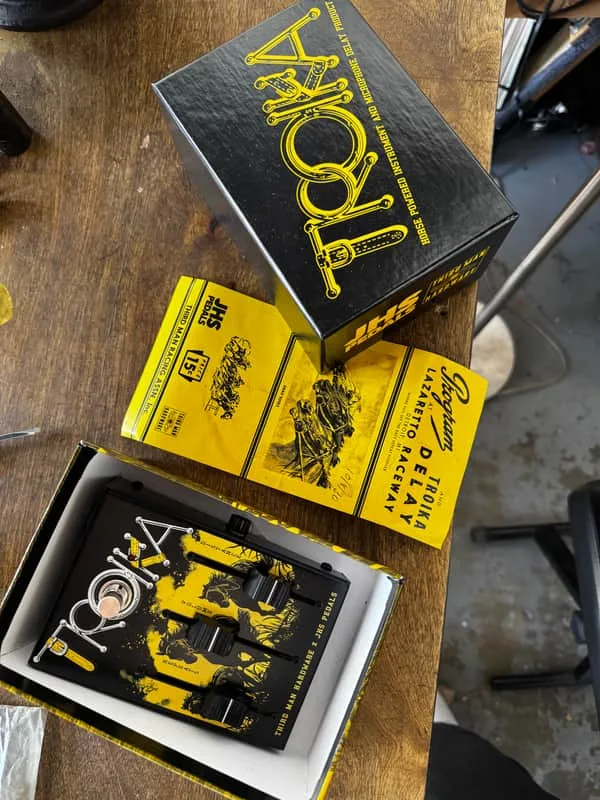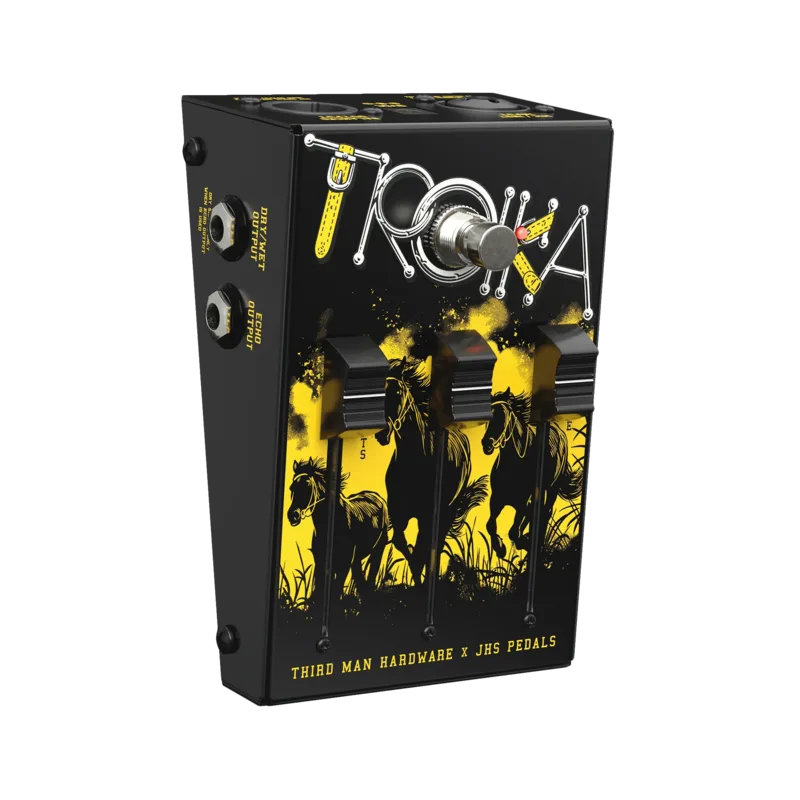


The JHS Troika Delay is a multi-purpose, studio-grade delay device built to work with microphones, guitars, or any instrument you want to plug into it. It came out of a collaboration between JHS Pedals and Third Man Hardware, Jack White's gear company, and it exists because Jack White likes using delay on his voice but found the usual process caused noise and volume drop problems1. The result is a wedge-shaped unit with sliders instead of knobs, a microphone preamp, and both XLR and 1/4" connections213.
JHS describes it as a hi-fidelity digital delay, built on an FV-1 chip running a DSP digital delay algorithm, with a Lundahl 1578 transformer on the mic input and a TY-250P output transformer1. Guitar World characterizes its sound as a tape delay that leans into White's love of "mechanical" sounds while eliminating the hum, hiss, and extra snarl of vintage units4.
A digital delay with a microphone preamp
The Troika is not just another delay pedal. Delicious Audio calls it "a studio-grade signal-processing machine built for the stage," usable on a desktop in the studio or at your feet in front of a crowd5. The core idea is a delay that treats a microphone as a first-class input: the mic preamp has adjustable gain from +20dB to +80dB, set by a mini Mic Gain dial on the side of the unit14.
The signal path is transformer-balanced at both ends. The input transformer is a Lundahl 1578 with a 1:10 winding (+20dBu) and a frequency range of 10Hz to 70kHz; the output transformer is a TY-250P with a 1:1 winding (0dB) and a 20Hz to 20kHz range1. Pedal of the Day's take:
"Utilizing a hi-grade Lundahl transformer on the mic input, and a secondary output transformer, this is like no delay you’ve seen before."
The unit is internally switchable between Instrument Mode and XLR Mode, so one box covers both jobs1. In Instrument Mode there is no true bypass; instead it has a high-quality, always-active JFET op-amp buffer1. It passes +48V of phantom power from an external source, though it does not provide phantom power itself3.
The faders and controls
The Troika's controls are three 60mm metal-shaft faders laid out like a small mixing console, a layout JHS says was chosen to give Jack White easy, real-time control in a live setting1. The bypass switch sits above the sliders so it stays out of the way of on-the-fly adjustments36.
| Control | What it does |
|---|---|
| Distance | Sweeps the delay time from a tight 80ms slapback to a full one-second echo15 |
| Repeats | Adjusts the amount of repeats or feedback; down is less, up is more1 |
| Volume | Sets the level of the effected signal15 |
| Mic Gain | Mini dial on the side; sets preamp gain from +20dB to +80dB14 |
Other internal options:
- Trails are internally selectable, so you can choose whether repeats ring out after bypass3
- Dry/Wet is adjustable from 0 to 50/50, with full 100% wet available1
- The Echo output passes only the wet (delay) signal, which lets you print or blend the repeats separately1
Power and connections
The Troika runs on 9V DC, center negative, drawing 125mA, and JHS warns not to use more than 9V DC1. That draw rules out a standard battery, and the current is high enough that a small daisy chain shared with several other pedals is worth checking against your supply's rating.
- Input: one combo jack accepting either a 1/4" instrument cable or an XLR microphone cable, with input mode selected by an internal switch
- Outputs: Echo output (wet signal only), Dry/Wet output, and a balanced XLR output
- Impedances: 500k on the 1/4" input, 100 ohms on the 1/4" output, 1k on the XLR input, 150 ohms on the XLR output1
The pedal measures 2.6" x 4.8" x 2.2"1.
Designed with Jack White and Third Man Hardware
The Troika was announced on November 12, 2025, as a joint release from Third Man Hardware and JHS Pedals46. The story behind it is straightforward: Jack White loves using delay pedals on his voice, but the process caused problems including noise and volume drop, so he brought the idea to Josh Scott at JHS, who gave it the same care and attention as the Colour Box13. Delicious Audio frames it as "conceived to solve Jack White's specific challenge of using delay on a live microphone"5.
White did not just sign off on it. Guitar World quotes him on the prototype4:
"We got the prototype right before working on No Name, and we used this a lot on vocals, guitars, [guitar solos,] and synths."
Guitar.com notes that White opted for the slider layout himself, to give him greater real-time control in a live setting6.
Two versions exist: the standard version at $349, sold exclusively at Third Man Hardware14, and a limited-edition yellow version at $369, sold exclusively through Third Man Hardware's Reverb shop47.
Some retailer listings describe the Troika's circuit as analog, while JHS's own product page specifies a hi-fidelity digital delay on an FV-1 DSP chip. The maker's specification is the one to trust here: the delay itself is digital, with analog transformer-balanced input and output stages1.
Videos
JHS Pedals and 3 more
Reverb and 3 more
R.J. Ronquillo and 2 more
Questions
Can you use the JHS Troika Delay on vocals?
Yes. It was designed for exactly that. Jack White wanted delay on his live vocal microphone without the noise and volume drop of the usual workarounds, so the Troika has a microphone preamp with +20dB to +80dB of gain, an XLR input, and a balanced XLR output. It also passes +48V phantom power from your mixer or interface.
Where can you buy the JHS Troika Delay?
JHS sells the standard version exclusively through Third Man Hardware at $349. A limited-edition yellow version is sold exclusively through Third Man Hardware's Reverb shop at $369. It is not sold through regular JHS dealers.
What is the delay time range of the Troika Delay?
The Distance slider sweeps the delay time from 80 milliseconds, tight slapback territory, up to a full one-second echo. Trails behavior is internally selectable, so you can choose whether repeats continue after you bypass the effect.
Is the Troika Delay true bypass?
No. It uses buffered bypass with silent, soft-touch switching. In instrument mode there is a high-quality, always-active JFET op-amp buffer, and the microphone preamp stays active even when the delay is bypassed, so your vocal level does not drop when you switch the effect off.
Is the Troika Delay analog or digital?
JHS describes it as a hi-fidelity digital delay built on an FV-1 DSP chip running a digital delay algorithm. The mic input and output are transformer-balanced with a Lundahl 1578 input transformer, which gives the analog front end its studio character. Some retailer listings describe the circuit as analog, but the maker's own specification says digital.
Sources (7)
- TROIKA - JHS Pedals, JHS Pedals
- Guitar Pedal X, Guitar Pedal X, 2025-11-14
- Third Man Hardware / JHS Pedals Troika Delay, Pedal of the Day, 2025-11-13
- Third Man Hardware and JHS Pedals release Troika Delay, Guitar World, 2025-11-12
- New Pedal: Third Man + JHS Troika Delay, Delicious Audio, 2025-11-12
- Third Man Hardware and JHS Pedals’ new Troika delay is “more than a pedal”, Guitar.com, 2025-11-12
- Third Man and JHS Pedals Debut Troika Delay, Premier Guitar, 2025-11-14