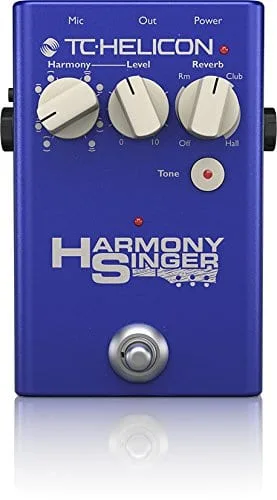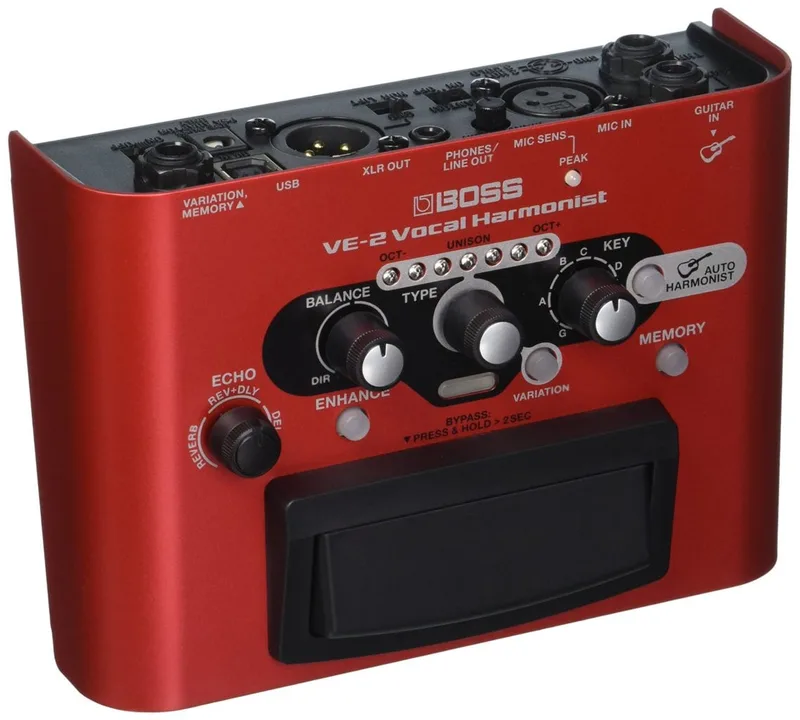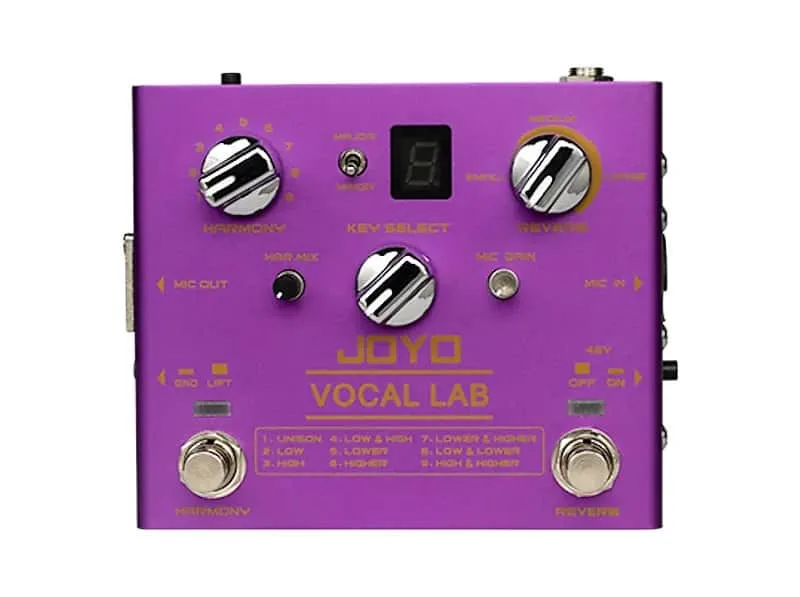


The R-16 VOCAL LAB is a vocal effector from JOYO, and the maker describes it as the first vocal effector it has built, specially designed for singing. Its effect type is Harmony and Reverb: it takes a microphone signal and adds harmony voices and reverb to the sung line, with the harmony amount and reverb level set on the face of the pedal1. It sits in the same family of dedicated vocal pedals as the TC Helicon Harmony Singer 2 and the Boss VE-2 Vocal Harmonist.
The six harmony modes
The harmony engine offers nine harmony numbers, spread across six named modes. Each mode places harmony voices at fixed intervals below or above the sung note1.
| Mode | Harmony voices |
|---|---|
| 2. Low | 4th below |
| 4. Low & High | 3rd above, a perfect 4th below |
| 5. Lower | 6th below |
| 6. Higher | a perfect 5th above |
| 7. Lower & Higher | 6th below, a perfect 5th above |
| 8. Low & Lower | a perfect 4th below, and a 6th below |
Key selection is handled by the Key Select control together with a Major/Minor toggle switch. JOYO states that a tonality of 24 major or minor diatonic scales is available, so the harmony voices can be matched to the key of the song in either tonality1.
Controls and operation
The pedal carries five controls and two footswitches, with three LED modes for stage use1.
- Controls: Harmony, Key Select, Reverb, Har.mix, Mic.gain1
- Toggle switch: Major/Minor1
- Footswitches: 21
- LED modes: Sync, Always, Off1
The Mic.gain control sets the microphone input level, Har.mix blends the harmony voices with the lead vocal, and Reverb sets the reverb level. A 6.35mm input jack takes the microphone connection, and a 3.5mm headphone output allows silent practice1.
The R-16 is not battery powered and draws a working current of 500mA at DC 9V center minus. It needs a supply that can deliver that current on its own; a shared daisy chain rated lower will not run it1.
Videos
Matt Perry
The Rolling Store
Animan Music
Questions
Does the JOYO R-16 run on batteries?
No. JOYO lists the R-16 Vocal Lab as not battery powered, so it needs an external 9V DC power supply with a center minus plug. Because it draws 500mA, a supply with enough current on tap is needed, and a low-current daisy chain shared with other pedals may not be suitable.
What power supply does the R-16 Vocal Lab use?
The R-16 works on DC 9V with a center minus plug and draws a working current of 500mA, according to JOYO's product page. It cannot run on batteries, so a dedicated 9V DC adapter or a pedalboard power outlet rated for at least 500mA is required.
Can the R-16 harmonize in minor keys?
Yes. JOYO states that 24 major or minor diatonic scales are available, selected with a Maj/Minor toggle switch alongside the Key Select control. That covers major and minor tonality for the harmony engine.
Does the R-16 have a headphone output?
Yes. JOYO specifies a 3.5mm headphone output with a 32 ohm impedance, so the pedal can be used for quiet practice with headphones as well as through a PA or interface.
Is the JOYO R-16 true bypass?
JOYO's product page lists the signal bypass type simply as Bypass. The page does not describe the bypass as true bypass, so players who need that distinction should treat it as a standard bypass design as described by the maker.
Sources (1)
- R-16 VOCAL LAB_JOYO, JOYO, 2020-03-03