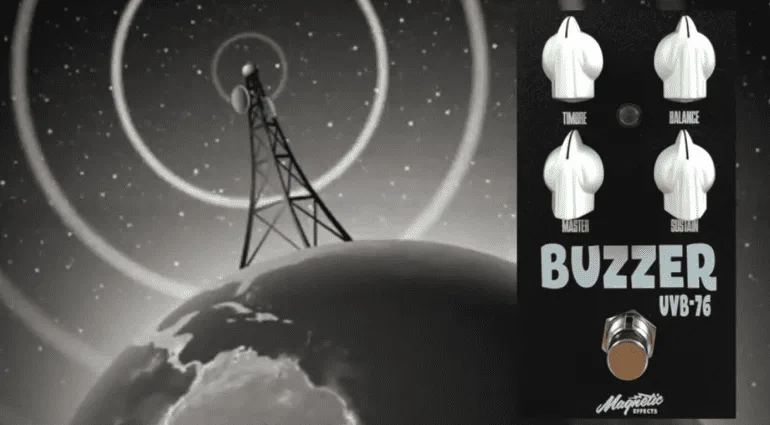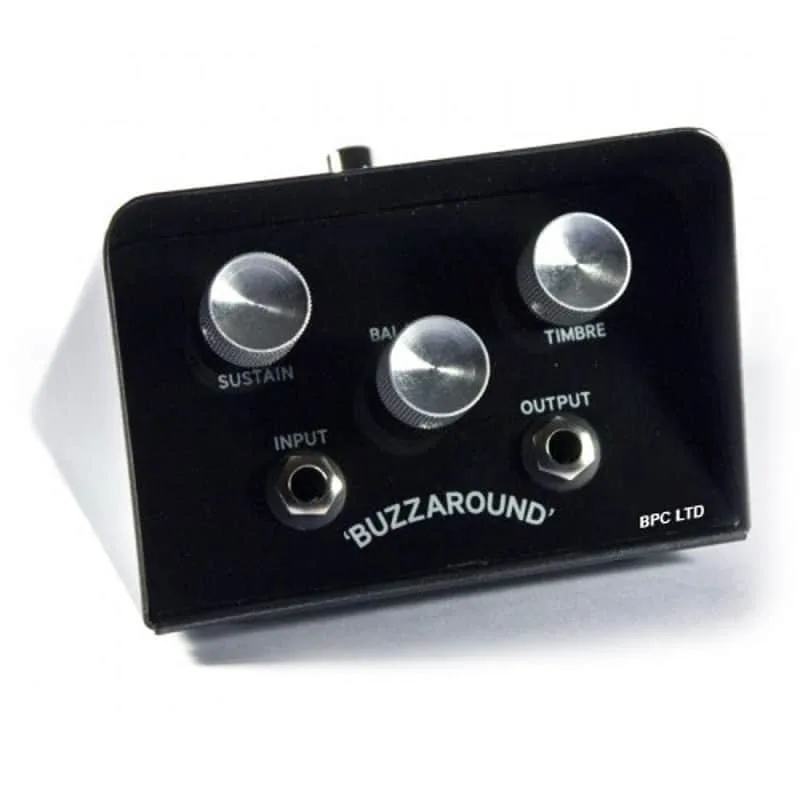


The Magnetic Effects Buzzer UVB-76 is a fuzz pedal from Magnetic Effects. It runs on a standard 9V DC center negative adapter, which the maker says "enables you to run the pedal on a standard 9V DC center negative adapter"1.
What the Buzzer does
Magnetic Effects built the Buzzer around a trio of carefully selected and tested NOS germanium transistors, the component at the heart of the original Buzzaround's character21. The company added two things the 1966 pedal never had: a master volume control and a polarity reverse circuit.
The additions, and what each one changes for a player:
- Master volume: lets you explore the tones from the higher settings of the Balance control at a more manageable volume. Guitar Interactive's Jonathan Graham wrote that "An added master volume control allows you to harness different tones that were difficult to obtain on the originals"1.
- Polarity reverse circuit: a charge pump that enables the pedal to run on a standard 9V DC center negative adapter and to be daisy chained with other pedals1.
- Top mounted jacks and DC socket: both point toward tight pedalboard layouts2.
Vintage-style germanium fuzz circuits are often positive ground and demand their own isolated supply, which is a common headache on a pedalboard. The Buzzer's charge pump polarity reverse circuit is what lets it share a standard 9V DC center negative adapter with other pedals1.
Gearnews' reviewer, writing under the name Jef, summed up the result: "Personally, I think it sounds pretty close to the originals and I welcome the added modern 'upgrades', which make it far" more useable with a pedalboard in overall sound and pedalboard useability3.
From the Baldwin Burns Buzzaround to the Buzzer UVB-76
The original Buzzaround was designed by Gary Hurst in 1966 for the Baldwin-Burns Company, and British Pedal Company's history notes it "was very different from its competitors" of the time4. TONEHOME describes the circuit as "extremely close to the 3-knob Tone Bender circuit"5. The pedal was reported in the November 1966 issue of Beat Instrumental to have been redesigned with a "special sustain effect," and the Troggs and the Soft Machine were photographed using the Burns Buzzaround6.
Side by side, the 1966 pedal and the 2016 clone:
| Baldwin Burns Buzzaround (1966) | Magnetic Effects Buzzer UVB-76 (2016) | |
|---|---|---|
| Designer / maker | Gary Hurst for the Baldwin-Burns Company4 | Magnetic Effects2 |
| Status | Original design, reported redesigned in November 1966 with a "special sustain effect"6 | Limited edition21 |
| Transistors | Germanium (the circuit TONEHOME calls "extremely close to the 3-knob Tone Bender circuit")5 | Three selected and tested NOS germanium transistors21 |
| Master volume | Not part of the original design1 | Added1 |
| Power | Positive-ground era design, typically needing its own supply1 | 9V DC center negative via charge pump polarity reverse, daisy chainable1 |
| Players seen using it | The Troggs, the Soft Machine6 | Not documented |
Magnetic Effects released the Buzzer UVB-76 as a limited-edition fuzz pedal, a clone of the Baldwin Burns Buzzaround, a circuit described as extremely close to the 3-knob Tone Bender circuit25. The Buzzer adds top mounted jacks and a DC socket, and runs on a standard 9V DC center negative adapter1.
Videos
Magnetic Effects
JJ Tanis
Questions
What is the Magnetic Effects Buzzer based on?
The Buzzer is a limited-edition clone of the Baldwin Burns Buzzaround fuzz, a pedal designed by Gary Hurst in 1966 for the Baldwin-Burns Company. Magnetic Effects added a master volume control and a polarity reverse circuit to the original design, changes aimed at making the pedal easier to use on a modern pedalboard.
Does the Buzzer use germanium transistors?
Yes. According to Premier Guitar and Guitar Interactive Magazine, the Buzzer contains a trio of carefully selected and tested NOS germanium transistors, matching the transistor type associated with the original Buzzaround circuit.
Can the Buzzer be daisy chained with other pedals?
Yes. The Buzzer adds a charge pump acting as a polarity reverse circuit, which lets it run on a standard 9V DC center negative adapter and be daisy chained with other pedals. That is a departure from positive-ground germanium fuzz designs, which often need their own isolated supply.
Is the Buzzer a limited edition?
Yes. Both Premier Guitar and Guitar Interactive Magazine describe the Buzzer UVB-76 as a limited-edition clone of the Baldwin Burns Buzzaround fuzz when it was announced in August 2016.
What does the master volume do on the Buzzer?
The added master volume control lets you run the higher settings of the Balance control at a more manageable output level. Guitar Interactive's Jonathan Graham wrote that it allows you to harness different tones that were difficult to obtain on the original Buzzaround pedals.
Sources (6)
- Magnetic Effects Release Limited Clone of Buzzaround Pedal, Guitar Interactive Magazine, 2016-08-01
- Magnetic Effects Introduces the Buzzer, Premier Guitar, 2016-08-08
- Magnetic Effects Buzzer UVB76, gearnews.com, 2016-08-10
- Buzzaround History, British Pedal Company
- TONEHOME, TONEHOME
- Baldwin-Burns Buzzaround • Fuzzboxes, fuzzboxes.org, 2021-05-13