| Type | Vintage fuzz pedal, three-transistor germanium circuit23 |
| Maker | Baldwin-Burns Ltd., England1 |
| Produced | 1966 to 1968 (one source dates the design to 1965)215 |
| Transistors | NKT213 germanium units in the originals6 |
| Controls | Balance, Timbre, Sustain678 |
| Status | Discontinued in England around 1968; originals sell for a 4-figure sum29 |
The Buzzaround is a vintage germanium fuzz pedal built by Baldwin-Burns Ltd. in England, produced by hand on tagboard from 1966 to 19681. It is a three-transistor germanium fuzz, and British Pedal Company describes it as very different from its competitors at the time, with a gritty, aggressive tone that Tru-Fi calls renowned23. Its fame rests largely on one player: Robert Fripp, who used it in the early days of King Crimson4.
Only a handful of units were produced during its roughly two-year run, so originals are almost mythical to some collectors2. For most players today, the Buzzaround circuit is something you meet through a clone, a reissue or a DIY printed circuit board rather than an original unit.
Where the Buzzaround came from
British Pedal Company's history credits Gary Hurst with designing the Buzzaround in 1966 for the Baldwin-Burns Company, as a competitor to the Sola Sound Tone Bender6. Hurst was the designer behind the Tone Bender, and the Buzzaround carried his three-transistor approach forward with NKT213 germanium units, which British Pedal Company says offered rich, smooth sustain6.
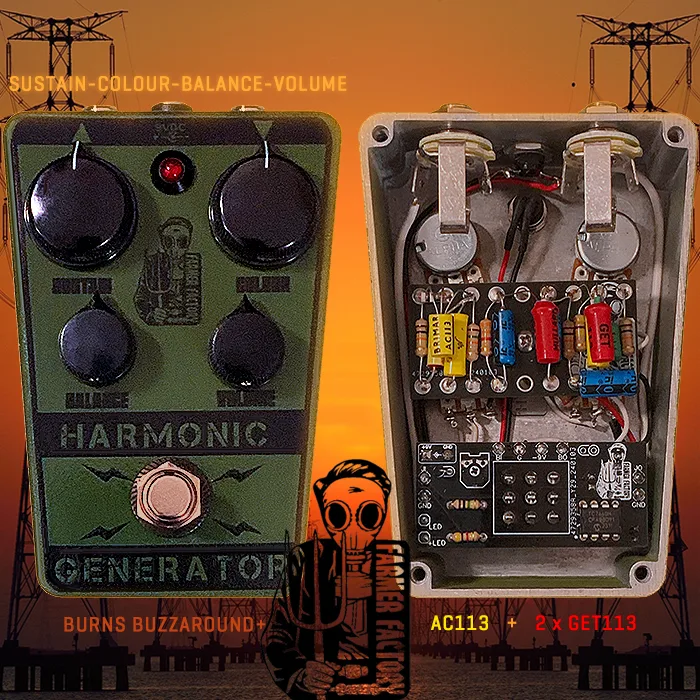
The attribution is not settled, though. BLAMMO! Electronics, which builds its own Buzzaround copy, reports that conventional wisdom said Hurst designed it, but that the circuit is actually an unauthorized copy of a much more obscure design called the Harmonic Generator, by Gerry Pope of G.P. Electronics1. Tru-Fi tells the same story: the GP Harmonic Generator, which it dates to 1966, was then booted by the Burns company for the more famous Buzzaround fuzz4. Tru-Fi also notes that Burns produced the pedal in England and Australia4.
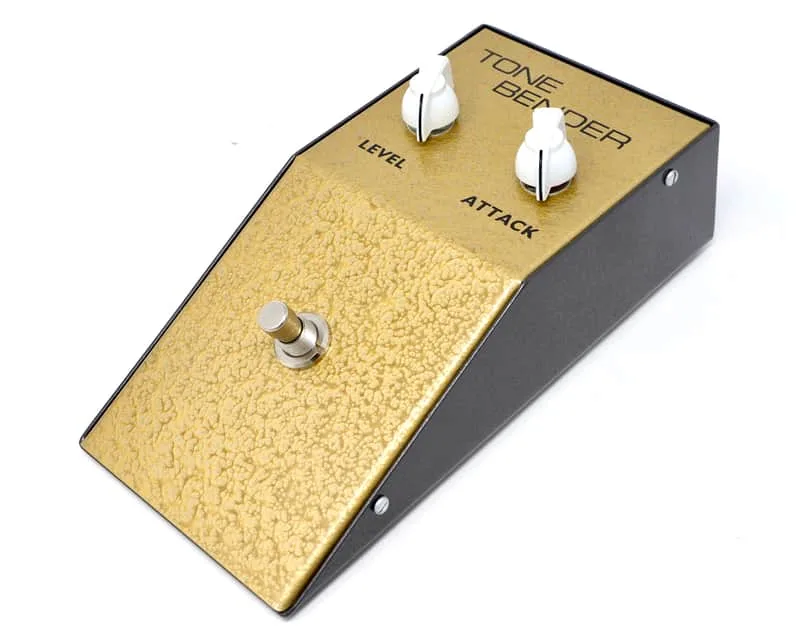
The hardware itself was distinctive. The Buzzaround was housed in a wedge-shaped casing with a sliding tray, similar to the Dallas Rangemaster, and it was constructed on tagboard with a new configuration of transistors6. Production ended in England around 1968; Fripp himself noted in a 1974 interview that it had been discontinued about six years earlier26.
"On stage, I use three pedals on a pedalboard: A volume pedal, fuzz-tone, and wah-wah. I'm not sure what type of wah-wah"
Fripp is the player most associated with the pedal. Tru-Fi describes him as a major Buzzaround user from the early days of Crimson4, and BLAMMO! adds that he used one on the earlier Giles, Giles and Fripp recordings1.
How it works: a three-transistor germanium fuzz
The Buzzaround is a three-transistor germanium fuzz circuit. The originals used NKT213 transistors6, hand-built on tagboard1. Germanium transistors are the older, leakier, gain-variable cousins of silicon transistors, and they are part of why vintage fuzz circuits behave the way they do: Tru-Fi notes that the original Fuzz Face circuit used germanium transistors, contributing to its warm and smooth fuzz sound10.
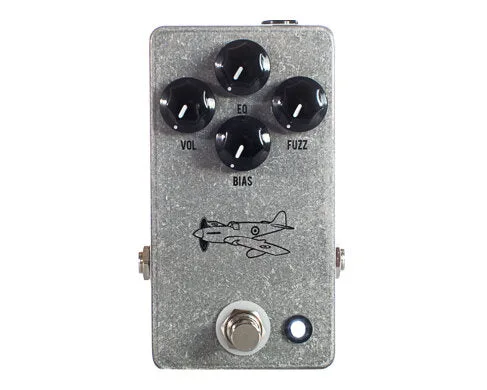
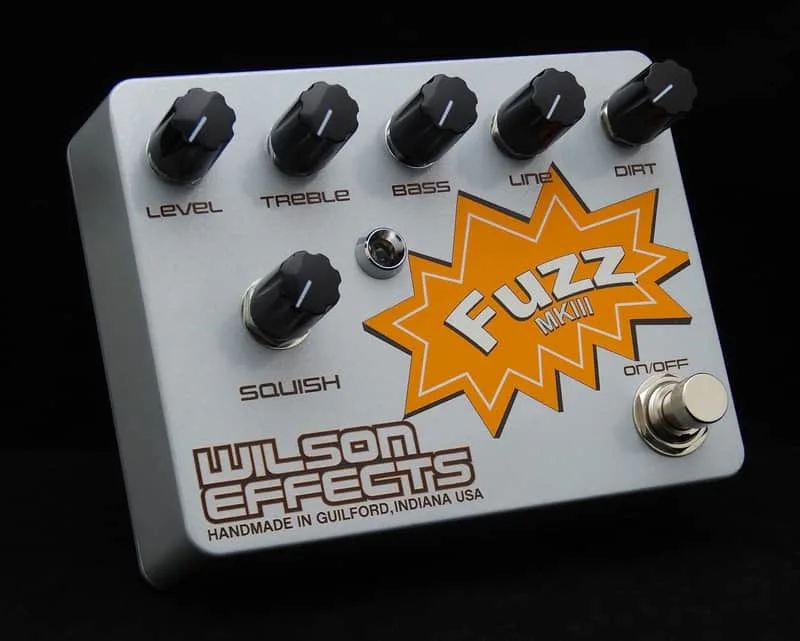
The three-transistor germanium format is not unique to the Buzzaround. JHS Pedals describes its Firefly as its take on delivering "this classic three transistor Germanium fuzz circuit"11, and Wilson Effects builds its Fuzz MKIII around three NOS Motorola PNP germanium transistors12. Hudson Electronics likewise builds germanium-transistor-based fuzz circuits13. What set the Buzzaround apart was its particular transistor configuration and its control set, both of which British Pedal Company describes as new for its time6.
Germanium fuzz circuits are sensitive to transistor gain and leakage. BLAMMO! hand-tests its three NPN germanium transistors for gain and leakage to ensure the proper values are placed in each position, a practice that mirrors why original units vary so much from example to example1.
The Balance, Timbre and Sustain controls
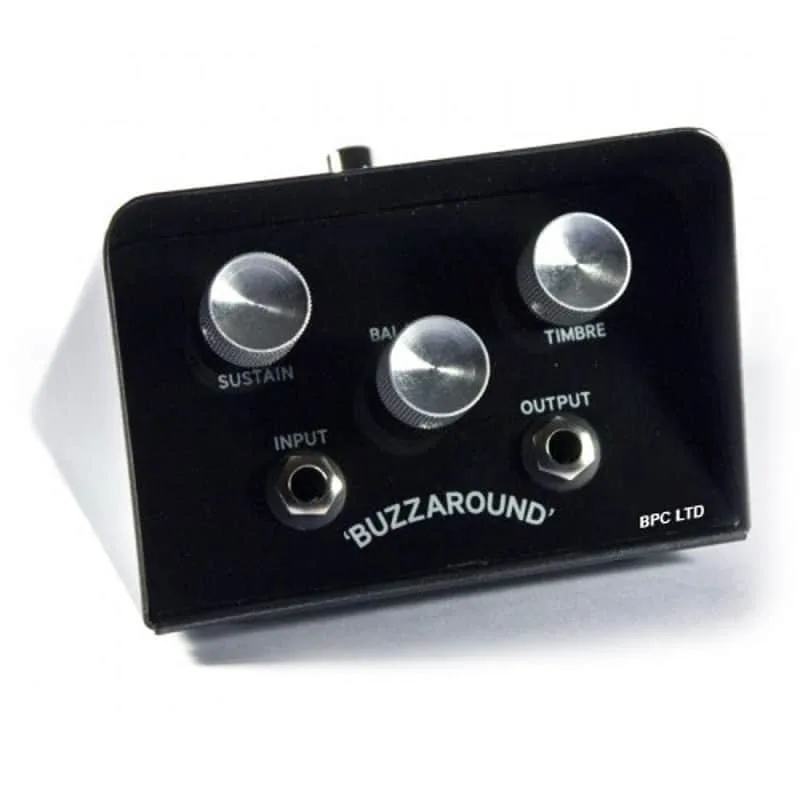
The Buzzaround's control set is one of its defining features. British Pedal Company explains that the controls were updated from the Tone Bender to include Balance, Timbre and Sustain, which gave the user a larger sonic scope than its predecessors6.
| Control | What it does |
|---|---|
| Balance | Controls the volume of the pedal5 |
| Timbre | Shapes the tone |
| Sustain | Sets the fuzz intensity |
The Balance control is the easiest to pin down: British Pedal Company's own Buzzaround manual states plainly that "Balance controls the volume of the pedal"5. The name is unusual, and it can mislead players who expect it to blend signals, the way a Balance control on a modern pedal such as the Drunk Beaver Fuzzmaster blends a clean signal with fuzz. On the Buzzaround it is simply the output level.
The Timbre and Sustain controls carry the tonal weight. Together with Balance, they gave the pedal a wider range than the simpler volume-and-tone arrangements of earlier fuzz boxes, which is part of why the circuit still attracts builders more than half a century later6.
How it relates to the Tone Bender
The Buzzaround sits in the same British family as the Tone Bender. British Pedal Company describes it as designed by the Tone Bender's own Gary Hurst, with its controls updated from the Tone Bender's6. The Tone Bender Mk II is likewise a three-transistor fuzz circuit; SolidGoldFX notes that its Bias control adjusts the operating point of the third transistor in that design14. The Buzzaround kept the three-transistor architecture but changed the transistor configuration and expanded the control set6.
The lineage runs further than England. Tru-Fi reports that the Italian company Elka produced the Dizzy Tone in 1969, a later version of the Buzzaround circuit4. And the circuit's own ancestry is murkier still: if the Harmonic Generator account is correct, the Buzzaround is itself a copy of Gerry Pope's earlier design, making the Harmonic Generator the true origin of the circuit14.
Tru-Fi, for its part, produces many reissues and clones of the Tone Bender circuit, allowing modern players to capture that classic fuzz sound15, and the Buzzaround is part of the same broader story of 1960s British fuzz.
Clones and reissues
Because originals are ridiculously rare and command a 4-figure sum when they do surface9, the Buzzaround survives mainly through modern builders.
| Builder | Product | Relationship to the Buzzaround |
|---|---|---|
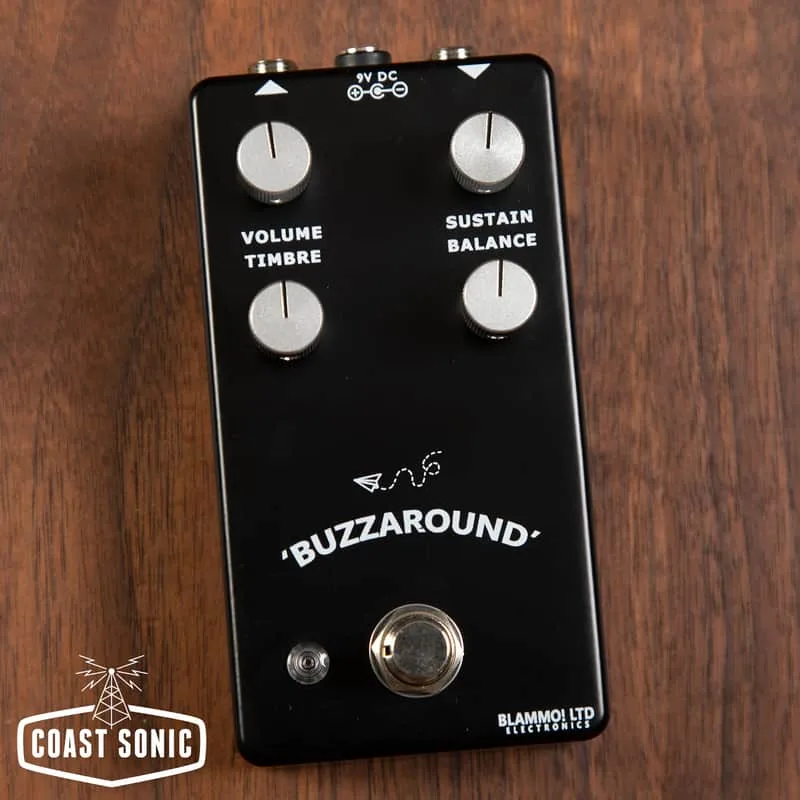
| BLAMMO! Electronics | Buzzaround | Copy of the circuit, with MP38A NOS germanium transistors, $164.99 as of October 20261 |
| Wilson Effects | Mordant | Based on a vintage Baldwin Burns Buzzaround circuit, with extra options added16 |
| Tru-Fi | Dizzy Buzz | Based on the Baldwin Burns Buzzaround fuzz4 |
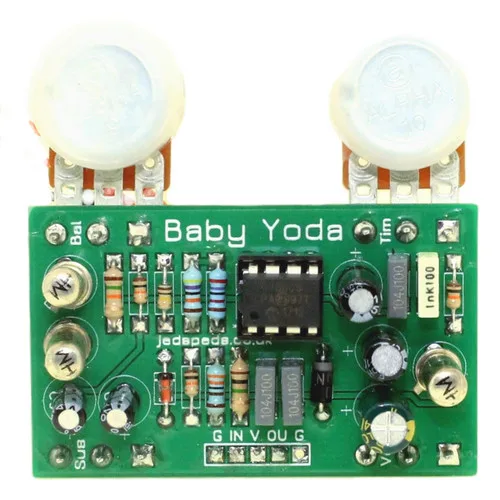
| Jed's Pedals | Baby Yoda | Based on the classic Baldwin Burns Buzzaround fuzz from the mid to late 60's9 |
| Expresso FX | Buzzabout | A faithful replica of the Buzzaround circuit17 |
| Mojo Hand FX | Rounder | Inspired by the rare and sought after Burns Buzzaround fuzz18 |
| GuitarPCB | Fuzzy Bee | A PCB for building a modernized version of the Buzzaround fuzz pedal1920 |
BLAMMO!'s version is a limited take that uses three NPN germanium transistors, hand tested for gain and leakage, with MP38A NOS germanium transistors specified1. Wilson Effects describes its Mordant as based on a vintage Baldwin Burns Buzzaround circuit, adding that it includes some extra options in classic Wilson fashion16. Tru-Fi's Dizzy Buzz traces the circuit through the GP Harmonic Generator story4, and Jed's Pedals' Baby Yoda is a straightforward nod to the mid-to-late-60s original9.
For builders, GuitarPCB sells the Fuzzy Bee, a printed circuit board it calls the best Buzzaround PCB, and its manual describes the board as allowing you to make a modernized version of the Buzzaround fuzz pedal1920. Expresso FX's Buzzabout rounds out the list as a faithful replica of the circuit17.
Originals are not a realistic target for most players. Jed's Pedals reports that working originals sell for a 4-figure sum when they appear at all9, so a clone or a DIY build is how the circuit is actually played today.
Pedals on this page
Questions
Who designed the Burns Buzzaround?
The design has long been attributed to Gary Hurst, the designer behind the Tone Bender, and British Pedal Company's history credits him with it in 1966. However, BLAMMO! Electronics and Tru-Fi report that the circuit was actually an unauthorized copy of the Harmonic Generator, designed by Gerry Pope of G.P. Electronics. Both accounts are published, and they conflict.
Did Robert Fripp use a Buzzaround?
Yes. Tru-Fi notes Fripp used the Buzzaround in the early days of King Crimson, and BLAMMO! adds that he used one on the earlier Giles, Giles and Fripp recordings. In a 1974 interview quoted by British Pedal Company, Fripp described his stage pedalboard as a volume pedal, a fuzz-tone and a wah-wah.
What transistors are in a Buzzaround?
The originals used NKT213 germanium units, which British Pedal Company credits with a rich, smooth sustain. It is a three-transistor circuit, built on tagboard. Modern clones vary: BLAMMO!'s version uses hand-tested MP38A NOS germanium transistors.
How rare is an original Buzzaround?
Very. British Pedal Company says only a handful of units were produced between 1966 and 1968, making them almost mythical to some collectors, and Jed's Pedals describes originals as ridiculously rare to come by. Production ended in England around 1968.
How much is a vintage Buzzaround worth?
Jed's Pedals reports that when working originals do appear, you are looking at a 4-figure sum. That rarity is why most players today reach for a clone instead, such as the BLAMMO! Buzzaround at $164.99 as of October 2026.
Sources (20)
- Buzzaround, BLAMMO! Electronics
- Buzzaround History, British Pedal Company, 1966
- Elka Dizzy Tone and Buzzround, tru-fi.com
- Dizzy Buzz Fuzz NEW, tru-fi.com
- BPC-Product-Manual-2021-V1.pdf, British Pedal Company, 2021
- Buzzaround History, British Pedal Company, 1974
- TONEHOME, TONEHOME
- Best Burns Buzzaround Fuzz Clones & Evolutions In 2023, Delicious Audio, 2023-02-15
- Baby Yoda, Jed's Pedals (jedspeds.co.uk)
- The guitar pedal that changed the world the Fuzz Face, Tru-Fi (tru-fi.com)
- FIREFLY - JHS Pedals, JHS Pedals
- Fuzz MKIII, Wilson Effects
- FUZZ - HUDSON ELECTRONICS UK, Hudson Electronics UK, 2026
- FUZZBOX - BENDER FUZZ - SolidGoldFX, SolidGoldFX
- The Sound of Rock, tru-fi.com
- Mordant | Wilson Effects, Wilson Effects
- Buzzabout, Expresso FX, 2018-08-15
- Rounder - A Nod to a Rare Fuzz, Mojo Hand FX
- FUZZY BEE, GuitarPCB
- BD_FuzzyBee.pdf, GuitarPCB.com, 2023