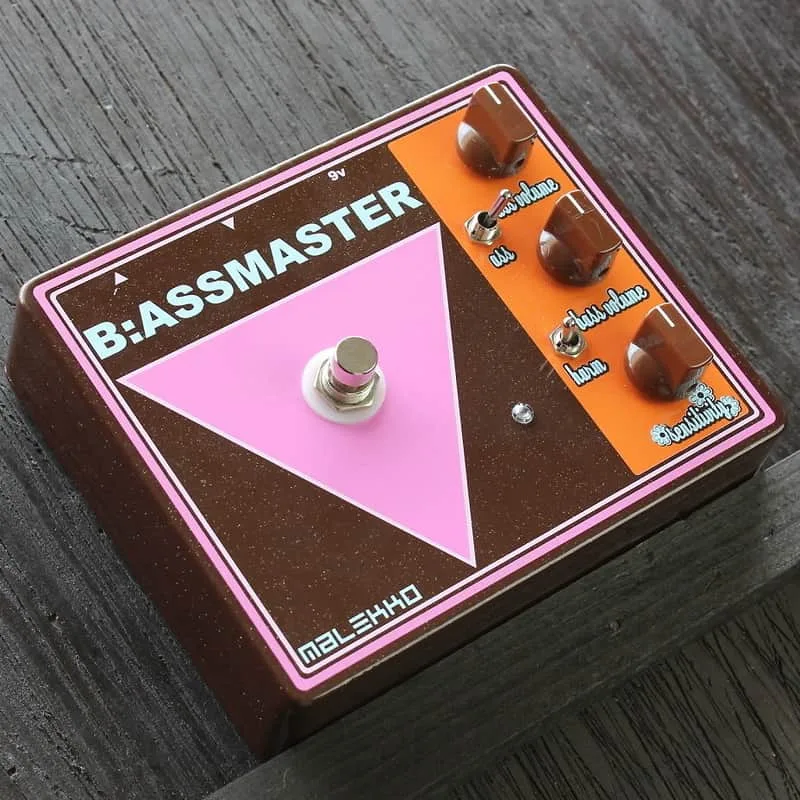


The Malekko Diabolik is an analog bass fuzz pedal from Malekko, built on the company's B:Assmaster circuit and tuned for bass players who want fuzz without losing the bottom of their sound. RockBoard's PedalPedia says it was tuned specifically to allow more low end to pass through both the Clean and Fuzz channels, with a range that runs from a subtle harmonic fuzz to extreme, mangled low end squash, and that it suits bass and guitar alike1. Premier Guitar reviewed it as a bass fuzz and summed up its verdict as "Superb tones, beefy fuzz, compact footprint"2.
What it does to your sound
The Diabolik is a harmonic fuzz, a family of designs that traces back to the Maestro Bass Brassmaster octave fuzz. The B:Assmaster, its direct ancestor, was inspired by that original Maestro pedal, and Delicious Audio's Paolo De Gregorio notes that although the B:Assmaster is aimed at bassists, it performs equally well on guitars3. The Diabolik carries that approach forward in a smaller box.
The two channels are the heart of it. The Fuzz control determines the amount of fuzz2, and per Pedal of the Day's review, the Fuzz knob adjusts the level of just the fuzz signal, with no effect on the clean signal, which the reviewer called out as a strength4. That means you can run a full clean bass tone underneath and dial in as much or as little fuzz on top as the part needs. Two of the controls, Fuzz and Clean, are developed straight from the original B:Assmaster circuit4.
On the B:Assmaster itself, Jimmy Shaw of Metric and Broken Social Scene described the appeal of that blend: "you're able to mix in a super fuzzy sound, which is really cool because bass fuzz, as common as it is, is incredibly hard to do well mixing fuzzy sound with dry signal"3.
Where it came from
The Diabolik is a Malekko design, refined while working with Justin on its signature sound1. Premier Guitar's reviewer reported that Nathan Meldal-Johnsen wanted to build on the tonal advantages of another Malekko pedal but reduce the footprint size and simplify the controls, which is how the Diabolik relates to the B:Assmaster2.
The B:Assmaster has a documented pedigree of its own. Flea's tech Tracy Robar described it in Flea's Red Hot Chili Peppers rig: "We have our B:ASSMASTER here, which is Malekko. It's a great pedal, great fuzz, distortion pedal. That's his new favorite"3. A Premier Guitar rig rundown of the band also listed the Malekko Bassmaster for fuzz and distortion5.
What reviewers said
- Premier Guitar's reviewer praised "superb tones, beefy fuzz, compact footprint" as the pedal's pros2.
- Pedal of the Day's Joey D found "a ton of tonal possibilities," writing that "There are a ton of tonal possibilities, and better yet, it doesn't take up much room on the board," and reported it quickly became his go-to fuzz4.
- Premier Guitar noted the rugged blue and pink chassis "doesn't take up much more space than a bar of soap"2.
Power and practical notes
The Diabolik runs on 9V DC, center negative, and draws 80mA1. It can also operate on a battery2. At 80mA, it draws more than many simple fuzzes, so it is worth matching it to a power supply output that can deliver that current rather than assuming any spare spot on a daisy chain will do.
The 80mA current draw1 is higher than typical vintage-style fuzz pedals. If your pedalboard power supply has fixed low-current outputs, give the Diabolik an output rated for its draw.
Videos
Premier Guitar
Malekko HeavyIndustry
Malekko HeavyIndustry
Questions
Does the Malekko Diabolik run on a battery?
Yes. Premier Guitar's reviewer notes that the Diabolik can operate on a battery, alongside its standard 9V DC center negative power input. With a current draw of 80mA, a dedicated supply or a battery is worth considering if you plan to share a daisy-chained output with other pedals.
Is the Malekko Diabolik analog or digital?
The Diabolik is an analog fuzz pedal. Malekko's product information lists its circuit type as analog, and the pedal is built on the B:Assmaster circuit, a design that traces back to the Maestro Bass Brassmaster harmonic octave fuzz.
What power supply does the Diabolik need?
The Diabolik runs on 9V DC, center negative, and draws 80mA according to Malekko's product information. It can also operate on a battery. Because of the 80mA draw, check what your power supply's outputs are rated for before sharing one with other pedals.
How is the Diabolik different from the B:Assmaster?
The Diabolik is built on the B:Assmaster circuit but with a reduced footprint and simplified controls. Premier Guitar's reviewer reported that Nathan Meldal-Johnsen wanted to build on the tonal advantages of another Malekko pedal while shrinking the enclosure and streamlining the control set, keeping the Fuzz and Clean controls developed straight from the original circuit.
Does the Diabolik keep low end when the fuzz is on?
Malekko says the Diabolik was tuned specifically to allow more low end to pass through both the Clean and Fuzz channels, with a range from subtle harmonic fuzz to extreme, mangled low end squash. The separate Clean control also lets you blend an unaffected signal under the fuzz.
Sources (5)
- Diabolik by Malekko, RockBoard PedalPedia, 2026
- Malekko Diabolik Bass Fuzz Review, Premier Guitar, 2014-08-22
- Malekko B:Assmaster Octave Fuzz, Delicious Audio, 2023-04-10
- Malekko Heavy Industries Diabolik Harmonic Analog Fuzz, Pedal of the Day, 2014-11-14
- Rig Rundown, Premier Guitar, 2012-06-03
 Justin Meldal-Johnsen