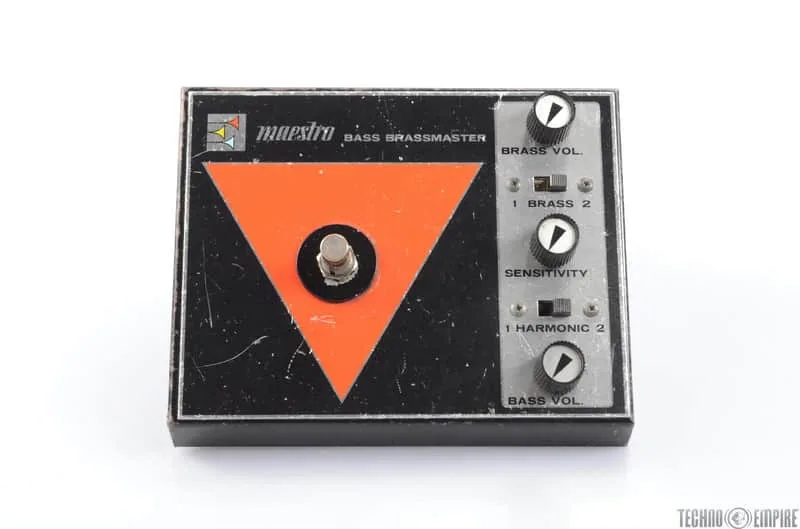
| Type | Bass fuzz/octave pedal2 |
| Maker | Maestro2 |
| Production | 1971 to 19742 (BLAMMO! dates the design to 19723) |
| Status | Discontinued; super rare, sells for $2,000+ used1 |
| Circuit | Split clean and fuzz paths, blended at the output2; onboard dual-voice ring modulator1 |
| Key component | Unmarked transformer of unknown winding6 |
The Maestro Bass Brassmaster BB-1 is a bass fuzz and octave pedal that Maestro built in the early 1970s. It splits the input signal into a clean path and a fuzz path and lets the player blend them back together, which is why it works so well on bass: the low end survives alongside the fuzz. MusicRadar describes it as an octave bass fuzz with an onboard dual-voice ring modulator, opening up a full spectrum of harmonically unorthodox sounds12.
It had a short life. Performer Mag reports the BB-1 was manufactured from 1971 to 1974, while BLAMMO! Electronics dates the design to 197223. Either way, production ran only a few years, and original units have become highly sought-after collector's pieces, with used units seeming to go for four figures nowadays45. That rarity, plus a circuit that was not a copy of any other pedal at the time, has made the Brassmaster a coveted Holy Grail device with a long line of clones and near-clones behind it26.
Where the Brassmaster came from
In the early 1970s, Maestro created a pedal aimed squarely at bass players, a corner of the market that fuzz makers had largely ignored. Performer Mag's retrospective puts it plainly: "In the early 1970s, Maestro created a pedal that would shed light on the bass player"2. The BB-1, a bass fuzz/octave pedal, had a relatively short span of production, manufactured from 1971 to 19742. BLAMMO! Electronics, which builds a clone, tells the story as 1972: "In 1972 Maestro wowed the pedal world with a new design that offered raw octave-up fuzz tones"3. Premier Guitar places its origin in the late '70s, so the press does not agree on the date; the 1971 to 1974 production window from Performer Mag is the most specific25.
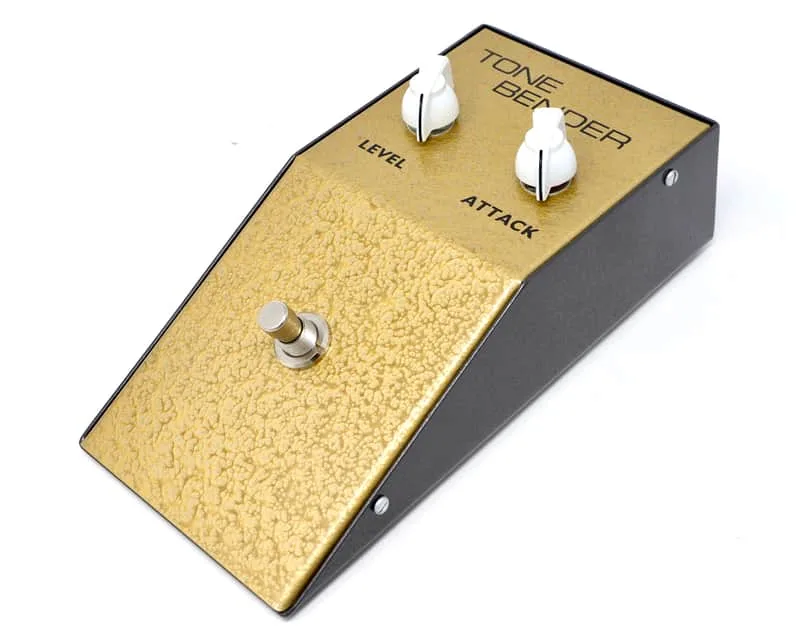
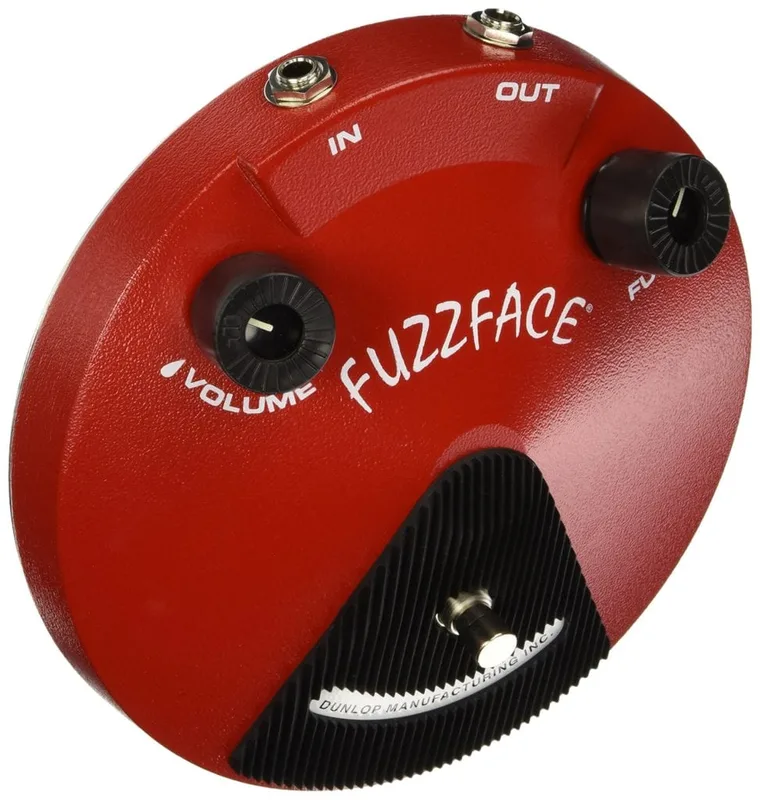
What is not in dispute is that the circuit stood alone. Performer Mag notes it was "quite unique in its circuitry and was not a copy of any other pedal at the time"2. Where most fuzz boxes of the era, like the Fuzz Face or Tone Bender, pushed the whole signal through a clipping stage, the Brassmaster kept a clean path alive alongside the fuzz. Maestro's own earlier Fuzz-Tone had nothing like it.
How it works: a fuzz built around an unmarked transformer
The core of the Brassmaster design is its split signal path. As Performer Mag explains, "Using a split at the input stage of the pedal, the signal is sent simultaneously through both a clean and a fuzz path"2. The two paths are combined at the preamp output stage, where they can be blended2. That blend is what lets a bassist dial in anything from a cleaner sound with a touch of harmonic distortion to a gnarly, over-the-top fuzz tone2.
The fuzz side of the circuit produces octave-up fuzz tones3, and the pedal also contains a dual-voice ring modulator, which is where its harmonically unorthodox character comes from1. The result, in the words of the madbean BoomBoom build document, is "that special kind of 'highly compressed wall of fuzz' that you can really dig into"4.
The part that has kept the Brassmaster mysterious for fifty years is its transformer76.
"One of the great mysteries of the Brassmaster is its unmarked transformer and how it was wound. Analysis suggests that this component may have actually been wired with negative polarity."
The transformer carries no markings, its winding is unknown, and analysis of the original suggests it may even have been wired with negative polarity6. For cloners, that means the one component at the heart of the octave generation cannot simply be bought off the shelf and dropped in. It is the main reason the Brassmaster has had, as Godlyke puts it, "few noble attempts made to clone it" compared with heavily copied circuits like the Big Muff or Univox Super-Fuzz6.
The Bass Brassmaster and the players who used it
The Brassmaster was originally conceived for bass guitar6. BLAMMO! Electronics notes that "at first, just bass players used them but word eventually got out to their six-stringed brethren"3, and MusicRadar reports it "sounds great on guitar" as well as bass1.
The best-known player associated with it is Chris Squire of Yes. Premier Guitar's review of a Brassmaster-style pedal states that "the Brassmaster has been used by some of rock's most famous bassists, including Chris Squire of Yes"5. The same review credits its "sputtery, sometimes synth-like sound" with defining an era of rock 'n' roll5.
How it sounds, in the words of those who have written about it:
| Source | What they said |
|---|---|
| MusicRadar | "nasty, weird, brilliant, a threat to your amp's speaker cone and a radical thing to expose your bass signal to"1 |
| Premier Guitar | "sputtery, sometimes synth-like sound"5 |
| madbean BoomBoom manual | "highly compressed wall of fuzz"4 |
| Performer Mag | blendable from "a cleaner sound with a touch of harmonic distortion" to "a gnarly, over-the-top fuzz tone"2 |
Pedals based on the Brassmaster
Because originals are nearly impossible to come by451, the Brassmaster lives on mostly through copies, kits, and inspired circuits. The clones fall into a few groups.
Faithful recreations. BLAMMO! Electronics builds the Brashmaster, whose core is "a faithful clone of the original Brassmaster with no value tweaks"3. Broughton Audio sells a pedal simply called the Maestro, "a faithful recreation of the original Brassmaster bass fuzz from the 70s," priced at US$190.008.
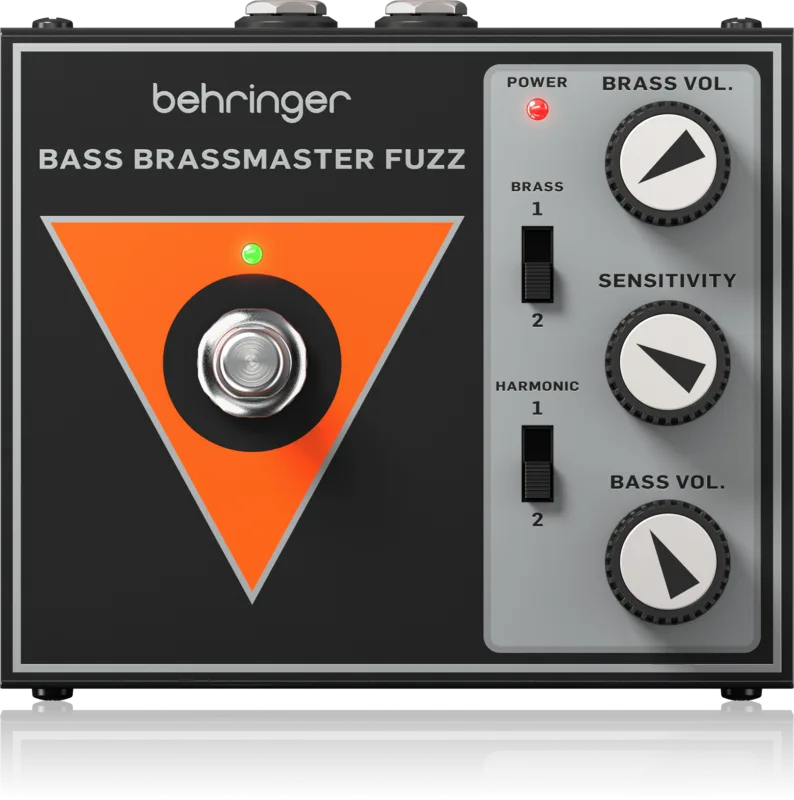
Mass-market and modeled versions. In December 2024 Behringer launched a Bass Brassmaster Fuzz, "recreating the legendary Maestro BB-1 Bass Brassmaster for the princely sum of $69"1. Line 6 modeled the circuit as the Bronze Master effect in its TonePort KB37, "based on Maestro Bass Brassmaster"9.
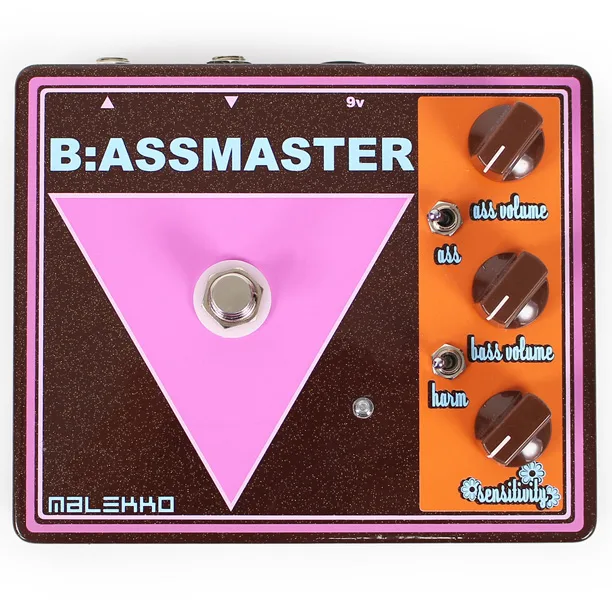
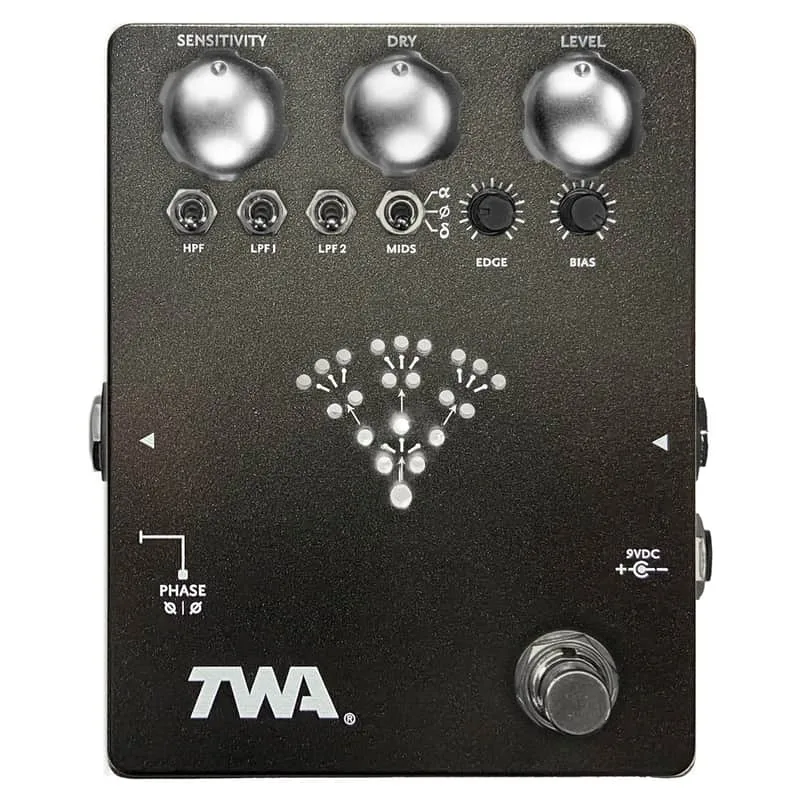
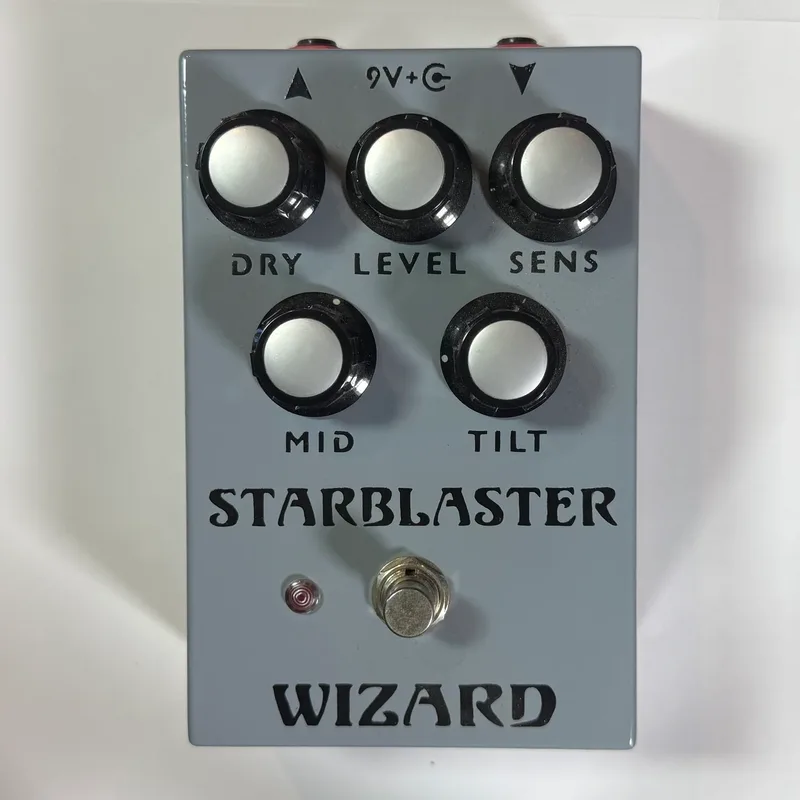
Boutique interpretations. Malekko Heavy Industry builds the B:Assmaster, a hand-built clone of the Maestro Bass Brassmaster harmonic octave fuzz1011. TWA's Krytical Mass is a fuzz circuit "inspired by vintage Maestro Bass Brassmaster," born from what Godlyke describes as exhaustive critical analysis into the original6. Wizard's Starblaster Fuzz promises "all the vicious overtones that the Brassmaster is known for and more"12.
DIY. General Guitar Gadgets offers the BRASSM, a Maestro Brass Master replica project kit and PCB credited to designer JD Sleep and to GEOFEX13. The build uses six 2N3391 or 2N3392 transistors for Q1 to Q6, a 2N5308 for Q7, and 1N914 or 1N4001 diodes in positions D1 through D413. The kit includes a Ready-to-Solder Circuit Board, and the standoffs are extra tall so the LED fits under the PCB on the 4-knob version13. Madbean Pedals' BoomBoom is a documented DIY project that is, in the maker's own words, "a 95% Brassmaster"4.
| Pedal | Maker | Relationship to the Brassmaster |
|---|---|---|
| Brashmaster | BLAMMO! Electronics | Faithful clone, no value tweaks3 |
| Maestro | Broughton Audio | Faithful recreation, US$190.008 |
| Bass Brassmaster Fuzz | Behringer | Clone, launched at $691 |
| B:Assmaster | Malekko Heavy Industry | Hand-built clone1011 |
| Krytical Mass | TWA | Fuzz inspired by the original6 |
| Starblaster Fuzz | Wizard | Brassmaster-style overtones12 |
| Bronze Master | Line 6 (TonePort KB37) | Software model9 |
| BRASSM | General Guitar Gadgets | DIY replica kit13 |
| BoomBoom | Madbean Pedals | DIY project, 95% Brassmaster4 |
Why the Brassmaster is hard to clone
The unmarked transformer is the short answer6. Without knowing how the original transformer was wound, or even whether it was wired with positive or negative polarity, every builder has to make a judgment call at the center of the circuit. That is why the copies differ so much in how close they claim to be: BLAMMO! states its version is a faithful clone with no value tweaks3, while madbean describes the BoomBoom as 95% Brassmaster4, and TWA frames the Krytical Mass as inspired by the original rather than a copy6.
The transformer question also explains why the Brassmaster never became a DIY standard the way the Fuzz Face or Tone Bender did. General Guitar Gadgets could publish a full parts list for its replica, transistors, diodes and all13, but the transformer remains the part that cannot be specified with certainty from the original units137.
Pedals on this page
Questions
What does a Maestro Brassmaster sound like?
It is an octave fuzz with a highly compressed wall of fuzz that players describe as sputtery and sometimes synth-like. Because the clean and fuzz paths can be blended, it can go from a cleaner sound with a touch of harmonic distortion to a gnarly, over-the-top fuzz tone. MusicRadar called it nasty, weird and brilliant, and a threat to your amp's speaker cone.
Was the Brassmaster made for bass?
Yes. The BB-1 Bass Brassmaster was originally conceived for bass guitar, and at first just bass players used them, though word eventually got out to guitarists. Performer Mag notes that in the early 1970s Maestro created a pedal that would shed light on the bass player, and the circuit was not a copy of any other pedal at the time.
How much is an original Maestro Brassmaster worth?
Original BB-1 units are super rare and sell for around $2,000 on the used market, with some sources reporting four-figure prices generally. Performer Mag wrote in 2020 that the vintage pedal goes for around $2,000 and is nearly impossible to come by, and MusicRadar reported the same figure in 2024.
Did Chris Squire use a Brassmaster?
Yes. Premier Guitar's review of a Brassmaster-style pedal notes that the Brassmaster has been used by some of rock's most famous bassists, including Chris Squire of Yes. Its sputtery, sometimes synth-like sound defined an era of rock 'n' roll, according to the same review.
Is there a Brassmaster clone?
Several. Behringer released a Bass Brassmaster Fuzz for $69 in 2024, Malekko builds the B:Assmaster, BLAMMO! Electronics makes the Brashmaster, Broughton Audio sells a recreation at US$190, and General Guitar Gadgets offers a DIY replica kit. Line 6 even modeled the circuit as the Bronze Master in its TonePort KB37.
Why is the Brassmaster hard to clone?
The great mystery of the Brassmaster is its unmarked transformer and how it was wound. Analysis suggests the component may have actually been wired with negative polarity, which leaves builders guessing at the original part. That uncertainty is why clones range from faithful copies with no value tweaks to pedals described as 95 percent Brassmaster.
Sources (13)
- “A unique octave bass fuzz with a built-in, 2-voice ring modulator”: The Maestro BB-1 Brassmaster is a super-rare bass octave fuzz from the '70s that sounds great on guitar, sells for $2,000+, and Behringer just made a $69 clone of it, MusicRadar, 2024-12-13
- FLASHBACK: 1970s Maestro Bass Brassmaster BB-1 Fuzz, Performer Mag (performermag.com), 2020-05-26
- Brashmaster, BLAMMO! Electronics
- BoomBoom24.pdf, madbeanpedals.com, 2024-11-20
- Black Cat Pedals Bass Octave Fuzz Pedal Review, Premier Guitar, 2011-05-17
- KRYTICAL MASS®, Godlyke Distributing, Inc.
- TWA Krytical Mass Fuzz, Delicious Audio, 2023-09-26
- Maestro | Broughton Audio, Broughton Audio
- Line 6 | Legacy Products, Line 6
- Malekko B:Assmaster Octave Fuzz, Delicious Audio, 2023-04-10
- Review: Malekko Barker Assmaster, Delicious Audio, 2010-01-23
- WIZARD Starblaster Fuzz, Godlyke Distributing, Inc.
- Maestro™ Brass Master™ Clone: Bass Fuzz Kit, PCB & Schematic, General Guitar Gadgets, 2014-05-12