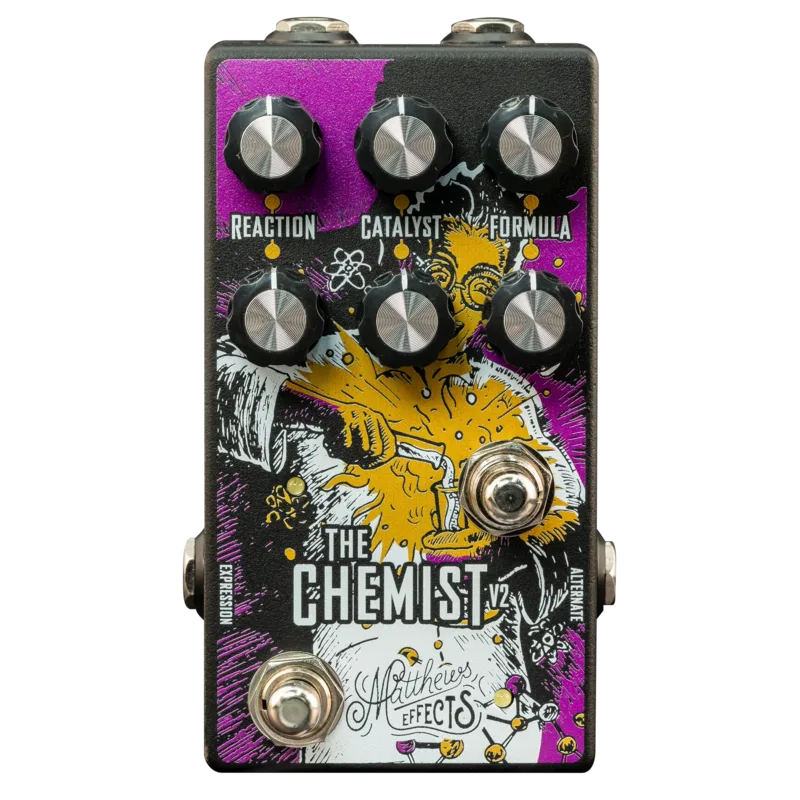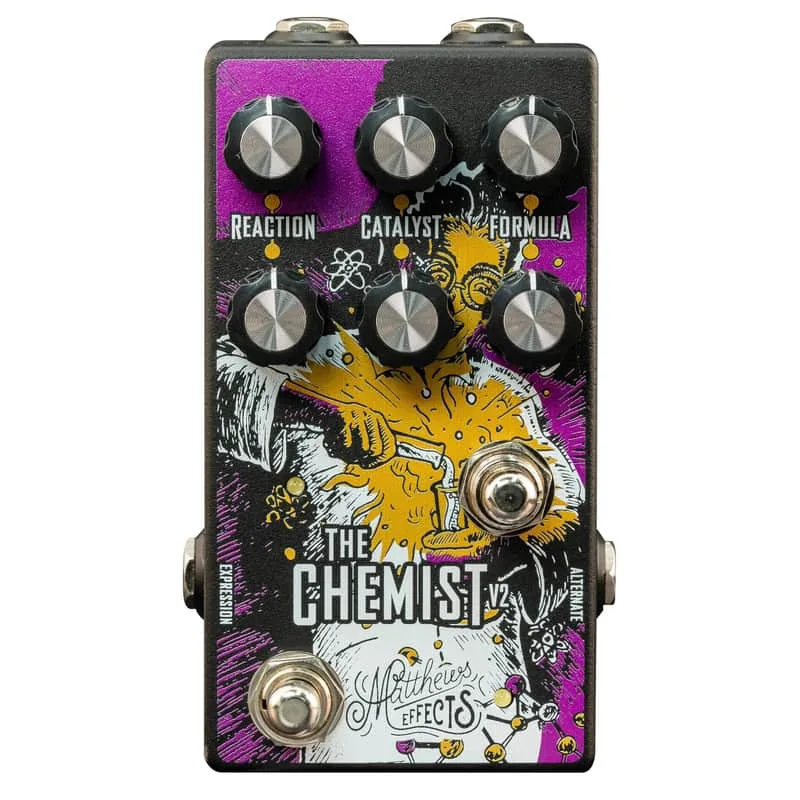


Matthews Effects The Chemist Atomic Modulator is a modulation pedal that puts three effects in one box: chorus/vibrato, octave and phaser. Announced in June 2017, it was described by Premier Guitar as "a one-stop sonic laboratory that generates organic modulation and phaser effects using three powerful algorithms: chorus/vibrato, octave, and phaser"1. MusicRadar called it a pedal "for sonic experimentalists"2.
The pedal runs on three named algorithms, each with its own character:
- Cobalt Chorus/Vibrato: recreate classic, lush chorus tones, or turn the Reaction (dry) knob down completely for vibrato1.
- Lithium Octave: generate rich polyphonic organ textures using the plus/minus octave and dry controls1.
- Iridium Phaser: manipulate speed and resonance combined with the dry signal to create swirling sonic elements1.
Two channels, one effect at a time
The Chemist offers two channels, and players can choose which algorithm is active on each channel, with controls for each2. As Premier Guitar put it, "You can select which algorithm is active on each channel, allowing you to quickly switch between two modes and settings"1. That means you can set up, say, chorus on one channel and phaser on the other and jump between them without re-dialing knobs.
One limit is worth knowing up front: only one effect can be active at a time1. The Chemist is a multi-algorithm pedal, not a multi-effect you can stack chorus and phaser together on.
The controls
The knob set is small, but two of the knobs are context-sensitive. The Reaction knob controls the dry signal, while the Catalyst and Formula knobs change depending on the algorithm you select1. MusicRadar laid out what each knob does in each mode2:
| Knob | Chorus/Vibrato | Octave | Phaser |
|---|---|---|---|
| Catalyst | Speed | Plus/minus octave | Speed |
| Formula | Dry | Dry | Resonance |
| Reaction | Dry signal | Dry signal | Dry signal |
The practical payoff is in Cobalt mode: because Reaction is the dry control, turning it down completely removes your clean signal and turns the chorus into a full vibrato1. In Lithium mode, the octave and dry controls together are what produce the polyphonic organ-style textures1.
Where it came from and what it cost
Matthews Effects, a US pedal company, announced The Chemist on 7 June 20172. It was available to preorder for $179.99 and was reported to ship on 15 July2. Premier Guitar's announcement gave the street price as $199.991; the two published figures differ, so both are given here as stated.
"The Chemist is a one-stop sonic laboratory that generates organic modulation and phaser effects using three powerful algorithms: chorus/vibrato, octave, and phaser."
The V2 and how it differs
In May 2019 a second version arrived. Delicious Audio reported that the Chemist Atomic Modulator was "now available in V2" from Matthews Effects3. The Chemist V2 Atomic Modulator keeps the same three algorithms, Cobalt (Chorus/Vibrato), Lithium (Octave) and Iridium (Phaser), but reworks how you interact with them3.
The main differences a player will notice:
- Two rows of identical controls, switchable on the fly without programming or menu diving, with slide switches on the side of the pedal selecting the algorithm for each row independently3.
- An Alt footswitch that jumps between the top and bottom rows of controls3.
- An analog dry path: the instrument's dry signal stays completely analog while the digital wet signal is mixed in3.
- An expression jack: an expression pedal dynamically controls the Formula knob on the second row of controls, bypassing the physical knob when plugged in, using a TRS cable3.
- An Alternate Jack Out for remote control of the Alt and bypass switches with a TRS cable, tip controlling the Alternate Switch and ring the Bypass Switch3.
The knob functions were also clarified on the V2: Catalyst controls the speed of the phaser and chorus and the mix of the upper octave; Formula controls the delay time of the chorus, the resonance of the phaser and the lower octave mix; and Reaction controls the mix of the effect3.
The original Chemist draws 200 mA at 9 to 18V1, which is well above what a low-current daisy chain output can supply. Plan on a dedicated power supply output.
Videos
Sweetwater
MatthewsEffects
aBunchOfPedals
Questions
Can the Matthews Effects Chemist run more than one effect at once?
No. Only one effect can be active at a time. What the two channels give you is fast switching between two different algorithms and their settings, so you can go from a chorus sound to a phaser sound with one press rather than re-dialing knobs.
What does the Catalyst knob do on The Chemist?
The Catalyst knob changes its job depending on which algorithm is selected. In the chorus/vibrato and phaser modes it works with speed, and in the octave mode it handles the plus/minus octave control. On the V2 it controls the speed of the phaser and chorus and the mix of the upper octave.
What does the Reaction knob do on The Chemist?
On the original Chemist the Reaction knob controls the dry signal, so turning it down completely in chorus mode leaves you with vibrato. On the V2 the Reaction knob controls the mix of the effect instead.
How much did The Chemist Atomic Modulator cost at launch?
MusicRadar reported a preorder price of $179.99 in June 2017, and Premier Guitar gave the street price as $199.99.
How many channels does The Chemist have?
Two. Each channel has a selectable algorithm and its own controls, so you can set up two different sounds, for example chorus on one and phaser on the other, and switch between them quickly.
Sources (3)
- Matthews Effects Unveils the Chemist Atomic Modulator, Premier Guitar, 2017-06-12
- Matthews Effects cooks up The Chemist Atomic Modulator pedal, MusicRadar, 2017-06-07
- Matthews Effects The Chemist V2 Atomic Modulator (Chorus/Vibrato, Phaser, Octave), Delicious Audio, 2019-05-16