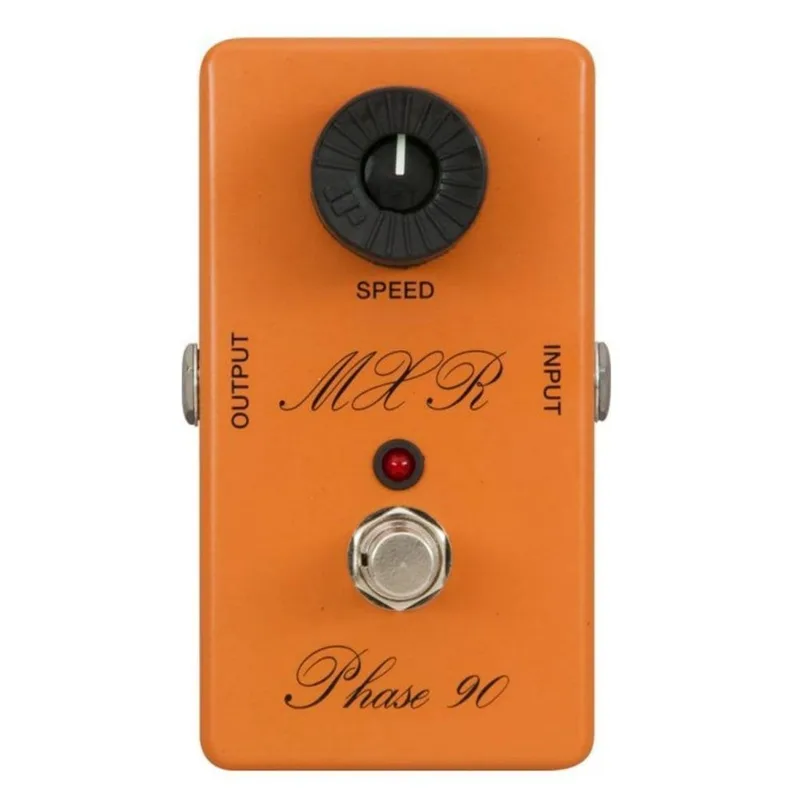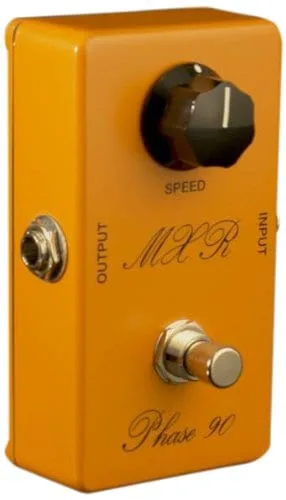


The MXR ’74 Vintage Phase 90 is a hand-wired reissue of the first Phase 90, the script-logo phaser that MXR produced from 1974 to 19771. Rather than simply updating the circuit, Dunlop reverse engineered an original pedal purchased in 1974 by Bob Cedro, a Dunlop engineer, and rebuilt it with original-spec components, hand-matched FETs, and a hand-wired circuit board12. The result is a four-stage phaser with one knob, no LED, no power jack, and the same dull orange finish and script logo as a 1974 original1.
MXR describes it as a faithful reissue that delivers the same smooth and warm modulation as the original, whose thick and rich tone set the benchmark for phasers2. It was introduced in 2008 with original-spec components3, and Vintage Guitar called it "a nuts-on reissue of the ’74 script-logo Phase 90"4.
A recreation of the script-logo Phase 90
The original Phase 90 went out of production when MXR went bankrupt in 198478. When Dunlop, the present owner of the MXR brand, decided to recreate it, the company started from an actual survivor: its in-house work horse, purchased in 1974, which was meticulously spec'd and recreated as the ’74 Vintage Phase 902. MusicRadar's Trevor Curwen explains that the company "basically reverse engineer[ed] an original pedal that had been purchased in 1974 by Bob Cedro, a Dunlop engineer"1. Vintage Guitar describes the pedal as an exact recreation of Cedro's personal 1974 script-logo Phase 904.
The circuit follows the original script-logo spec closely. It uses six single op-amps like the 1974 original7, replicating the original spec of 2N5952 JFET transistors and six 741 op-amps9. That spec was revised several times over the years, including under Dunlop ownership, with more recent versions of the Phase 90 using three dual op-amps instead9. The components are select resistors paired with hand-matched FETs, chosen to exactly recreate the original sound1.
The look matches the circuit. The pedal comes in the classic orange finished box with the script logo2, finished in a similar dull orange shade to a vintage pedal1, which Vintage Guitar calls the classic pumpkin orange chassis with black script logo4.
Controls and how it sounds
There is only one control: a single Speed knob, which comes with a removable rubber cap so you can adjust it by foot1. The footswitch toggles the effect on and off6.
| Control | What it does |
|---|---|
| Speed knob | Regulates the overall effect rate; removable rubber cap for foot adjustment61 |
| Footswitch | Toggles effect on/bypass6 |
The manual gives two sample settings6:
Vintage Guitar's reviewer went further with the knob: "At 10 o’clock, the Speed control offers a deep, liquid Van Halen-esque effect. Roll it up to 3 o’clock and behold its very usable Leslie-like sound."4 The same reviewer found it produced "a thick, rich buttery phase-shifting sound that doesn’t over-color the guitar/amp’s natural sound" in front of a tube combo amp4.
MusicRadar's reviewer described the range from one extreme of the knob to the other:
"From the slowly shifting tonality at one extreme to the fast bubbling at the other, this is organic phasing that seems an integral part of the guitar sound rather than something slapped on top of it."
Power: 9V battery only
This pedal can only be powered by one 9-volt battery, which is not included2. There is no AC connector7, so it cannot run from a pedalboard power supply or a daisy chain. To reach the battery you remove four screws and take the pedal's base off1.
Battery-only operation is part of the recreation: the original had the same limitation, and Vintage Guitar lists battery-only operation among its period-correct features4. Current draw is a modest 2.2 mA6, so a fresh battery lasts a long time at typical playing sessions. The 9V supply feeds the op-amps7.
What the ’74 Vintage Phase 90 leaves out
No modern tweaks were added, which means no status LED and battery power only1. The bypass is a Carling switch that is not true bypass17, again matching the original17. Vintage Guitar lists the full set of period features: a single Speed control, a non-true-bypass switch with no LED, chassis-mounted Switchcraft 1/4" in/out jacks, and battery-only operation4.
How it differs from the regular Phase 90
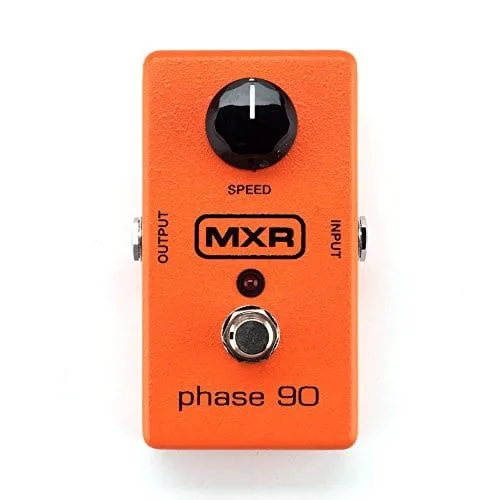
The regular MXR Phase 90 (model M101) is the modern production version of the same pedal10, while the ’74 Vintage Phase 90 is the hand-wired recreation of the very first version, the script-logo model produced from 1974 to 19771. The key differences:
- Construction: hand-wired circuit board with original-spec components and hand-matched FETs, versus the revised circuit of later versions, which use three dual op-amps69
- Switching and power: no LED, no AC connector, battery only, non-true-bypass Carling switch71
- Intent: an unadulterated clone aimed at purists, in MusicRadar's words1
Players who want the script-logo voicing with modern conveniences have other options in MXR's range, such as the MXR Script Phase 90.
Specifications
| Specification | Value |
|---|---|
| Input impedance | 470 kΩ6 |
| Output impedance | 10 kΩ6 |
| Max input level | -5 dBV6 |
| Signal to noise ratio | > 95 dB (all controls at mid, A-weighted, VREF = 1VRMS)6 |
| Current draw | 2.2 mA6 |
| Power | One 9V battery271 |
| Jacks | Switchcraft input and output6 |
What reviewers said
MusicRadar's review put the reissue head to head with a real 1974 model. In an A/B test the sound was not identical, with a slightly different tonality, "but not so much that we could say that one sounded better than the other, which means that MXR has achieved its aim"1. The reviewer's verdict:
"If you want that mid-seventies Phase 90 sound this reissue is as close as you'll get to it without trawling Ebay for a battered original."
The same review listed the authentic vintage sound and the rubber knob cap for foot control as reasons to buy, and battery access as the reason to avoid1. Vintage Guitar, reviewing the pedal at its 2008 introduction, found the thick, rich phasing did not over-color the guitar and amp's natural sound4.
Videos
ProGuitarShopDemos
Sweetwater
jimdunlopusa
Questions
Can the MXR '74 Vintage Phase 90 use a power supply?
No. The pedal can only be powered by one 9-volt battery, which is not included. There is no AC connector, so it cannot be run from a wall adapter or pedalboard power supply. To change the battery you remove four screws and take the base plate off the pedal, which reviewers found to be the main practical drawback of the design.
What is the difference between the '74 Vintage Phase 90 and the regular Phase 90?
The '74 Vintage Phase 90 is a hand-wired recreation of the first script-logo Phase 90, built with original-spec components, hand-matched FETs, and the same six single op-amps as the 1974 original. The regular Phase 90 is a modern production version. The '74 also omits an LED and runs on battery only, while later circuits were revised, for example using three dual op-amps.
Does the '74 Vintage Phase 90 have hand-wired circuitry?
Yes. The circuit board is hand-wired and built with original-spec components, including select resistors paired with hand-matched FETs. It uses six single op-amps, like the original 1974 script-logo Phase 90, and replicates the original spec of 2N5952 JFET transistors and six 741 op-amps.
What are the sample settings for the '74 Vintage Phase 90?
The manual lists two sample settings for the Speed knob: Classic '80s Rock at 9:00 and Pseudo Leslie at 12:00. The Speed knob is the only control and regulates the overall effect rate. Vintage Guitar's reviewer found a deep, liquid effect at 10 o'clock and a very usable Leslie-like sound at 3 o'clock.
Is the MXR '74 Phase 90 true bypass?
No. The pedal uses a Carling bypass switch that is not true bypass, matching the original 1974 design. Like the original, it also has no status LED. Players who want a fully modern switching arrangement would need to look at other versions of the Phase 90.
Does the MXR '74 Phase 90 have an LED?
No. No modern tweaks were added, which means no status LED. You tell whether the effect is on by ear, just as players did with the original 1974 script-logo Phase 90. The trade-off for the lack of conveniences is a circuit built to match the original as closely as possible.
Sources (10)
- MXR CSP-026 '74 Vintage Phase 90 review, MusicRadar, 2008-05-23
- MXR® '74 VINTAGE PHASE 90, Dunlop (jimdunlop.com)
- In praise of: MXR Phase 90, MusicRadar, 2015-06-10
- Dunlop MXR Carbon Copy, ’74 Phase 90 and Buddy Guy Signature Wah, Vintage Guitar magazine, 2010-03-24
- MXR® '75 VINTAGE PHASE 45, Jim Dunlop (jimdunlop.com)
- CSP026.pdf, Jim Dunlop, 2022
- MXR Phase 90 Analysis, GuitarPCB, 1984
- TONEHOME, TONEHOME
- Meet your maker: MXR at 40, MusicRadar, 2014-12-04
- MXR® PHASE 90, Dunlop (jimdunlop.com)