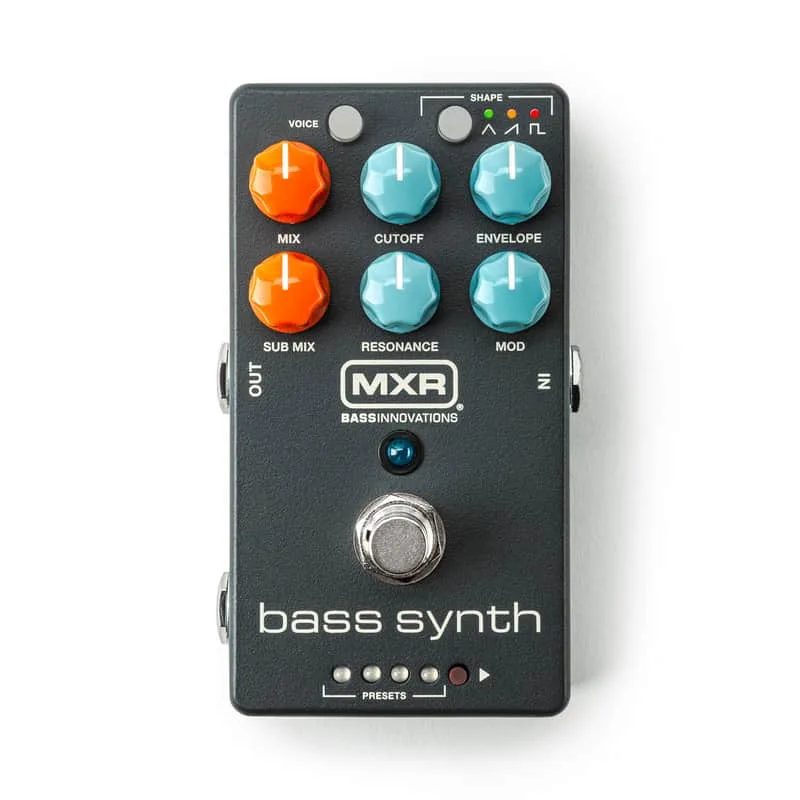


The MXR Bass Synth (MB301) is a digital effects pedal that turns a bass guitar into a monophonic synthesizer. MXR describes it as serving up "intergalactic grooves and vintage analog-style vibes with a range of monophonic synth tones"12, with presets that call back to classic synth bass lines from Stevie Wonder, Michael Jackson, Parliament Funkadelic and more2. It was announced on July 1, 2025 and was available at launch at $269.99 street3.
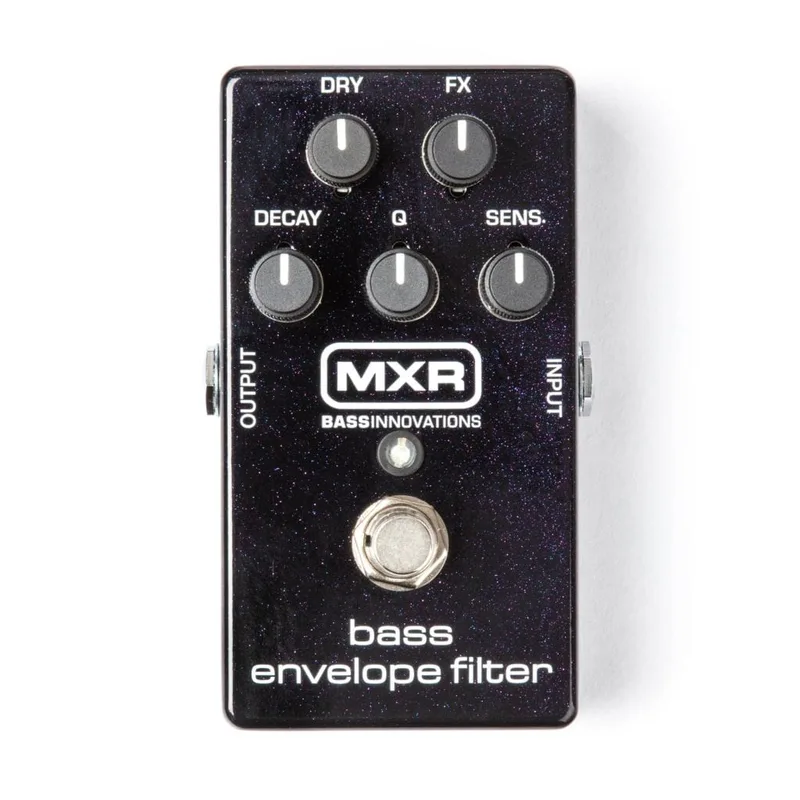
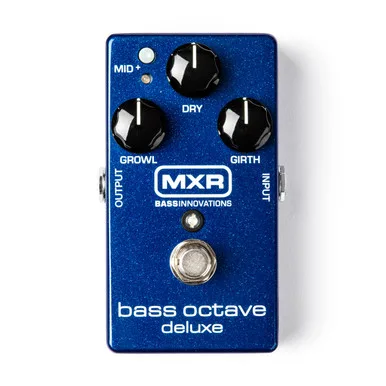
The pedal was designed with Ian Martin Allison, whom MXR calls a "low-end professor and tone connoisseur"1 and whom Guitar World describes as a session bassist, content creator and educator4. It is made by Dunlop Manufacturing under the MXR brand, and it sits in a long line of MXR bass effects alongside pedals like the MXR Bass Envelope Filter and the MXR Bass Octave Deluxe.
What it does
The Bass Synth tracks the notes you play on bass and converts them into synth voices built from triangle, sawtooth or square waveforms3. Bass Gear Magazine's announcement grouped its effects as "thunderous sub-octave, expressive envelope, and lush modulation effects"3. The core sound engine runs through a 4-pole resonant low-pass filter, and a sub-octave signal can be mixed underneath the main synth voice1.
Because it is monophonic, it tracks one note at a time, which suits single-note bass lines rather than chords. The manual lists a noise floor of -97 dBV and a maximum input level of +5 dBV1.
The controls and secondary functions
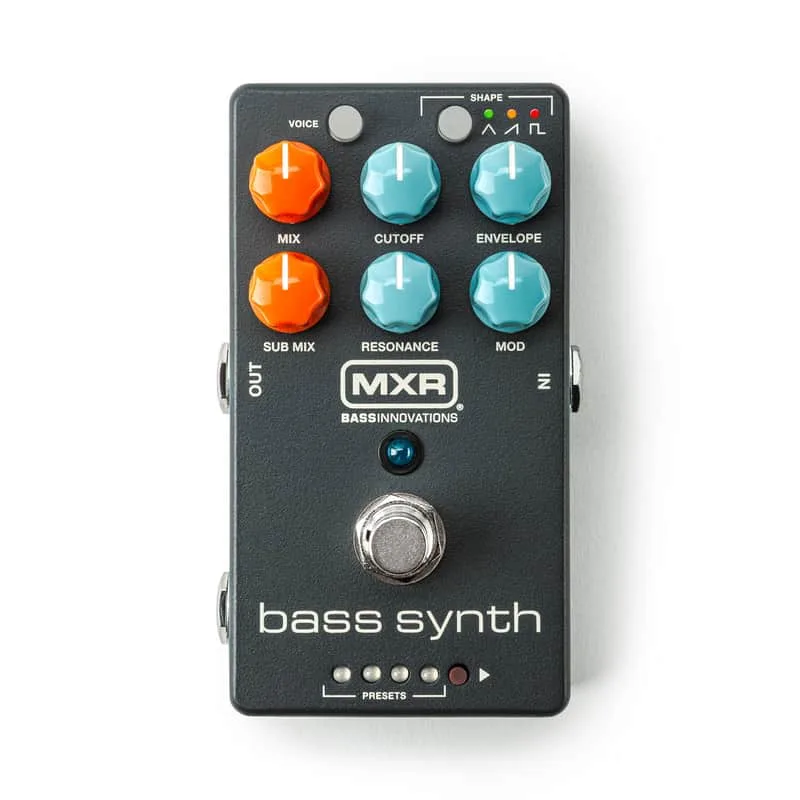
The front panel carries six knobs plus VOICE and PRESETS buttons and an on/off footswitch74.
| Control | What it does |
|---|---|
| CUTOFF | Sets the cutoff frequency of the 4-pole resonant low-pass filter1 |
| RESONANCE | Boosts the resonant frequency of the filter2 |
| ENVELOPE | Controls the attack/decay times of the filter envelope; fully counterclockwise turns the envelope filter off1 |
| SHAPE | Selects the LFO waveform: triangle, sawtooth, or square37 |
| MOD | Sets the amount of modulation1 |
| SUB MIX | Sets the mix between the main synth and sub signals1 |
| MIX | Sets the dry/wet mix, with secondary and tertiary functions17 |
| VOICE button | Adds additional oscillators harmonically tuned for more complex tones1 |
| PRESETS button | Selects one of the 8 presets1 |
| Footswitch | Tap to engage/bypass; hold to scroll presets; hold to freeze the current note once configured12 |
Each knob also carries secondary (violet) and tertiary (red) functions, reached by holding the Voice or Shape button while turning the knob7. Guitar World lists the additional parameters available this way: Voice Mix, Noise Mix, Filter Envelope Amount, Glide, Amp Envelope, Mod Blend, Compression, Output Gain, Gate Sensitivity, Tracking, Dry Thru FX, and Output Mode4. For example, the MIX knob's secondary function sets compression "from none to tight, punchy limiting"1, and the CUTOFF knob's secondary sets the direction and width of the filter envelope, opening the filter above noon and closing it below noon for a ducking effect1.
The eight presets
The pedal holds eight presets, four green and four red, plus a live mode that follows the current knob settings1. The green group is the funky side and the red group the electronic side7, and each preset is named for the song whose synth tone inspired it76.
| Preset | Group | Inspired by |
|---|---|---|
| 1 | Green (Funky) | Thriller, Michael Jackson7 |
| 2 | Green (Funky) | Boogie On Reggae Woman, Stevie Wonder7 |
| 3 | Green (Funky) | Chameleon, Herbie Hancock7 |
| 4 | Green (Funky) | Flash Light, Parliament7 |
| 5 | Red (Electronic) | Sledgehammer, Peter Gabriel7 |
| 6 | Red (Electronic) | Army of Me, Björk7 |
| 7 | Red (Electronic) | Head Like a Hole, Nine Inch Nails7 |
| 8 | Red (Electronic) | Ghosts N Stuff, Deadmau57 |
You can move through them by holding the footswitch and cycling, or by hooking up a tap switch to the CTR jack and using that2.
Tracking modes for 4-string, 5-string bass and guitar
Tracking is a global secondary parameter on the RESONANCE knob with three settings, and it determines how the synth signal responds to your instrument's range so notes track accurately1.
- 5-string bass: the default, with the knob fully counterclockwise. Tracks low B to high C on a 24-fret 6-string bass1.
- 4-string bass: at 12 o'clock. Faster response than 5-string mode, but it only tracks down to a low E1.
- Guitar: fully clockwise. Tracks the range of a 24-fret guitar in standard tuning1.
The guitar mode means the pedal is not bass-only, a point Guitar Pedal X highlighted when covering the release7.
Power, connections and output modes
The Bass Synth requires a 9-volt, 330 mA center-negative power supply6, and can be powered by the Dunlop ECB003 9-volt adapter or the MXR Iso-Brick, Iso-Brick Pro and Iso-Brick Mini power supplies6.
The pedal cannot be powered by a battery1, and its 330 mA draw is well above what a typical analog pedal needs, so it needs its own adequate 9V supply rather than a shared low-current daisy chain.
Connections are a mono input, a TRS output jack that allows stereo output, and a CTR jack that serves as an expression or tap input, or as a right-channel output, selected by a side switch1. Output impedance is 100 Ω1.
The MOD BLEND OUTPUT MODE secondary parameter sets one of three output modes1:
| Output mode | Bypass |
|---|---|
| MONO (default) | True bypass1 |
| WET/DRY | Buffered bypass1 |
| STEREO | Buffered bypass1 |
For stereo use, Bass Magazine found recording the MB301 in stereo "as easy as flicking the CTR side switch to AUDIO and using ordinary two-conductor cable" at the OUT and CTR jacks8.
Freezing a note
To configure the freeze function, hold the footswitch down and rotate the RESONANCE knob to its maximum position1. Once configured, holding the footswitch freezes the current note so it sustains beneath your playing. Bass Magazine's reviewer used freeze mode for an 808-style tone8.
What reviewers said
Guitar World's review rated the build quality five stars, calling it "a typically well-made and well-finished build from MXR"4. Guitar Pedal X called it "a total triumph for me at least by features and sounds," with very decent note-tracking throughout and the eight presets alone "worthy of the admission price"7. Bass Magazine praised its tracking, presets and price, while noting limits for deep sound design8.
"This pedal is a total triumph for me at least by features and sounds - as so far extrapolated from demos"
Videos
jimdunlopusa
Scott's Bass Lessons
jimdunlopusa
News
Questions
Does the MXR Bass Synth take a battery?
No. The manual states plainly that the pedal cannot be powered by a battery. It needs a 9-volt, 330 mA center-negative power supply, such as the Dunlop ECB003 adapter or an MXR Iso-Brick series supply, so plan on a pedalboard power source rather than a battery.
Can the MXR Bass Synth be used on guitar?
Yes. The Tracking parameter has a dedicated guitar setting, selected by turning the RESONANCE knob fully clockwise, which tracks the range of a 24-fret guitar in standard tuning. There are also settings for 4-string and 5-string bass.
Is the MXR Bass Synth true bypass?
It depends on the output mode. In MONO mode the pedal is true bypass. In WET/DRY and STEREO modes it uses buffered bypass, so players who want a true bypass signal path when the effect is off should leave it in MONO.
Does the MXR Bass Synth work in stereo?
Yes. The output is a TRS jack that allows stereo output, and the CTR jack can serve as a right-channel output when its side switch is set to AUDIO. Bass Magazine found stereo recording as easy as flicking that switch and using ordinary two-conductor cables.
Who designed the MXR Bass Synth?
It was designed with Ian Martin Allison, described by MXR as a low-end professor and tone connoisseur, and by Guitar World as a session bassist, content creator and educator. The pedal is made by Dunlop Manufacturing under the MXR brand.
How do you freeze a note on the MXR Bass Synth?
Hold the footswitch down and rotate the RESONANCE knob to its maximum position to configure the freeze function. Once configured, holding the footswitch freezes the current note, which sustains for pads and drones under your playing.
Sources (8)
- MB301.pdf, Jim Dunlop, 2025
- “Thunderous sub-octave, expressive envelope, and lush modulation effects with killer tracking and sustain”: MXR unveils the MB301 Bass Synth, MusicRadar, 2025-07-02
- MXR® Bass Synth Serves Up Intergalactic Grooves & Vintage Analog-Style Vibes, Bass Gear Magazine, 2025-07-01
- MXR MB301 Bass Synth Pedal review, Guitar World, 2025-08-01
- Guitar Pedal X, Guitar Pedal X, 2026-07-30
- MXR® BASS SYNTH, Jim Dunlop (jimdunlop.com)
- Guitar Pedal X, Guitar Pedal X, 2025-07-03
- Review: MXR MB301 Bass Synth, Bass Magazine, 2025-10-14