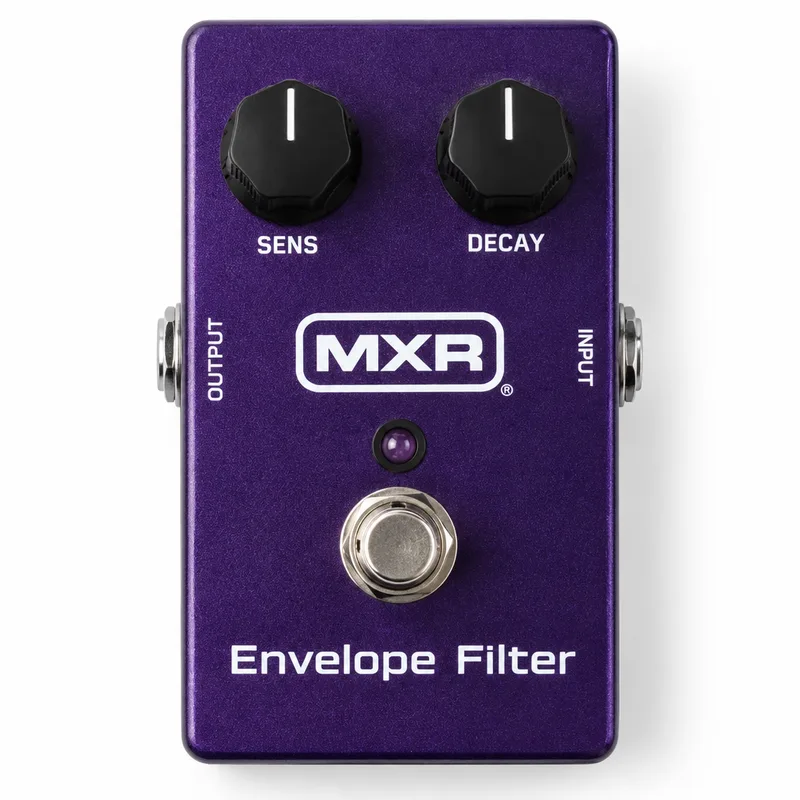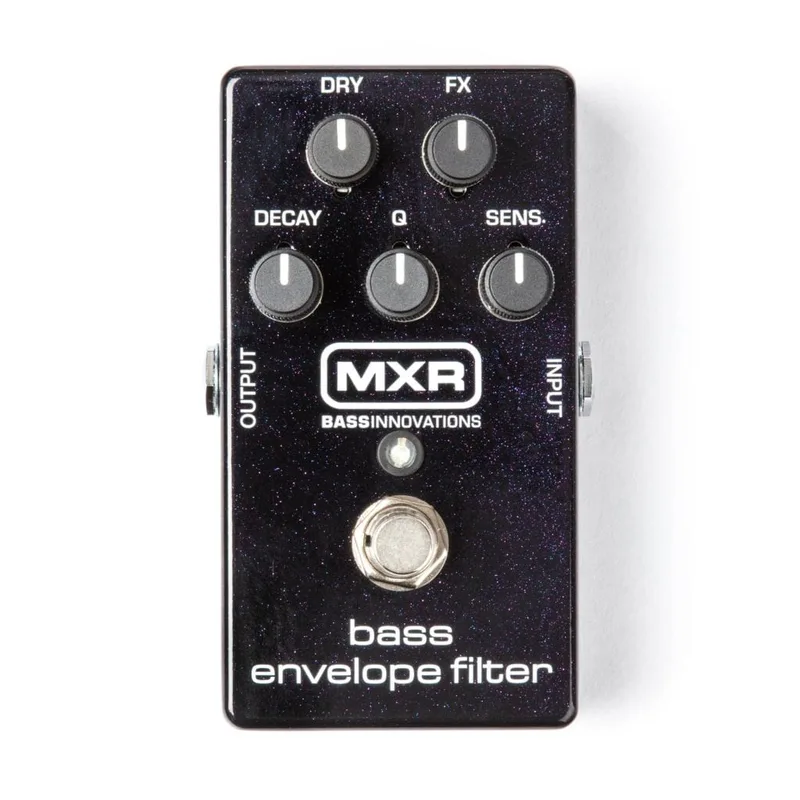


The MXR Bass Envelope Filter is an analog envelope filter pedal made by MXR and designed specifically for bass. An envelope filter listens to how hard you pluck and opens a resonant filter in response, giving the quacky, vocal funk sounds associated with the effect. MXR describes it as delivering "classic analog envelope filter sounds" in a compact pedal, with separate Dry and Effect level controls so you can keep your low end intact while the filter does its thing1.
The pedal was introduced in 2010 as part of MXR's Bass Innovations line2, and it carries on a family name: the original MXR Envelope Filter, the MX-120, was made in Rochester, New York in 19793. The current list price is $179.994; Premier Guitar's review pegged it at $149 street5.
The controls: Dry, Effect, Decay, Q and Sensitivity
The pedal has five knobs, and they split into two jobs. Dry and FX set the mix of your clean and filtered signals, while Decay, Q and Sensitivity shape the filter's behavior itself82.
| Control | What it does |
|---|---|
| Dry | Volume of the unaffected signal6 |
| FX | Volume of the envelope filter signal7 |
| Decay | Sets the filter's decay stop frequency; clockwise raises it, counterclockwise lowers it7 |
| Q | Controls the intensity of the effect, its peak resonance78 |
| Sensitivity | Adjusts how responsive the filter is to your attack72 |
The separate Dry and FX controls are the feature that matters most to bass players, because an envelope filter on its own can thin out the bottom of your sound. MXR's pitch is that you "can bring the funk without losing the low end"1, and the manual lists the separate level controls specifically "for preserving low end"6. Guitar World's reviewers called these controls "absolutely key to shaping the sound you're looking for"8, and found the pedal easy to live with, with bad sounds hard to dial in8.
For Decay, Guitar World's guidance is to wind it anticlockwise for fast, quacky sounds and clockwise for slower, more subtle effects8. The manual includes three sample settings to start from6:
- Bottom Dweller: synth bass
- Bubble Funk: classic 70's funk
- Gorilla Biscuit: techno/dance
Premier Guitar's reviewer went straight to Bubble Funk, described there as "classic '70s funk"5.
Power and connections
Setup is simple: run a cable from your bass into the INPUT jack and another from the OUTPUT jack to your amplifier6. Power comes from one of three sources1:
- A 9-volt battery (remove the bottom plate to install it)6
- A Dunlop ECB003 9-volt adapter1
- The DC Brick, Iso-Brick or Mini Iso-Brick power supplies, sold separately1
The 2023 Blackout Series manual also lists the Dunlop ECB003/ECB003EU adapter and MXR Brick Series power supplies9. The power supply circuitry is designed to withstand over-voltage or polarity mishaps, which protects the pedal if a supply is connected the wrong way1. At 6 mA of current draw, it is a light load on a shared pedalboard supply6.
On bypass, the sources use slightly different wording: the current product page says true-bypass switching preserves your tone in bypass mode1, while the 2019 manual's specification table reads "True Hardwire"6. Either way, the signal passes through unaffected with the effect off.
Filter sweep: 76 Hz to 3.2 kHz
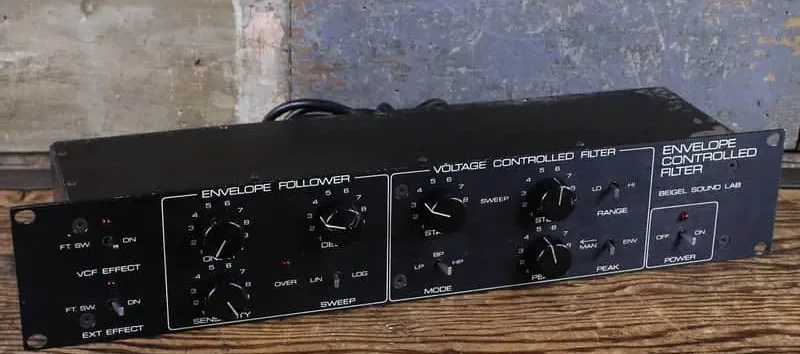
The filter's center frequency sweeps from 76 Hz to 3.2 kHz6, a range that reaches down into bass territory rather than sitting entirely in the guitar-focused upper mids. For comparison, the Beigel Sound Lab Envelope Controlled Filter's HI mode sweeps from 350 Hz to 12 kHz10, so the MXR's range is weighted toward the low frequencies a bass player actually uses.
The manual's full specification set7:
| Specification | Value |
|---|---|
| Filter sweep (fc) | 76 Hz to 3.2 kHz |
| Decay stop frequency | 76 Hz to 1.3 kHz |
| Sensitivity range | 46 dB |
| Filter gain at fc | +8 dB (Q min, fc = 76 Hz) to +26 dB (Q max, fc = 3.2 kHz) |
| Dry range | -∞ to +6 dB |
| FX range | -∞ to 0 dB relative to filter gain |
| Noise floor | -94 dBV (A-weighted, all controls at mid position) |
The decay stop frequency range of 76 Hz to 1.3 kHz6 means the Decay knob decides where the filter settles after the initial sweep, which is what separates a quick quack from a slow, blooming sweep.
The Blackout Series edition
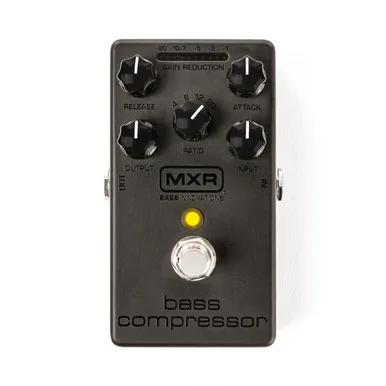
In 2025 MXR marked 15 years of Bass Innovations with a special edition version of the pedal, the MXR Blackout Series Bass Envelope Filter978. It was a run of 1,500 pieces9, finished in a matte black housing with gloss black text and a bright yellow LED in place of the standard pedal's blue LED96. A companion Blackout Series Bass Compressor was released in the same 1,500-piece format11.
MXR lists the Blackout Series Bass Envelope Filter as a legacy product that is no longer in production9. The standard Bass Envelope Filter remains in the range9.
Both versions share the same Phase 90-size aluminum housing, which MXR describes as durable and lightweight, and the same control set, power options and true-bypass switching19.
What reviewers said
Premier Guitar reviewed the M82 and found it held its own against the competition, with the blend controls as the standout:
"the M82 proves itself to be a strong contender in the analog filter world. Its separate level controls for dry and wet sounds are an especially important advantage over the competition."
The same review noted the sparkle-purple finish, five knobs and true-bypass footswitch, and found the pedal sturdy and a bit smaller than most stompboxes5. Bassist Fabrizio Grossi, interviewed by Guitar World, was blunt in its favor:
"Billy's the gear king, and these things sounds like no other envelope filter I've ever tried."
Guitar World's 2025 guide to the best bass effects pedals lists the M 82 among its 11 picks, citing its funky analog tones, compact size and separate Dry and FX controls8.
Videos
Guitar World
Bass Whisperer TV
jimdunlopusa
Questions
Is the MXR M82 true bypass?
Yes. MXR describes the Bass Envelope Filter's switching as true bypass, so your tone is preserved when the effect is off. The 2019 manual labels the bypass spec "True Hardwire" while the current product page and the 2023 Blackout Series manual say true bypass, but all agree the signal passes unaffected when the pedal is disengaged.
Does the MXR Bass Envelope Filter take a battery?
Yes. It runs on one 9-volt battery, installed by removing the bottom plate, or on a 9-volt adapter. The battery option makes it usable on its own without a power supply, though most pedalboard setups will use the DC jack instead.
Is the MXR Bass Envelope Filter analog?
Yes. MXR describes it as delivering classic analog envelope filter sounds, and the manual specifies all-analog circuitry for what it calls rich, organic tone. Reviewers have placed it among analog filter pedals rather than digital ones.
What power supply does the MXR M82 use?
It takes 9 volts DC and draws about 6 mA. MXR lists a 9-volt battery, the Dunlop ECB003 9-volt adapter, and the DC Brick, Iso-Brick and Mini Iso-Brick power supplies as options. The power supply circuitry is designed to withstand over-voltage or polarity mishaps.
How many Blackout Series Bass Envelope Filters were made?
The Blackout Series Bass Envelope Filter was a special edition run of 1,500 pieces, marking 15 years of MXR Bass Innovations. MXR now lists it as a legacy product that is no longer in production, so it is only available secondhand.
Sources (12)
- MXR® BASS ENVELOPE FILTER, Jim Dunlop (jimdunlop.com)
- Gear Watch: MXR Bass Envelope Filter, No Treble, 2010-02-19
- TONEHOME, TONEHOME - the World of Vintage Guitar Effects Pedals
- Dave Matthews is a Dunlop Artist, Jim Dunlop
- MXR M82 Bass Envelope Filter Pedal Review, Premier Guitar, 2010-09-21
- M82.pdf, Dunlop Manufacturing, Inc., 2019
- M82B.pdf, Jim Dunlop (jimdunlop.com), 2023
- Best bass effects pedals: best pedals for every style, Guitar World, 2021-12-20
- MXR® BLACKOUT™ SERIES BASS ENVELOPE FILTER, Jim Dunlop (jimdunlop.com)
- Beigel Sound Lab, Musitronics Mu-Tron (mu-tron.com)
- MXR® BLACKOUT™ SERIES BASS COMPRESSOR, Jim Dunlop (jimdunlop.com)
- Fabrizio Grossi has worked with everyone from George Clinton to Billy F.Gibbons, Steve Vai to Ice-T. But in the event of an unlikely effects-based apocalypse, which pedals would he save from the flames?, Guitar World, 2022-10-24
 Justin Chancellor
 MonoNeon