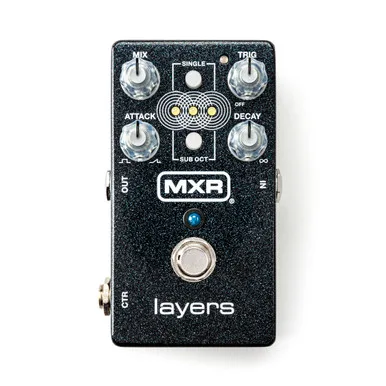


The MXR Layers is a sustain and layering pedal that freezes and holds notes or chords, up to three at a time, so you can play over the top of your own sustained sound. MXR describes it as a pedal that "blooms with rich, organic sustain that imbues every strum and pluck with resonance and depth"1. Pressing the footswitch takes a sample of your playing at that moment, which sustains until you release the footswitch2. It all fits in the standard MXR housing, which GuitarPlayer noted makes integrating it into an existing pedalboard straightforward3.
By default the pedal runs three simultaneous layers that overlap with each other4. Each layer has its own mini LED showing whether it is active1, and once the third layer has been captured, each new layer replaces the oldest one2. Engaging the Single switch limits the effect to one layer at a time14. Premier Guitar called the pedal "this addictive mashup of delay, modulation, harmonizer, and sustain effects"5.
What the Layers does
The core function is freeze and sustain. Hold the footswitch and the pedal samples what you are playing, holding that sound indefinitely; release it and the layer decays according to your settings2. Stack a second and third capture on top and you have a bed of sustained harmony to solo or arpeggiate over. Guitar Pedal X described it as a "Mighty Shoegaze-Style Effect" in its stereo 3-layer form6.
The three layers overlap by default, and their status is shown by three glowing LEDs2. If you would rather work with a single sustained layer, the Single button restricts the effect to one4. A Mix knob sets the level of the layers in relation to your dry sound2.
Controls and onboard effects
The front panel keeps things compact: four pots, two small buttons, a CTR switch and the main footswitch9.
| Control | What it does |
|---|---|
| Mix | Sets the level of the layer in relation to your dry sound2 |
| Trig | Allows the pedal to be automatically activated by playing dynamics9 |
| Attack | Controls the attack of the captured audio9 |
| Decay | Controls the decay of the captured audio9 |
| Single button | Limits the sustain effect to a single layer4 |
| Sub Oct button | Adds a sub octave; also used to control the built-in delay and modulation while held down9 |
| CTR switch | Selects control-input behavior9 |
| Footswitch | Bypass; also takes a sample of your playing which sustains until released2 |
The onboard effects are accessed as secondary knob functions while you press and hold the Single or Sub Oct buttons2. Guitar World's reviewer, Trevor Curwen, explained what is available:
"You can set up delay, modulation (chorus, tremolo or a blend) and a diffusion amount that adds texture to the layer(s)"2
The Mix knob has a hidden secondary function too: with Sub Oct held, rotating it clockwise mutes the dry signal and counterclockwise restores it4. The pedal's tap tempo, dry kill, mono or stereo operation, dry/wet split, sub octave and FX are all listed among its features2. The manual also quotes a noise floor of -97 dBV4.
Power and connections
The Layers cannot run on a battery. It requires a 9-volt, 300mA, center-negative power supply1, and a 9V DC adaptor is supplied with the pedal2. At 300mA it draws more current than many compact analog pedals, so check that your pedalboard power supply has an outlet with enough headroom before adding it to a daisy chain.
Connectivity is a standard input, a standard output and a CTR input2. The CTR input takes an expression pedal, which MXR's launch coverage described as making the pedal "more performance friendly"10, or external switches that trigger layers2. With an expression pedal connected you can blend between two setting configurations, effectively moving between two versions of your sound mid-performance2.
Stereo and dry/wet split modes
The Layers can run in Stereo Input, Stereo Output and Dry/Wet Split modes1. In stereo, the three layers are panned left, center and right, which spreads the sustained bed across the stereo field2. In Dry/Wet Split mode, the dry signal and the layered effect are sent to separate outputs, so you can route your clean sound and the sustained layers to different amps or destinations2. Mono operation is also supported2.
Where it came from and what it costs
MXR unveiled the Layers Pedal on 27 August 2024, priced at £249/$219 and available immediately10. Bass Magazine reported the US launch pricing as $219.99 street against a $314.27 MSRP7, and Gearnews quoted about €210 in Europe11. Later reviews quoted $229 and $229.99 as the launch price29. MXR's current list price is $245.99 as of October 202618.
What reviewers said
Guitar World's Trevor Curwen reviewed the pedal and concluded that MXR's own claim for it holds up2:
"MXR's claim that Layers will "extend the creative potential of your instrument" is absolutely right"2
MusicRadar's reviewer Alex Lynham listed the pedal's controls and noted the trigger function that lets playing dynamics activate the effect automatically, alongside control of both the attack and decay of captured audio9. Premier Guitar's take framed the pedal as a hybrid: "this addictive mashup of delay, modulation, harmonizer, and sustain effects"5. Guitar Pedal X highlighted its shoegaze appeal and its "host of smart hidden features"6.
Videos
Premier Guitar
jimdunlopusa
AndyDemos
Questions
Is the MXR Layers true bypass?
No. The Layers uses a buffered bypass, as listed in Guitar World's review. That means a buffered signal passes through the pedal's circuitry when it is off, which some players prefer on long signal chains and others avoid. It is not a true bypass pedal.
Can the MXR Layers run on a battery?
No. MXR states plainly that the pedal cannot be powered by a battery. It requires a 9-volt center-negative power supply delivering 300mA, and a 9V DC adaptor is supplied with it. You will need a power supply or an isolated pedalboard outlet with enough current.
Can I use an expression pedal with the MXR Layers?
Yes. The pedal has a CTR input that accepts an expression pedal, which you can use to blend between two setting configurations for live performance. The same input also takes external switches that trigger layers, so you can capture and release layers without bending down.
How much does the MXR Layers cost?
MXR's current list price is $245.99 (as of October 2026). At launch in August 2024 it sold for $219.99 street in the US, with a $314.27 MSRP, and £249 in the UK. Launch reviews later quoted $229 and $229.99.
Does the MXR Layers have tap tempo?
Yes. Guitar World's review lists tap tempo among the pedal's features, alongside dry kill, mono or stereo operation, dry/wet split, a sub octave and onboard FX. Tap tempo is useful for matching the onboard delay to your tempo.
Sources (11)
- MXR® LAYERS™ PEDAL, Jim Dunlop (jimdunlop.com)
- MXR Layers review, Guitar World, 2024-12-09
- “Build richly detailed soundscapes that elevate musical expression to new heights”: MXR gets wild and weird with Layers, GuitarPlayer (www.guitarplayer.com), 2024-08-28
- M307.pdf, Jim Dunlop (jimdunlop.com), 2024
- MXR Layers Review: Unleash Your Sonic Creativity, Premier Guitar, 2024-10-09
- Guitar Pedal X, Guitar Pedal X, 2024-08-28
- MXR Releases New Layers Pedal, Bass Magazine, 2024-08-29
- MXR® CARBON COPY® DELUXE ANALOG DELAY, Dunlop (jimdunlop.com)
- "The Layers is a subtle and unique pedal, with a lot of expressive depth": MXR Layers review, MusicRadar, 2025-01-25
- “Pull off chord voicings you never thought possible, compose transcendent melodies, orchestrate harmonic ensembles…”: MXR unveils the Layers Pedal, opening a world to adventures in hi-fi guitar sustain, MusicRadar, 2024-08-27
- MXR Layers: The last Ambient Freeze pedal you'll ever need?, gearnews.com, 2024-08-27