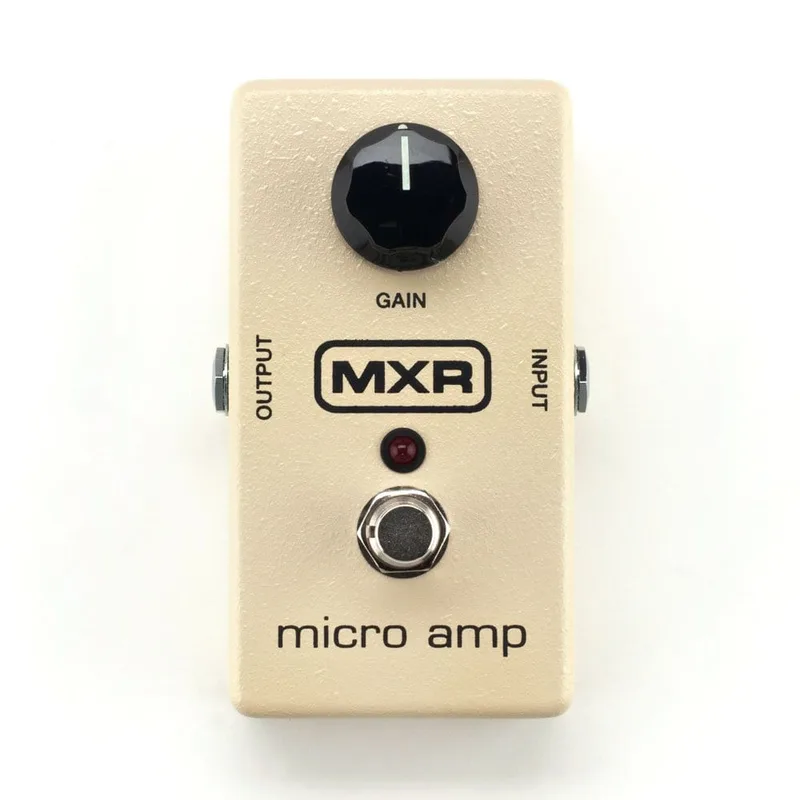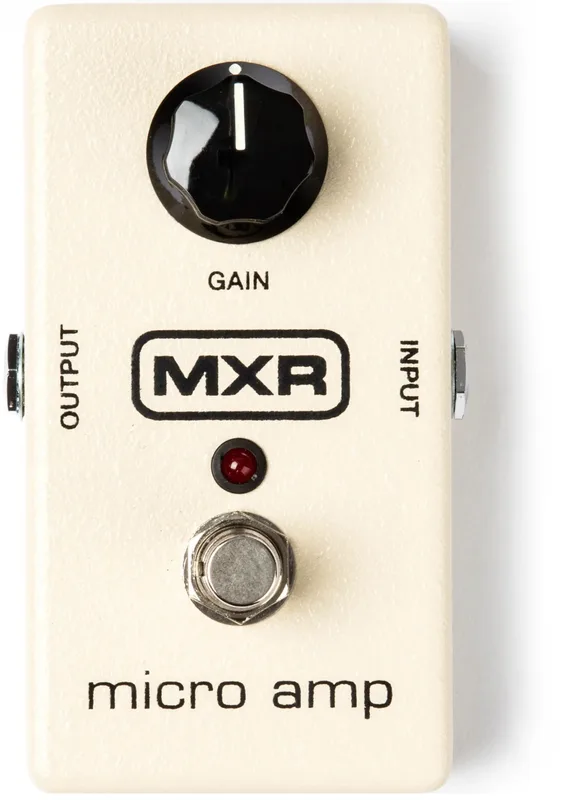


The MXR M-133 MicroAmp is a clean boost and volume pedal with a single control, first released in the early 1970s as part of MXR's Reference Series12. It is designed to be a transparent clean volume booster: it does not color or modify the guitar tone, it simply makes the signal louder1. Its main application is louder solos, and it can also supply a permanent boost at the end of a long effects chain or cable run where signal drop is a problem1. Dunlop's manual adds a practical use: it is handy for switching between guitars with unmatched output levels3.
A transparent clean boost
The MicroAmp's whole purpose is volume without coloration. GuitarPCB's technical analysis states plainly that the pedal "is designed to be a transparent clean volume booster; it does not color or modify the guitar tone"1. Two impedance figures back that up in practice: the 6.8MΩ input impedance does not load the guitar pickups, preventing tone sucking, and the 539Ω output impedance keeps signal fidelity1.
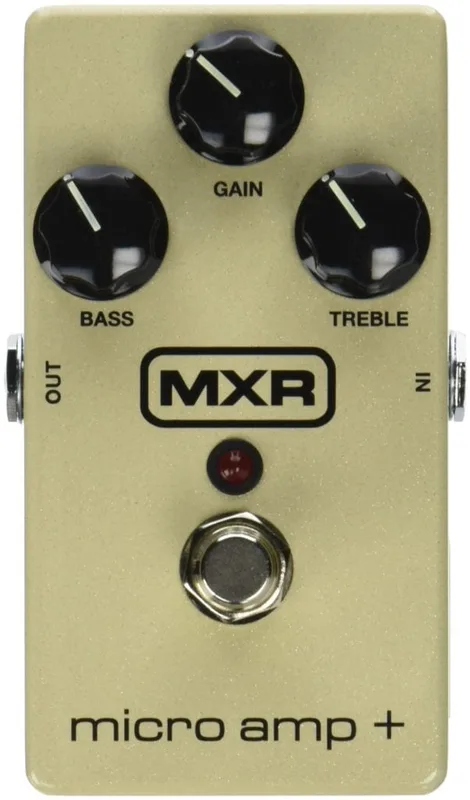
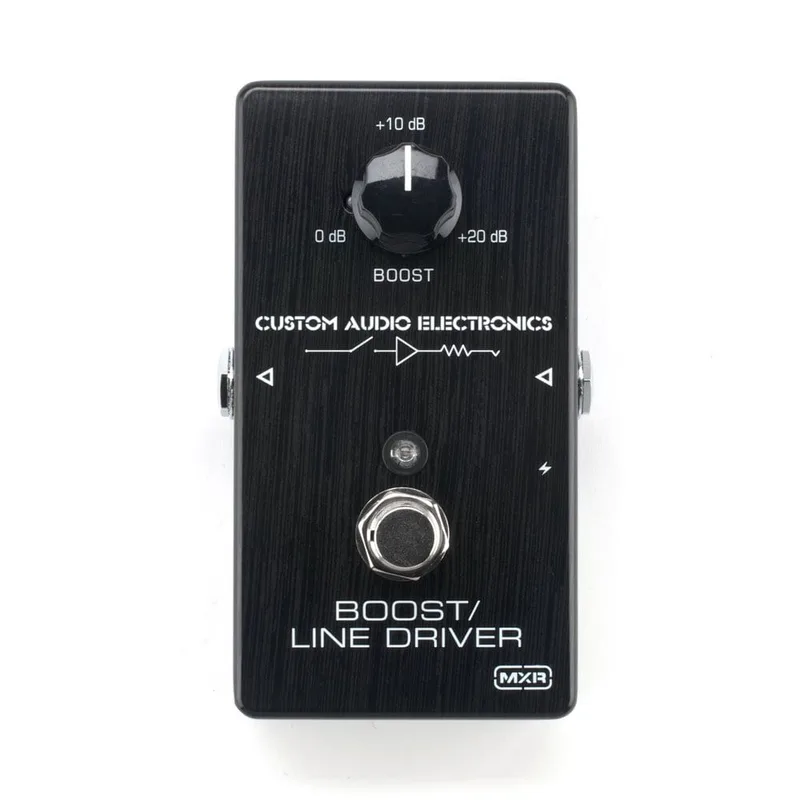
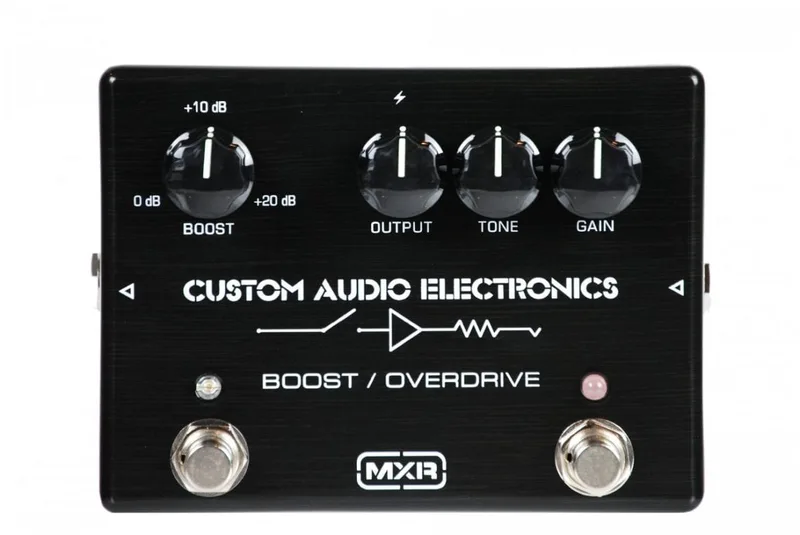
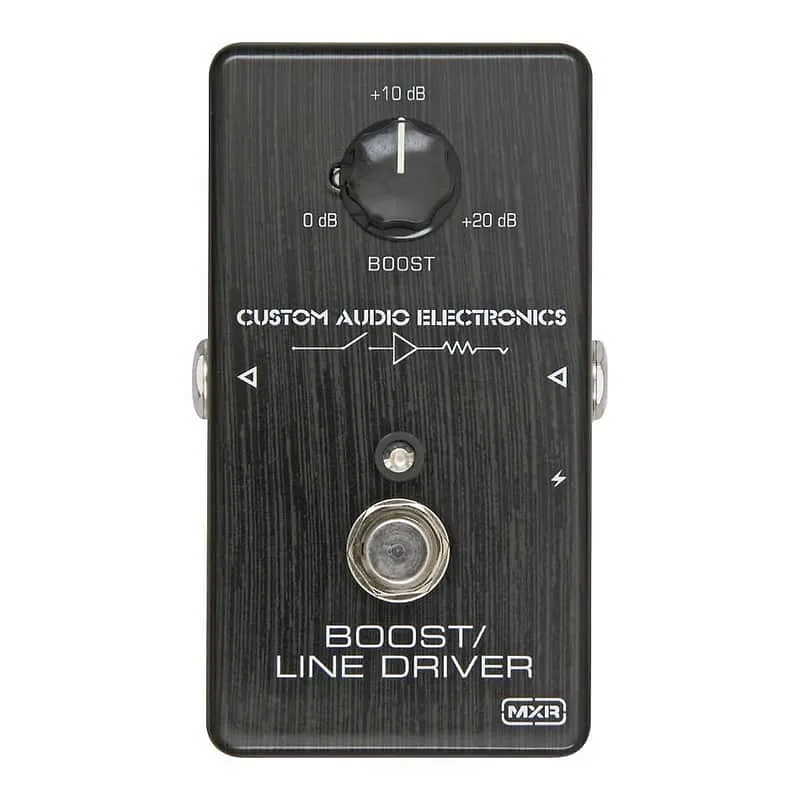
By the late '70s and '80s, pedals like the Micro Amp helped popularize the very idea of a transparent clean boost, and the original became famous for its simple one-knob boost sound, a studio and live favorite, as Gearnews' buying guide puts it4. For players comparing options today, the MicroAmp sits among the classic entries in the boost pedals family, alongside later MXR takes such as the MXR Micro Amp + and the MXR Boost/Line Driver.
The volume control and the circuit
The circuit divides into two blocks: a power supply stage and an op-amp amplifier1. The single GAIN knob controls the overall amount of signal boost, with a range of +0.5 dB to +26 dB and a maximum output level of +6 dBV3. Dunlop's manual suggests starting with the control at 12 o'clock3.
The volume potentiometer itself is a 500K reverse log pot (R5) that sets the voltage gain. A linear pot can be substituted, but its action would not be evenly spread across the range1. The op-amp is a TL061 (U1), fed by the 9V supply, with a 100K resistor divider (R7, R8) generating a 4.5V bias voltage for single-supply operation1.
| Part | Role |
|---|---|
| U1 (TL061) | Op-amp that provides the gain1 |
| R5 (500K reverse log) | Volume control, sets voltage gain1 |
| R7, R8 (100K divider) | Generates the 4.5V bias voltage1 |
| C2 (47pF) | Low-pass filter across the feedback loop, avoids instability and softens harsh harmonics1 |
| C3 (with R5, R6) | High-pass filter that attenuates low frequencies which could overload the op-amp1 |
| C5 (with R9, R10) | Output high-pass filter, corner frequency 1.06Hz, removes useless bass harmonics1 |
The filtering is worth a note for circuit-minded players. The small 47pF C2 capacitor across the feedback loop works as a low-pass filter, avoiding instability and softening the corners of harsh harmonics1. C3, with R5 and R6, acts as a high-pass filter to attenuate low frequencies that could overload the op-amp; similar caps exist in the Tube Screamer (C3), the Pro-Co Rat (C5, C6) and the Boss DS-1 (C8)1. At full gain, the pedal boosts a 100mV peak-to-peak single-coil signal to 2.06V1.
The build is compact: the circuit sits on a double-layer PCB with the potentiometer, LED, jacks and footswitch mounted directly on the board1.
Power and the stereo jack switch
The MicroAmp runs on 9 volts DC3. Power comes from one 9-volt battery, installed by removing the bottom plate, or from a 9-volt AC adapter such as the Dunlop ECB003/ECB003E or a power supply such as the DC Brick3.
The original stompbox had no power-on LED and no AC connector1. It was originally issued without an on/off LED or the means to accept an external power supply2, so there is no indicator light showing the effect is engaged.
The battery switching is built into the input jack. The stereo input jack is used as an on-off switch, connecting the battery's negative terminal to ground when the guitar jack is plugged in1. In other words, plugging in your guitar turns the pedal on, and unplugging it turns the battery off. Setup is straightforward: run a cable from your guitar to the MicroAmp's INPUT jack, then another cable from the OUTPUT jack to your amplifier3.
From the M-104 Distortion+ to the reissues
The MicroAmp's circuit has a direct ancestor: it is an un-distorted redesign of the previous M-104 MXR Distortion+ pedal1. MusicRadar calls the MicroAmp "a close non-distorting cousin, of MXR's Distortion+"2. The Distortion+ itself is a simpler affair control-wise, with just output and distortion level knobs and a red LED indicating the effect is on56.
The pedal went through several PCB releases in green and red color, with minor component modifications due to manufacturing component resourcing and the Dunlop handover1. Jim Dunlop bought the MXR licensing rights and currently manufactures reissues of the classic MXR effect1, which is why the current version carries the Dunlop manual and Dunlop power accessories3.
"By the late '70s and '80s, pedals like the MXR Micro Amp helped popularize the idea of a transparent clean boost."
For players weighing the alternatives, the MicroAmp's distinction is its simplicity: one knob, no tone shaping, no clipping. Where an overdrive or distortion pedal changes the character of the signal, the MicroAmp's job is to leave it alone and make it louder, the approach that later MXR boost designs such as the MXR Micro Amp + built on with added controls41.
Videos
Jack Griffiths
tunnelvisionmusic
Giusy StratoCATter Tranchino
Questions
Does the MXR MicroAmp change my tone?
No. The MicroAmp is designed as a transparent clean volume booster that does not color or modify the guitar tone. Its 6.8MΩ input impedance avoids loading the pickups, which prevents tone sucking, and its 539Ω output impedance keeps signal fidelity intact.
What op-amp is in the MXR M-133 MicroAmp?
The circuit uses a TL061 op-amp (U1) in a single amplification stage. The 9V supply feeds the op-amp, and a 100K resistor divider (R7, R8) generates a 4.5V bias voltage so the op-amp can amplify the guitar signal on a single supply.
Does the MXR M-133 MicroAmp have an LED?
The original stompbox did not have a power-on LED or an AC power connector. It was originally issued without an on/off LED or the means to accept an external power supply, so there is no light to tell you the effect is engaged.
How does the MicroAmp turn on and off its battery?
The stereo input jack doubles as an on-off switch. When you plug a guitar jack into the input, the jack connects the battery's negative terminal to ground, completing the circuit. Unplug the guitar and the battery disconnects, which is why you should unplug the pedal when not in use.
Is the MXR MicroAmp based on the Distortion+?
Yes. The circuit is an un-distorted redesign of the previous M-104 MXR Distortion+ pedal. MusicRadar describes the MicroAmp as a close non-distorting cousin of the Distortion+, which itself carries just output and distortion level controls.
Sources (6)
- MXR MicroAmp Analysis, GuitarPCB (guitarpcb.com)
- Meet your maker: MXR at 40, MusicRadar, 2014-12-04
- M133.pdf, Dunlop Manufacturing, Inc., 2019
- The 7 Best Boost Pedals of 2026: Make it Louder Better!, www.gearnews.com, 2026-05-11
- 13 Best Distortion Pedals For 2026 (Top Picks), Tone Island (toneisland.com), 2026
- M104.pdf, Dunlop Manufacturing, Inc., 2019