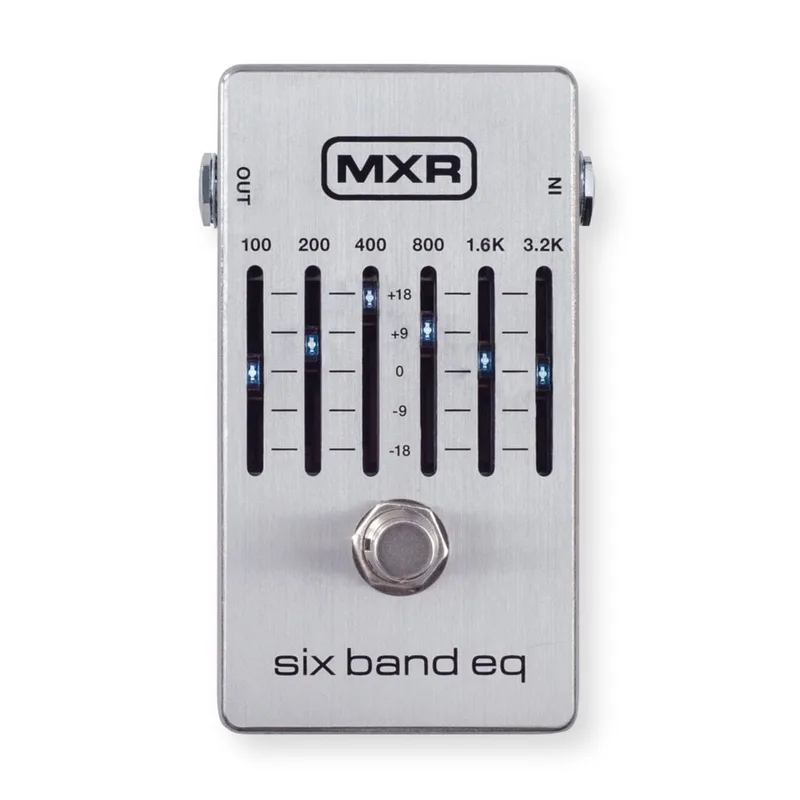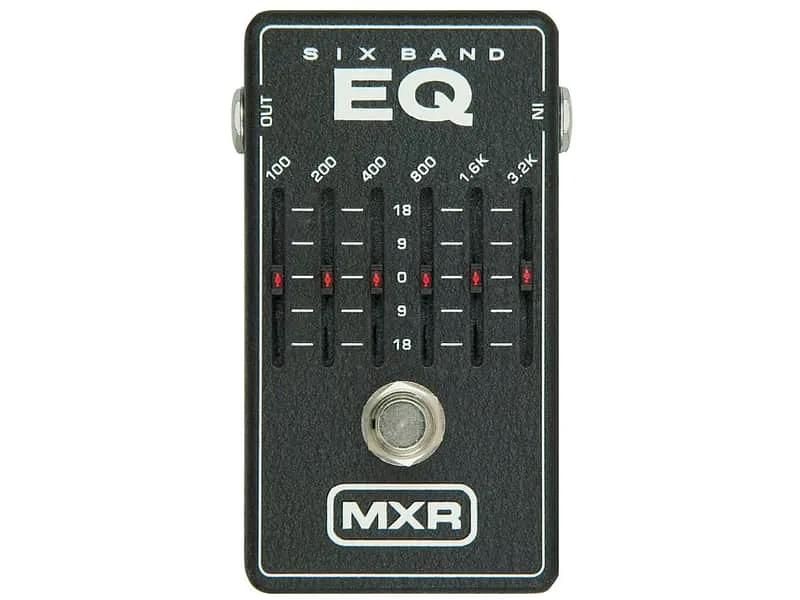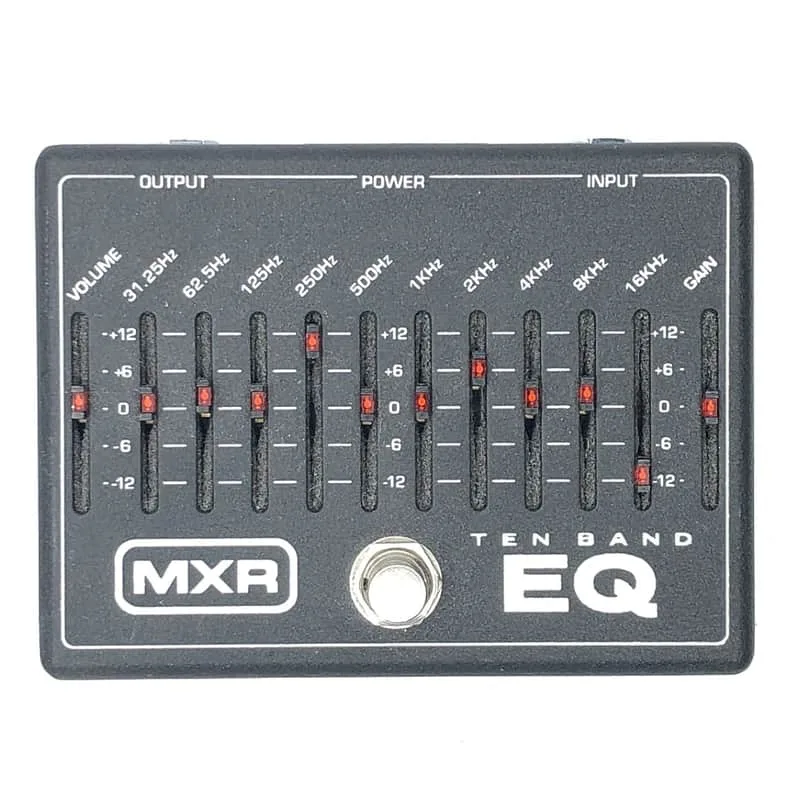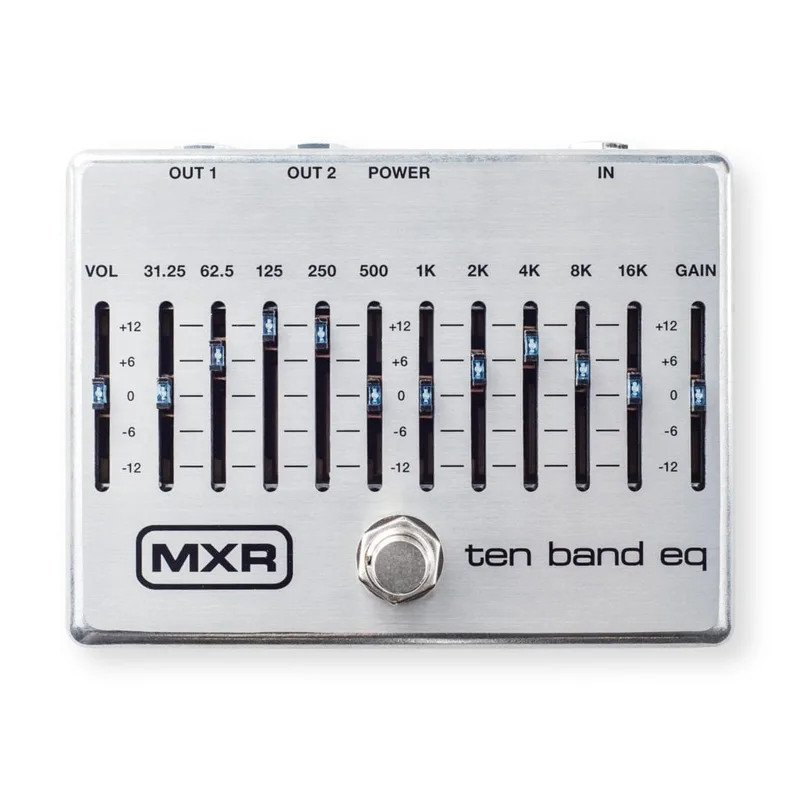


The MXR M108S Ten Band Graphic EQ is a graphic equalizer pedal: ten sliders, each cutting or boosting a fixed frequency band, plus a master volume and a gain control. It is made by MXR, the pedal brand of Dunlop Manufacturing, Inc., and it carries two outputs so it can feed two amplifiers at once1. It sits in MXR's line of equalization pedals alongside the Six Band EQ, the M109 6 band EQ and the M108 10 Band EQ1.
Controls and frequency bands
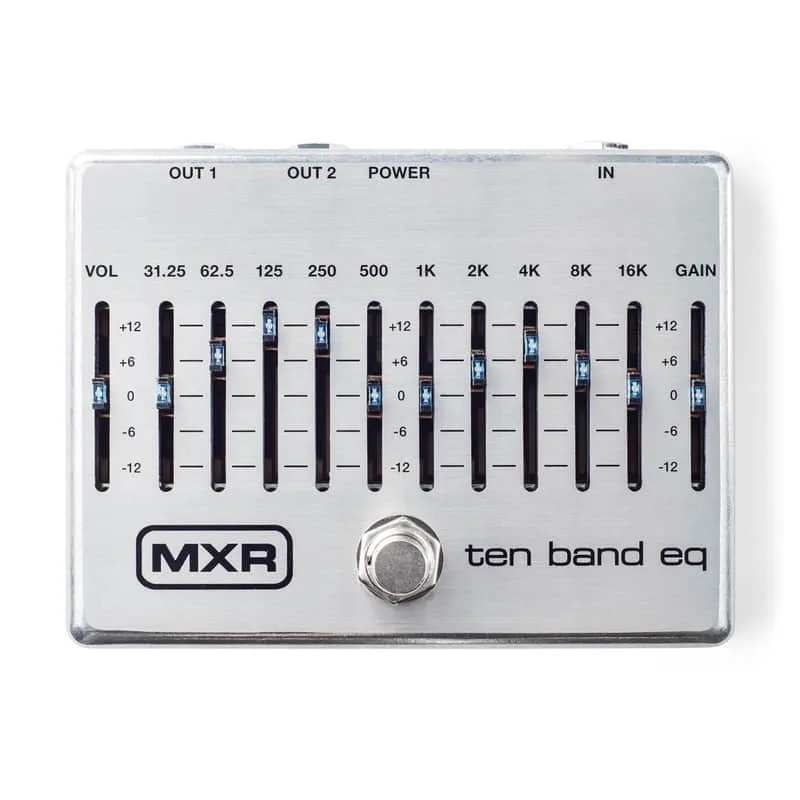
The pedal's face carries twelve sliders in all: ten EQ bands, a VOLUME slider that controls the overall effect volume, and a GAIN slider that controls the amount of gain boost1. A FOOTSWITCH toggles the effect on and to bypass, and the blue slider LEDs indicate when it is on1.
| Slider | Center frequency | What it does |
|---|---|---|
| VOL | 31.25 Hz | Overall effect volume |
| 1 | 62.5 Hz | Cut or boost |
| 2 | 125 Hz | Cut or boost |
| 3 | 250 Hz | Cut or boost |
| 4 | 500 Hz | Cut or boost |
| 5 | 1K | Cut or boost |
| 6 | 2K | Cut or boost |
| 7 | 4K | Cut or boost |
| 8 | 8K | Cut or boost |
| 9 | 16K | Cut or boost |
| GAIN | Amount of gain boost |
The band centers run from 31.25 Hz up to 16K Hz, and the pedal's frequency response is listed as ±1 dB from 20 Hz to 20 kHz1.
Two outputs and noise reduction
The M108S has two separate outputs. OUTPUT 1 runs to your amplifier and OUTPUT 2 feeds a second amplifier, which is the usual reason a player with a two-amp rig reaches for this pedal1. Delicious Audio's buying guide, written by Griffin Jennings, summed up the feature set this way:
"Noise reduction circuitry, 18v operation, and 2 separate outputs make this a flexible and powerful EQ pedal."
Power and specifications
The M108S runs on 18 Volts DC. The manual specifies an 18-volt AC adapter such as the included Dunlop ECB004, and notes that Dunlop DC Brick or Iso-Brick power supplies can also run it1. Current draw is 48 mA1.
The M108S draws 48 mA of current1, so it is worth planning a dedicated output for it on your power supply rather than sharing a daisy chain output with other pedals.
| Specification | Value |
|---|---|
| Input impedance | 470 kΩ |
| Output impedance | 5 kΩ |
| Max input level | +14 dBV, all sliders at 0 dB at 1 kHz |
| Max output level | +14 dBV |
| Frequency response | ±1 dB, 20 Hz to 20 kHz |
| Current draw | 48 mA |
To use it, run a cable from your guitar to the M108S's INPUT jack, then connect OUTPUT 1 to your amplifier and, if you are running a second amp, OUTPUT 2 to it1.
Videos
Strings Direct
Rock Hard Riffs
Tim Guitar
Questions
Can the MXR M108S run on a 9V battery?
No. The M108S is specified for 18 Volts DC, and the manual calls for an 18-volt AC adapter such as the included Dunlop ECB004. It can also be powered from Dunlop DC Brick or Iso-Brick power supplies. A standard 9V battery or 9V pedal supply is not what the pedal is designed for, so plan your board power around the 18V requirement and its 48 mA current draw.
Is the MXR M108S true bypass?
Yes. The manual lists the bypass type as True Hardwire, so when the effect is off, the pedal's FOOTSWITCH has toggled it to bypass and your guitar's signal passes through without the EQ circuit in the way. The blue slider LEDs indicate when the effect is on.
What frequencies do the M108S sliders cover?
The ten EQ sliders are centered at 31.25, 62.5, 125, 250, 500, 1K, 2K, 4K, 8K and 16K Hz. Alongside them, a VOLUME slider sets the overall effect volume and a GAIN slider controls the amount of gain boost.
What does the second output on the M108S do?
OUTPUT 1 runs to your amplifier, and OUTPUT 2 feeds a second amplifier, so one pedal can drive two amps at once. Delicious Audio's buying guide noted that the two separate outputs, together with the noise reduction circuitry and 18V operation, make it a flexible and powerful EQ pedal.
What power supply does the M108S use?
The M108S needs 18 Volts DC. The manual specifies an 18-volt AC adapter such as the included Dunlop ECB004, and says it can also be run from Dunlop DC Brick or Iso-Brick power supplies. Current draw is 48 mA.
Sources (2)
- M108S.pdf, Jim Dunlop, 2025
- 2023 UPDATE! Best EQ Pedals For Guitar: Graphic & Parametric, Delicious Audio, 2023-12-13